John the Baptist – a reset for 2026 Part 3 (i) baptism of fire (ii) judgement here and now
John the Baptist is often overlooked. The warm-up act before the entrance, stage-left, of the Messiah: Jesus of Nazareth, and eclipsed, as we all are, by the Word made flesh.
He is mentioned in all four gospels, but here’s Luke’s account, which is the fullest.
John said to the crowds coming out to be baptised by him, ‘You brood of vipers! Who warned you to flee from the coming wrath? Produce fruit in keeping with repentance. And do not begin to say to yourselves, ‘We have Abraham as our father.’ For I tell you that out of these stones God can raise up children for Abraham. The axe is already at the root of the trees, and every tree that does not produce good fruit will be cut down and thrown into the fire.’
The people were waiting expectantly and were all wondering in their hearts if John might be the Messiah.
John answered them all, ‘I baptise you with water. But one who is more powerful than I will come, the straps of whose sandals I am not worthy to untie. He will baptise you with the Holy Spirit and fire. His winnowing fork is in his hand to clear his threshing floor and to gather the wheat into his barn, but he will burn up the chaff with unquenchable fire.’
But when John rebuked Herod the tetrarch because of his marriage to Herodias, his brother’s wife, and all the other evil things he had done, Herod added this to them all: He locked John up in prison.
(i) Baptism of fire, and (ii) Judgement here and now
Really, these subdivisions can be run together. I’ve only separated them because the phrase ‘baptism of fire’ is so well-known.
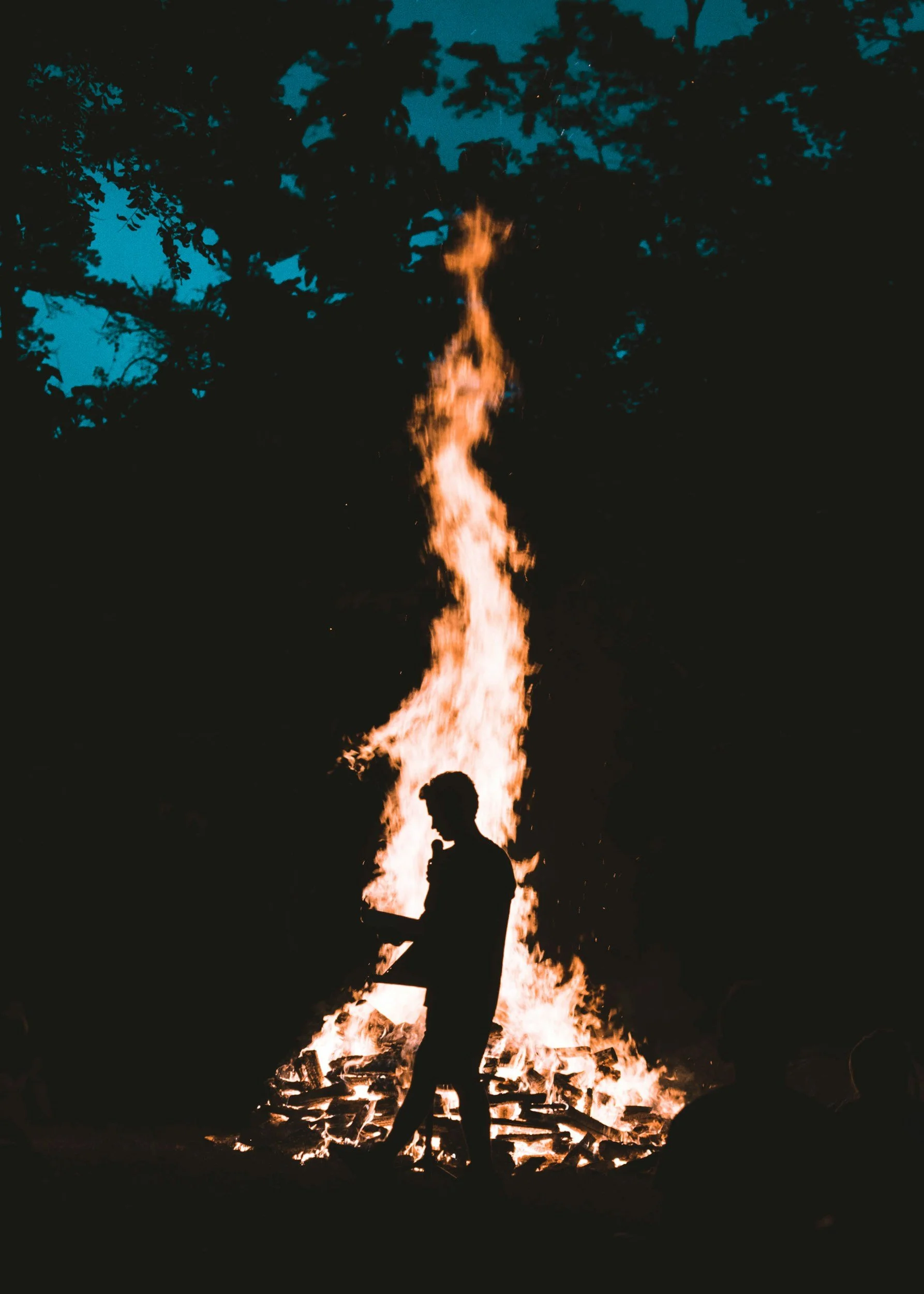
There is, of course, some validity in co-opting this biblical phrase for impending trouble, but it is sharper than that. Far sharper. We are talking about judgement. Not a universally popular subject. Immediately, when we hear the word ‘judgement’ within the scope of religion, our minds migrate to The Day of Judgement, or eternal resurrection or damnation. I am certainly not objecting to this - except in this way: God is eternal, and therefore His judgement is eternal. From our temporal space and time perspective, that means that whatever eternal judgement is, it affects the past, the present, and the future.
John the Baptist Part 3 is a look at eternal judgement through the biblical notion of ‘today’.
John the Baptist foresaw that the ministry of the Messiah would be characterised by two baptisms – not in water like his, but in the Holy Spirit and also in fire. That in the future believers would receive the gift of the Holy Spirit and would walk through life ‘saturated’, ‘wet through’, ‘baptised’ in the Spirit. No longer would they have to make a pilgrimage to the temple; they would be temples of the Holy Spirit. Temples on the move.
But he also said they would be ‘baptised with fire’. On the Day of Pentecost, of course, there were flames of fire. Signs that each believer was alive with the judgement that is found in Christ.
We’ve already seen how Simeon prophesied the manifestation of this judgement through Jesus: ‘…this child is destined for the fall and rising of many in Israel…that the thoughts of many hearts may be revealed’ Luke 2v34,35
Jesus himself spoke about the sword of judgement: ‘I came to send fire on the earth…do you suppose I came to bring peace on earth? I tell you, not at all, but division…’ Luke 12v49-53
One example of this division was at Nazareth in the synagogue that he attended from childhood. When he was handed the scroll and read from Isaiah, it says ‘the eyes of all who were in the synagogue were fixed on him’ Luke 4v20 nevertheless, when He confessed his Messiahship and when he reminded the congregation that in Elijah’s day it was the Gentile widow who had welcomed him, the congregation rose against him ‘they led him to the brow of a hill…that they might throw Him down over the cliff’.
During the Day of Pentecost, when the crowd gathered due to the sound of a rushing wind and the sight of flames of fire on the believers’ heads, despite hearing the newly baptised in the Spirit believers ‘speaking in our own languages about the wonderful works of God’ some mocked, ‘they’re full of new wine’, in other words drunk. But Peter replied, ‘These are not drunk, as you suppose, it is only 9 o’clock in the morning’ Acts 2v11-15.
Division. The account goes on to say that 3000 were baptised that day. But opposition also grew.
John prophesied about this baptism of fire as a present-day divisive fire of judgement and the consequences of accepting or welcoming Christ or rejecting Him.
‘His winnowing fork is in his hand to clear his threshing floor and to gather the wheat into his barn, but he will burn up the chaff with unquenchable fire.’
This agricultural picture would have been well-understood until the era of mechanisation with combine harvesters. The wheat grains are heavier than the husk around the grain, so when a winnowing fork threw them both up into the air, any wind would blow the chaff away, leaving the grain to fall to the ground, where it could be collected and stored in a barn. The chaff is also collected and burnt.
The separation is therefore a picture of judgement.
We can see this in action through the apostles, for example, with Paul and Barnabas. In Acts chapter 13, they had been preaching in Antioch on the Sabbath but ‘when the Jews saw the multitude, they were filled with envy…and opposed the things spoken by Paul (v45)
‘Then Paul and Barnabus grew bold and said, ‘It was necessary that the word of God should be spoken to you first: but since you reject it, and judge yourselves unworthy of everlasting life…we turn to the Gentiles’
In John chapter 5, Jesus deals with ‘judgement now’ in tension with ‘the day of judgement’.
‘Truly I say to you, he who hears my word and believes in Him who sent Me, has everlasting life, and shall not come into judgement, but has passed from death into life. Truly I say to you, the hour is coming and now is when he dead will hear the voice of the Son of God, and those who hear will live’ v 24,25
This is both a NOW and a THEN resurrection to life or condemnation. Once we believe we experience a ‘resurrection’ from death to life. It’s not the complete work of resurrection, but it is the irreversible start.
Charles Wesley caught hold of the immensity of this transformation in And Can It Be?
Long my imprisoned spirit lay/Fast bound in sin and nature’s night/Thin eye diffused a quickening ray/I woke, the dungeon flamed with light/My chains fell off, my heart was free/I rose, went forth and followed Thee
So, it is an awesome thing to be a Christian. To carry within us the baptism in the Spirit and fire. Just as John prophesied, as we give witness and tell our story, some believe and some will not. Division. It is not that we are seeking opposition and division; we are only too aware of how receiving Christ has been an act of mercy, and receiving the gift of the Holy Spirit has nothing to do with our worthiness. But John warns us, as Jesus did later, that we are sheep sent out among wolves. The wolves howled against Jesus in Nazareth, despite their synagogue attending religiosity. But he walked free. It wasn’t his time.
As we continue in Christ, Christ living out His life in our form, we will see the chaff blown away and the grain gathered into His barn. We cannot have one without the other.