Book Review: No Bad Parts Richard C. Schwartz, Vermilion
‘We need a new paradigm that convincingly shows that humanity is inherently good and thoroughly interconnected.’
Schwarz can be thought of as an apostle of the Internal Family Systems (IFS) approach to psychotherapy, a very popular therapeutic methodology that is based on a collection of foundational ideas that give rise to a worldview encompassing well-being, ecology, and spirituality.
As Schwartz explains, ‘IFS has morphed over time from being exclusively about psychotherapy to becoming a kind of spiritual practice’.
The above two quotes are from pages 3 and 4, so Schwartz sets out his stall early on. I liked that. An honest declaration of his core beliefs and the foundation for all that follows.
What I want to achieve in this book review is exactly that: to review the book. However, it would be disingenuous of me not to state that I do not share Schwartz’s very positive view of human nature, and that I fundamentally disagree that we need a new paradigm to show that humanity is inherently good. But this review is not an excuse to parade my viewpoint!
My first point about the book is that it is well-structured and well-written. It is not too scholarly to frighten off the average reader with obscure technical language, but neither does it shy away from detailed explanations.
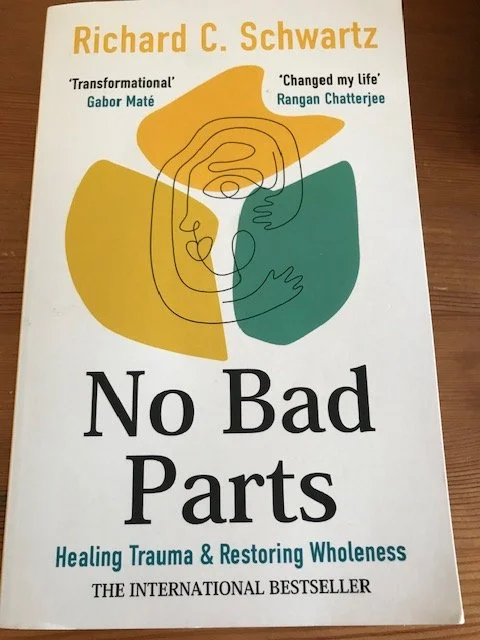
Schwarz builds his argument, and his pitch for IFS, carefully over just over 200 pages organised into two Parts (IFS, and Self-Leadership), and eleven Chapters. The overall purpose is set out on the cover: ‘Healing Trauma & Restoring Wholeness’.
He combines theory with his own personal life experience and some compelling examples of how IFS has helped those who have used it to heal.
Secondly, and perhaps most importantly, even if you, like me, conclude that IFS is built on a weak philosophical foundation, its insights into the human condition and how past traumas can be faced courageously, compassionately, and truthfully from an IFS perspective are valuable. This case for not throwing out the baby with the bathwater is strong.
He advocates speaking to the various ‘parts’ of ourselves that have protected our vulnerable inner self.
I did find that I was crying out for Schwarz to acknowledge the role of the imagination in this, rather than projecting the view that these ‘parts’ can be spoken to as separate personalities of beings.
‘My main goal was to help my clients form better relationships with their parts’
His contention, ‘I believe it is safe to say there are no bad parts’, allows him to lead clients to rediscover (probably better to say ‘uncover’) their true Self, the spiritual core, when these parts (which can be those inner voices that speak up after trauma to provide strategies to avoid being hurt) are set aside from dominating the person.
Readers will have to judge whether the distinction between imagination and parts as entities is important, but the idea that each of us has an ‘internal family system’ of parts that play a role in protecting the Self, is well explained. Later in the book, once the groundwork of defining IFS is complete, Schwartz sums up the goal to be ‘Self-led’ and ‘this is what healing means in IFS – wholeness and reconnection’.
Reviewing No Bad Parts has been quite a struggle. Philosophically, whilst I can’t support Schwartz’s premise and argument, neither should I attempt to dissuade anyone from considering IFS if you need healing from past trauma, or simply coming to terms with who you are, trauma or no trauma.
Lastly, it’s said you shouldn’t judge a book by its cover…but the cover gets a thumbs-up from me. It’s worth stopping and taking it in.