Welcome to my blog...whatever image springs to mind, be it a hippopotamus, Tigger, red-haired Highland cattle, or a simple kitchen table, 'Unless a Seed' is a four-legged creature. My hope is that having read a Book Review, a Poem, or a What is a Christian? or some random post in Everything Else, you will be kind enough to leave a comment or a short reply. And I hope you enjoy reading its contents

What is a Christian?

Book, Podcast, Film, and Blog Reviews

Poetry

For Writers, Writing and Everything Else
I Was There
Jacob at Jabbok
I was there
To witness the first shove
And the wild, confident
Aggression of the man, Jacob
Who crossed the Ford
At Jabbok, weighed down
With fear and promises,
And I was there each hour
Of the moon-lit night-fight
I saw the lion-man’s eyes
Flash with unearthly colours
And music leak from his lips
In the struggle
Until dawn
I was there listening
To mighty Jacob gripping
The lion-man, yet finally
Disinterested in victory
Reduced to the whisper
Of one request
Bless me
The Lion-man extended a finger
Made of light and word
And touched Jacob’s strength
His hip joint dislocated
As a new name descended
From heaven and a new man
Walked the Earth
Remembering the Future
A directional poem…enjoy the flight
It wasn’t dementia,
I’m sure of that
But a glance
Along my outstretched feathers
Above the clouds
Wings left and right
Making the sun dance
Iridescent and normal
Thermal swimming

Strong and unhindered,
I left all my memories untended
Slipping into the present
Far below the cloud banks
Through to a tight circle of
Proudly assembled eyrie
I hear someone unfamiliar
Calling, pulling me into a dive
To unclench my prey.
Talons relaxing
I drop my dormouse load
In front of a hair-filled
Inquisitive, pleading ball
As recollection fires
And I watch
Myself forming again
MA Creative Writing, Exeter University The Other Module: Prose Week 4: Disaster – bad day at the office
Bad day at the office…Doh!
Came away from today befuddled, feeling like a literary dwarf compared with fellow students, and rather downbeat…but that wasn’t the disaster.
I knew I’d be walking into a room of students and staff with heads far fuller than mine with English literature. Although that can leave one daunted, that’s exactly why I’m here…to wear L plates and learn from others.

No, the disaster was simple.
A third of the class uploads work each week. ‘Homework’ for the rest of us is to write critical reviews on their posted work, ready to share our perspectives verbally in the second half of the workshop.
The upload is to an online animal called Padlet. The disaster, as I found out after the lecture, was that I had failed to scroll Padlet right and so missed all but one of the offerings, was lost, had nothing to say, and wanted the earth to open up and swallow hard.
It’s one thing to be in awe of others’ relative ability, but combine that with simple incompetence: that’s my definition of a bad day at the office.
Home now. Sanctuary. Safe space. Last week’s pieces printed out, ready for me to write critiques and catch up in the morning…AND get on with this week’s assignment.
Live and learn, eh? We press on.
Sinatra, where are you when I need you?
Each time I find myself
Flat on my face
I pick myself up and get
Back in the race
That's life
Hostage Return: Prisoner Release
Israel-Gaza…the latest…the long wait
‘He who kidnaps a man, whether he sells him or he is found in his possession, shall surely be put to death’ Exodus 21v 16
Is this post written with the release of the hostages taken by Hamas on Oct 7th 2023, from the Nova Music festival and the kibbutz, in mind? Yes…in part.
The other part is to explore the question of how we should distinguish between the OT Law written on tablets of stone and papyrus, and the NT, or new covenant, where the law is written on our hearts by the Holy Spirit.
I’m writing this on Sunday, 12th October 2025, listening to news reports during the day, hoping that the hostages, alive or dead, are handed back to Israel tomorrow.

If the Old Testament Law were still in place, it would not apply to Hamas; it only applied to Jews and foreigners living within the borders of Israel.
St Paul, writing to Christians, mostly non-Jews, in Galatia, wrote, ‘the law acted as our schoolteacher to bring us to Christ.’ In other words, the Law teaches us right from wrong, but it cannot change our hearts; the bible contends that this can only happen through faith in Christ.
Reading the verse from Exodus, we can discern right from wrong in terms of the outward action of kidnapping; however, the prophets Jeremiah and Ezekiel foresaw a new covenant, the New Testament, where the Law is written on our hearts. This changes our perspective on the Law.
Those who put their faith in Christ are promised a spiritual heart transplant, after which the spiritual truth underlying the above verse begins will sink in. The Holy Spirit, in writing this verse on our hearts, begins to point out the awkward truth that we are all prone to taking others hostage! If we treat others as commodities, a means to further our plans, or when we manipulate circumstances so that others become pawns on our chessboard, are we not taking others hostage?

(That could, of course, include actual hostage taking, as has been the case with Hamas, but at the heart level, it’s far more subtle, invisible, and unobservable).
Under such conviction, the believer is forced back to the love of God, knowing that Christ took the punishment that we deserved by His death on the cross, to bring us forgiveness and reconciliation with God.
And it is forgiveness that brings us to the heart of the issue with Israel and the Palestinians.
A two-state solution alone will not resolve the problem of Israel-Palestine. Only forgiveness. That’s not to say a two-state solution isn’t a laudable aim or necessary political objective, but, in itself, it could exacerbate the mutual distrust that exists between Israelis and Palestinians as easily as playing a part in solving long-held grievances.
A two-state solution alone will not resolve the problem of Israel-Palestine
In the Parable of the Prodigal Son, the older brother could not find it in his heart to rejoice at his younger brother’s return and the favour, it seemed, their father gave to the returning prodigal. Despite the father’s best efforts to lift his oldest son’s mood, he failed. If we run the parable beyond its finishing point and revisit the family home the following morning, and the day after that, and the day after that, what do we imagine happened next? Perhaps there are two possible outcomes:
A. The antipathy remains, and the two brothers occupy two different zones, unable to restore their closeness. The bitterness of the older brother prevents any reconciliation. A ceasefire, maybe, a truce, but no peace.
B. Or, mutual forgiveness and mutual respect. Brothers, yes, but not one person. Mutual zones, maybe, but very porous borders, through whose pores, forgiveness, blessing, and peace flow – in both directions. It’s still a two-state solution, but not a standoff.
Today, the ceasefire is holding.
Tomorrow, I hope, along with the world, that the hostage and prisoner exchange goes smoothly and with respect.
The Day after? Phase 2. Far harder. Our prayers ascend to Almighty God.
For Zion’s Sake I will not keep silent – Isaiah 62v1
We need many like Isaiah the prophet of old
Whilst the world holds its breath to see if the Israel-Gaza ceasefire will evolve into a lasting peace, we have some space to explore our own hearts rather than our minds. What is lurking there…the good and the not so good, the fears, and the hopes and longings?

The second anniversary of the appalling premeditated attacks carried out by Hamas against unarmed young civilians at the Nova music festival and against those living in the Kibbutz Be’eri was Tuesday of this week, October 7th.
On Tuesday, I travelled to Exeter to attend a lecture at the University, with Keir Starmer’s appeal to pro-Palestinian protestors to desist from protesting on the anniversary as a mark of respect, in the background and on my mind.
What did I find?
Two things of note.
1. No Palestinian flags or protests on campus – that I saw or heard
2. In the Forum, a large open space, containing the library, Sainsbury’s, two coffee shops, and a large atrium area in which various groups set out their stalls, sat two students manning a stall advertising the Jewish society; a young man and a young woman, sitting peacefully and quietly. On their stall, they had photos of the remaining hostages, candles to light, and small yellow ribbons to wear to indicate support.
I lit a candle and fumbled with the pin before managing to wear the yellow ribbon.
I was impressed with the calmness of the two students and the atmosphere of ‘normalness’, if that’s a word, that seemed to pervade the Forum; a remarkable Pacific oasis. I was, unconsciously perhaps, steeling myself en route to Exeter, to wade through vehement, loud, well-organised protestors, waving Palestinian flags and denouncing Israel, Netanyahu, and so on.
I find myself saying, as the years pile up, ‘nothing surprises me anymore’…but the reality was a pleasant surprise: two brave students, manning a stall, whether they would be the target of antisemitic protest, hatred, or something far worse, or support.
Isaiah, also, was brave. He spoke up. He protested. Often against his own government or rulers, the kings and priests of his day. And against Israel’s enemies. The rest of his quote is worth examining.
‘For Zion’s sake, I will not be silent
And for Jerusalem’s sake, I will not rest
Until her righteousness goes forth as a burning torch’ Is 62v1
What is Zion’s sake? What is Jerusalem’s sake?
One of the strengths that democracies espouse is upholding free speech. Whilst I have been staggered at what has been permitted to be stated on banners and in chants during the pro-Palestinian marches – well beyond the bounds of free speech – the sheer fact that such freedoms exist and society doesn’t resort to rioting and civil war is testimony to the strength of our democratic society…at least for the time being.
The final test of the righteousness of a nation embroiled in a war, however, is determined by how it acts after the war
Such freedoms exist in Israel as well. But not in Hamas-controlled Gaza. Israel is a society driven to extremes by this latest onslaught unleashed by Hamas from Gaza and Hezbollah in Lebanon, and the Houthis in Yemen. Many Israelis, including some of the families of hostages, are bitterly opposed to the conduct of the war in Gaza. Others support the dual aims of the war – the return of the hostages and the destruction of Hamas – and the military option taken by Netanyahu’s government.
The final test of the righteousness of a nation embroiled in a war, however, is determined by how it acts after the war.
I think it would be true to say that most British, French, Norwegian, and Polish citizens and other European and non-European allies after WW2 were able to differentiate between Nazi Germany and the general German population. The rebuilding of Germany into a free, democratic state happened remarkably quickly, with good relations restored between, say, Britain and Germany occurring in double quick time.
Much will be expected of Israel in the recovery from the shock of Hamas’s attack and promise to repeat such attacks, and the chant heard in Western countries, ‘Free Palestine from the River to the Sea’ – a chilling reminder of the combined jihadist and Marxist aim to remove Israel from the map…a publicly declared genocidal aim. And we have permitted this in the name of free speech!
Can Israel delineate between Hamas and the general population in post-war Gaza?
The world holds its breath. I hold mine. Righteousness is on the line.
Will Gazans denounce Hamas in the same way that Germany, largely, has distanced itself from Nazi ideology and created a state that opposes dictatorship and fascism, whether the fascism of the left or the right?
It’s no wonder that Jesus taught us :
‘Blessed are those who hunger and thirst for righteousness, they shall be filled’
The world holds its breath. I hold mine. Righteousness is on the line.
I want to see a Gaza and West Bank that seeks to live cooperatively and at peace with Israel, to seek Israel’s security and blessing. I want to see an Israel whose righteousness shines like a burning torch and returns the blessing to Gaza and the West Bank, helping to rebuild a Gaza physically shattered after two years of war.
I worry that the deep sense of injustice that fuels Palestinian antipathy against Israel – and Israel’s largely western supporters - will again descend into the kind of inhumane action taken on October 7th 2023, and that terror attacks will continue against Israel and the West.
I worry that the far-right. ultra-orthodox, ultra-nationalist Jews in Israel will continue to push into the West Bank, claiming it is Judea and Samaria, and seek to displace their neighbours either directly or indirectly.
I worry that Netanyahu will continue along the path to place the government above the Supreme Court in Israel and undo one of the vital lynchpins of any free society to hold its government to account.

I worry that the new international administration in Gaza will prove to be as stable as a paper boat in my morning coffee, will collapse and ruin any prospects of a lasting peace, and, in the end, sow the seeds for a resumption of war.
I have my hopes and my fears, but, to conclude, I’m with Isaiah
But I also have my prayers before Almighty God.
And they are neatly summed up by Isaiah. In fact, I would recommend reading Isaiah chapters 61 and 62 in the light of the delicate political situation – this pause – that we find ourselves in.
The Need for Ice
This is not a poem about ice cubes…but I do like an ice cube
It’s 11am, or thereabouts
The kettle switch flicked and
The red-light beams,
Noises build from the kettle
Creating the time to assemble
The familiar cup, unwashed
Rinsed, maybe
Then a heaped spoonful
Instant coffee, plus a sugar lump
The spoon circling and clinking
The cube to oblivion

Then the tipping
Boiling water…
…mind drifting now…
I jump back, legs burning
Hollers suspended
In lingering curses
A longed-for cause
Occupying the moment
Where my mind ended
Anchored in a movie
A scent
A memory of light
Falling from the overflow
Of her hair
Disturbed, once more
By the very thing
Designed to bring me peace
Trapped again
By a fire sent to burn
Away all that I don’t need
I shake myself
Free of meandering
And return to hard-core life:
Of the need
For ice
A Tabernacles Trilogy 3. Yom Kippur/Manchester/Hostages
A time to reflect, yes, and a time to look ahead
I am well aware that I am writing this blog post just a day short of when Jews around the world celebrate Tabernacles, or Sukkot.

This year, as the world holds its breath over Hamas’s response to the Peace Plan on the negotiating table, and as Jewish eyes are blurred with tears not only with hope but grief, Sukkot 2025 could mark real change in Gaza, Israel, and the whole of the Middle East.
Hope, because no one wants war, conflict, destruction, grief, and hopelessness to set up more than a temporary home in the human heart. And hope, for Israeli’s, that the remaining hostages, alive or dead, will be returned during Sukkot. And hope for some Gazans at least that they can wake up very soon from the nightmare that has been Hamas’s regime.
Grief? Of course. The murderous attack on Yom Kippur in Manchester has chilled the bones of not only Jews but also horrified Britons who have had to clear Jewish blood and the blood of the attacker from their streets; blood spilt days before a credible peace plan might bring the horror of the Israel-Hamas war to a close.
Tabernacles, one of the three main Jewish feasts that Jews were commanded to attend each year, and, therefore, which Jesus would have attended many times, is the final feast in the calendar.
It is no surprise then that many bible commentators link Tabernacles prophetically, despite its evident purpose as a reminder of the temporary tents (tabernacles) that the Jews had to erect in the desert en route from Egypt to the Promised Land, to the end of the world and the final judgement (Rev 21v3).
My comment here is not that this is incorrect, but it falls short of the relevance of Tabernacles in this age and its prophetic significance to the church.
Just as William Seymour and others rediscovered the fulfilment of Pentecost to the church in preaching and receiving the baptism of the Spirit…hence the Pentecostal churches and the Charismatic movement in the 20th Century…so we are on the brink of a rediscovery, this time of Tabernacles.
1. Jesus as a mobile tabernacle
2. Christians as mobile tabernacles
3. Church as mobile tabernacles
Jesus
‘The Word became flesh and tabernacled among us, and we beheld His glory’ John 1v14
‘Jesus said “destroy this temple and I will raise it up after three days”…but He was speaking of the temple of His body’ John 2v19-22
‘the Father in Me does the works’ John 14v11
Christians - individually
‘If anyone loves Me…My father will love him and we will come and make our home with him…the Spirit…will be in you’ John 14v17, 23
‘Do you not know your body is the temple of the Holy Spirit?’ 1 Cor 6v19
‘You are the temple of the living God’ 2Cor6v16
Church
‘You are…a building being fitted together and growing into a holy temple…a dwelling place of God in the Spirit’ Eph 2v21,22
‘We know that if our earthly house, this tabernacle, is destroyed, we have a building from God, not built with hands, eternal in the heavens’ 2 Cor 5v1
The question facing us is: What are the implications for our church experience of the Feast of Tabernacles?
The clue comes from the simple ceremony conducted by Jews from tomorrow onwards for a week. They will meet in specially erected booths, the roofs loosely covered with palm branches and the like, and they meet under these roofs with holes to eat and drink, say prayers, and sing hymns. The holes in the roof mean that it is open to heaven.
It is a picture of the church gathering, the ekklesia (those called by Christ, not a human organisation) bathed in God’s presence (the light through the holes). It is not for one week in the year, but a picture of the potential reality of any church, at any time, anywhere.
Those believers who know the church is the temple of the living God will come with expectation and faith, not simply in a future fulfilment à la Revelation 21v3 ‘Behold the tabernacle of God is with men, and He will dwell with them and they shall be His people…’ but an expectation and living faith in God’s presence now.
If Tabernacles 2025 is to be remembered as the time when the hostages were returned and the dreadful war in Gaza is brought to a close, the world will breathe a great collective sigh of relief
New Testament churches are places where the kingdom of God has already broken in, where the presence of God is normal, and where each believer is functioning as a priest and a king in training…learning, for example, to only do what they see the Father doing. It is a holy place. It is a place where, metaphorically, man removes his shoes, God is there, and the church moves as He moves. It is an awesome place. We become like Moses before the burning bush, where all our doubts, all our fears, all our past sin has been dealt with to such an extent that referring to our ‘old man’ or our ‘old creation’ is irrelevant…we grow in our understanding that God is fellowshipping with churches full of new creations in Christ. Moses lost his arguments with God at the burning bush, ‘I can’t speak’, or ‘I’m afraid’. It’s a place where we lose all our arguments with God. A holy place.
It is now 7pm on Sunday, 5th October 2025.
Jews around the world will be celebrating Tabernacles from sunset tomorrow, 24 hours from now.
If Tabernacles 2025 is to be remembered as the time when the hostages were returned and the dreadful war in Gaza is brought to a close, the world will breathe a great collective sigh of relief. The rebuilding of broken lives, broken homes, broken politics, broken hopes, and broken dreams can begin.
Universal Haiku
Does what it says on the tin
Dark, old universe,
It cannot contain itself,
A laugh bursts all bounds
A Tabernacles Trilogy 2. Sports Junkies and Ugly Scenes at the Ryder Cup ?
An unexpected parable …Tabernacles and the Ryder Cup
Oh dear, I confess, my normal early morning devotions have been severely disrupted by a trinity of compelling sports events; a Ryder Cup sandwich, in fact.
Friday: Ryder Cup
Saturday: Ryder Cup + Women’s Rugby Union World Cup Final + Match of the Day
Sunday: Ryder Cup + Match of the Day

Early morning devotions are not exclusively ‘spiritual’ as if the spiritual can be neatly separated from other aspects of life. But my routine, after a few seconds sat on the edge of the bed with as many thoughts as there are gold balls in a bunker…not known for brisk movement, and often plugged, is to perform some limbering up exercises. Exercises over in about 5 – 10 minutes, I can move in a less zombie-like manner. Then follows either walking boots or running gear and an exit for 30 minutes or so of madness, listening to a podcast, if the earbuds are charged.
Back, shower, cereal & toast & tea, I flip the pages of the bible open; these days in the book of Revelation, followed by prayer.
But, if, like me, you’re a sports junkie, this routine can suffer a series of setbacks, particularly in the summer months.
Here’s the thing, before we approach an indirect link to Tabernacles. The unpleasant, rude, coarse, uncalled-for and provocative comments, jeers, and boos from the American crowd at the Ryder Cup are a form of trespass that leaves a bad taste in the mouth.
Nothing wrong with being partisan and a passionate supporter of your team, but ugly comments come from somewhere. Jesus said, ‘The mouth speaks what the heart is full of.’
So, what has gone wrong? Why has the normal restraint characteristic of the thousands that watch that curious of all sports – golf – a sport in which all its participants accept such an old-fashioned concept as ‘Etiquette’: behaviour expected that has little or nothing to do with the rules of the game.
Here’s my thesis. Those who abandon self-restraint and cross the line in terms of foul behaviour and Etiquette have misunderstood ‘sport’ altogether.
The unpleasant, rude, coarse, uncalled-for, and provocative comments, jeers, and boos from the American crowd at the Ryder Cup are a form of trespass that leaves a bad taste in the mouth
For sport to exist, there has to be cooperation; surprisingly, perhaps, it is an exercise in respect and humility. Sport cannot exist unless one is willing to lose. If you, as an individual or a team, are unwilling to lose, you spend your life on the practice ground, all alone. For sport to exist, two teams must contact each other, agree on a date to do battle, play within the rules, and defer to the referees on hand to settle disputes, whoever wins.
True supporters understand the tension between partisanship (I have been a passionate supporter of Portsmouth Football Club for 60 years) and respect, admiration, and even applauding one’s opponents, especially if they conduct themselves in the spirit of the competition…including playing to win and within the rules.
To pour scorn on your side’s opponents or make personal remarks about family members not only means you have misunderstood the nature of sport but have impoverished yourself; in demeaning others, you have demeaned yourself, become mean, narrow, and embittered, and, if your support is defined by the level of abuse you can hurl, you are blind and cannot see.
Finally, we arrive at Tabernacles, a picture of not two teams but twelve going at it. The twelve tribes of Israel. Or the twelve apostles of Christ. Or the umpteen apostles of our age.
First, a reminder of the biblical Feast of Tabernacles. Jews from the twelve tribes of Israel would make their way to Jerusalem each year to celebrate the week-long feast. In part, it was a reminder of their deliverance from slavery in Egypt and their journey to the Promised Land, from camp to camp, living in tents (tabernacles) in the wilderness, but it also serves as a prophetic sign, like Passover and Pentecost.
So, if Passover represents salvation and Pentecost the baptism in the Spirit, what about Tabernacles?
Evangelical churches have preached salvation as a free gift, or ‘grace’, through faith in Christ – a Passover faith – since the Reformation. And Pentecostal and Charismatic churches have added Pentecost, preaching the baptism of the Spirit and the ministry of the Holy Spirit through the church in terms of supernatural and miraculous gifts and fruit.
But what about Tabernacles? The third major feast of the Jewish calendar, what is its prophetic fulfilment in and through Christ?
So, if Passover represents salvation and Pentecost the baptism in the Spirit, what about Tabernacles?
Jews celebrate Tabernacles today under a roof strewn with palm branches; they eat and drink, say prayers, and sing psalms. The roof has holes open to heaven. It’s a prophetic picture. The whole body of Christ, all believers of all persuasions, under one roof – and, like sport – one referee, God. There is no one leader.
We get two glimpses in John’s gospel that I will end with.
‘The Word became flesh and tabernacled among us’ John 1 v 14
And in John 7 on the last day of the feast of Tabernacles, in the temple, Jesus cried out
‘If anyone is thirsty. Let him come to Me and drink…rivers of living water will flow from his inmost being’ This He said about the Spirit who had not yet been given’ John 7 v 37-39
The twelve apostles were not naturally on the same team. One was a zealot (terrorist or freedom fighter), one worked for the Romans collecting taxes, a few were northern fishermen, and so on. But the Spirit was poured out on all of them – and the 120 – and they became replicas of Christ, or ‘mini-Christs’ as CS Lewis wrote, temples or tabernacles of God the Holy Spirit.
There was no leader, apart from the Spirit. Each led by the Spirit and the Spirit trusted to choreograph the whole body. Until they were dispersed, the apostles formed a joint eldership in Jerusalem and reproduced this elders-led congregational model elsewhere.
Just like sport. Real sport. Once the final whistle is blown, both sides meet at the bar for a drink. Rivals but only rivals for the sake of doing what all wanted…to put a small white golf ball in a small hole under the Stars and Stripes and the European flags, each player bringing his unique swing, strengths, eye for the shot, club selection…I could go on…but I acknowledge the parable of the best and the worst from the Ryder Cup serves as a poor parable.

The question is – have we got eyes to see what a Passover+Pentecost+Tabernacles church looks like? What songs will be written? What happens when they gather? I don’t know about you, but, at best, I can only see a small cloud on the horizon.
That’s where we’ll start – small clouds – in the third and final part of this Tabernacles Trilogy in a few days time.
MA Creative Writing, Exeter University Creating a Poem…live…part one
An invitation to track creating a poem in real time, in four stages
This is an invitation to join me in a 4-stage writing process to give birth to a poem.
Nine of us were assembled in a small seminar room waiting for kick-off to get the Writing Poetry module underway.
Anticipation, a little conversation, but we don’t know each other, so it’s muted.
In walked a poet…and a teacher. I won’t name him; description is more important. Maybe early 50s, torn jeans, old jacket, various rings on a variety of fingers, earrings, an impressive head of hair, and peering eyes. Every inch a poet. And with a rich vocal delivery.
And the content of lecture 1 was formational, rather than a download of information; an introduction to his way of detecting the ‘sweet spot’ in a poem as a combination of imagery, musicality, and shape (form, direction, and energy).
So, this blog post is to invite you into the process of writing a poem.
Stage 1. Read and reflect on
Stage 2. Write a similar poem. A list. On an object close to hand. I chose the fountain pen I was holding to take notes as a starting point
Stage 3. Pinch one line from the poem and build from there
Stage 4. Submit the poem to the group and lecturer for critical appraisal….next week. Yikes.
Stage 1 George Szirtes poem, Some Sayings about a Snake

Loved this poem. It enters by the ear and exits through the navel. Come on! Whatever he had in mind that rocks my boat.
Stage 2. My ‘List poem’ on a fountain pen…written during the lecture, no time for edits
Some Sayings About A Fountain Pen
I don’t know, it’s a handful high
Spending time twitching to and fro
Weighing less with each hint of movement
A clock of sorts in indigo
Disturbing, that so much darkness
Lies at the core
A column of unformed words
It draughts Constitutions
Annoys restless Monarchs
The slender curve of the nib
Calms the writer
Fools the writer
Disappoints the writer if
It scratches or flows like glue
A pen should not be hard work
It lasts until it fades
The outer outlasting the inner
Unlike the writer
So…not quite a strict list. I found it impossible to constrict an image to a sentence. Maybe with time, I could have pared it down to essentials? But the task was to extract a line or a phrase, a key idea from the poem and re-work it. The last two lines, for me, were the message in the bottle.
Stage 3. Reworked poem (you may recognise this as Friday’s Irregular Poetry Corner Post)
Unlike the writer
Don’t be duped
Nothing escapes
The onward march to
I don’t know where
Swan Spring quills
Sleek-black biros
Grass-green rollerballs
SmartScreen scribblers, but
Who designed us
To chance upon
A charcoal brew of dyes
To daub, to draw, to draft?
Attached one end, and
Conceived in mystery
Words, hidden in ink,
Flood onto the page
And to mediate?
A handheld instrument,
Twitching to and fro
Emptying its gifts
Until the ink fades,
Nib-scratching the paper,
It’s outer outlasting the inner
Unlike the writer
Stage 4. Next week. Seatbelt on. I can see the editors’ sharp knives, glinting in the eyes of my fellow students and my every inch the poet, lecturer, AB.
A Tabernacles Trilogy 1. Our green and pleasant land.
Fields with hay or straw bales make me go Ahhh and relax…what has this to do with Tabernacles?
There’s something quite magical and evocative about a warm September afternoon. The air may retain its early morning autumnal chill, the grass, which had turned brown until a week or so ago, is green once more, and leaves are beginning to fall to cover the acorns scattered on the ground.
To top it all, the fields have been invaded by hay bales, which sit peacefully, possessing a proportional beauty somehow pleasing to the eye, awaiting transport to who knows where?

Rarely do we see how they’ve formed; it’s an agricultural conjuring trick. You wake up one morning, go for a walk, and the field that not a week or so ago was knee-high in grass or wheat has been harvested and transformed into bales.
There is a certain peace in a field strewn with bales. It’s difficult to put your finger on it, but there is that ‘Ahh, all is well with the world’ feeling, even if it is not. Forget expensive therapies, find a field with haybales and breathe. The quiet, the peace, the lovely aromas, and the light tan colours have only come about after the mowing, cutting, and baling of a combine harvester. There are no screams, of course, but it’s noisy work separating the grain from the straw and the chaff.
That tearing apart of the useful from the useless or the waste is a picture of the sudden polarisation of our society.
With society at large witnessing the formation of Farage’s Reform Party situated to the right of the Conservative Party, Corbyn’s, Your Party, sitting to the left of the Labour Party, and the radical Islamists, everyday Muslims, and Palestinian supporters shouting ‘Free Palestine From the River to the Sea’, it feels as if Britain’s seams are being stretched and tested as never before.
Add to that Scottish nationalism and the ructions over leaving the EU, and we can view the past few years either as a demonstration of the robustness of our democracy or a threat to its integrity.
So, is it escapism or good sense to find a field and simply enjoy the sight of a good harvest and luxuriate in the warmth of a sunny September afternoon?
the choice between escapism and good sense is a false dichotomy
In Old Testament days, the men of Israel were commanded to travel to Jerusalem three times a year to celebrate three feasts: Passover, Pentecost, and Tabernacles. That’s at least three weeks ‘off work’ per annum, away from work and wars, in addition to the weekly Sabbath.
There’s some wisdom in that, isn’t there?
Tabernacles, or Sukkot, as it’s also called, is right around the corner, sunset on Monday, October 6th and ends at sunset on Monday, October 13th, coinciding with harvest, the end of the agricultural year. Special ‘booths’ are constructed; it might be a plastic corrugated roof covered with palm branches and pampas grass on top to remind Jews of the temporary tents (tabernacles) they constructed on their journey through the desert to the Promised Land. Jews today meet in replica booths under the roof, to eat and drink, recite prayers, and swap news. It’s provides an occasion to remember the past but also a look into the future, as we all do when we take a break.
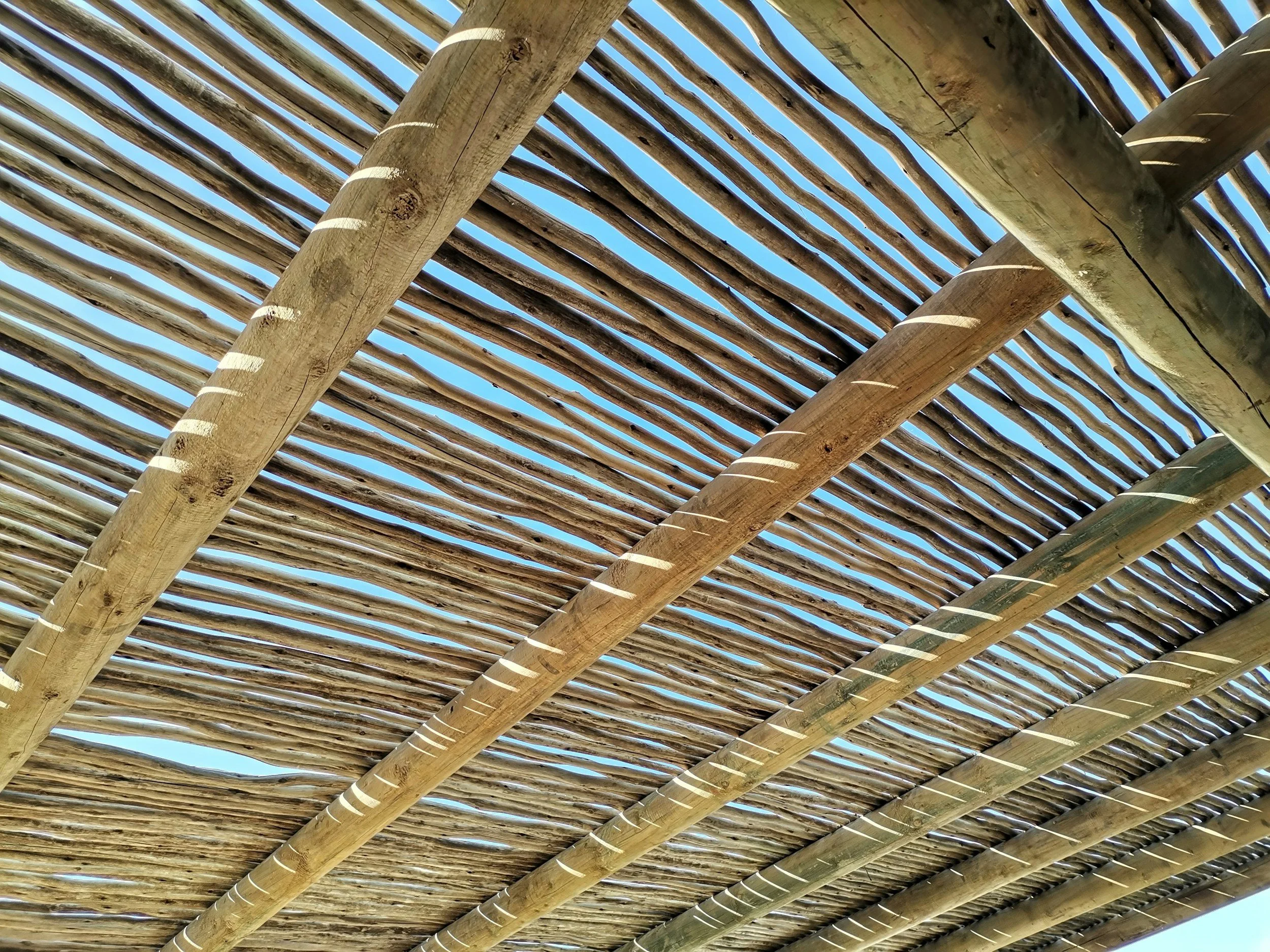
It is also a call to unity. Jews of all political persuasions meet under the branches, under the roof, in the booth.
I hope you can see what I’m saying?
In church, amongst Christian believers, there has been much talk and many sermons preached about Passover and Pentecost. But we have a deep spiritual need, whether we are Christians or not, to hear the message of Tabernacles, or Sukkot and to meet together under a roof with holes, somewhat open to the heavens, so that we experience a fellowship that transcends political differences and is open to God in heaven, like the light streaming through the roof; not an atheistic socialist utopia of unachievable equality and unity, or a capitalistic freedom that turns a blind eye to the losers, but a deeper note, a reverberation, the call of the Spirit of God. You know it when you hear it.
It's a call to the satisfaction of harvest, a call to completion, a call home, to feet up, to rest, for barriers to collapse, and friendship with neighbours and God to soak into work and world-weary souls.
So, the choice between escapism and good sense is a false dichotomy. To escape, to take time out, to celebrate, to worship, is time well spent; and it is good sense. There are plenty of days to attend to the affairs of the world of work and life.
Go for a drive, maybe. Find a field with hay or straw bales. Go in. See if you don’t go ‘Ahhh’ and relax to your core.
Unlike the writer
A meditation on a pen took a handbrake turn
Don’t be duped
Nothing escapes
The onward march to
I don’t know where
Swan Spring quills
Sleek-black biros
Grass-green rollerballs
SmartScreen scribblers, but

Who designed us
To chance upon
A charcoal brew of dyes
To daub, to draw, to draft?
Attached one end, and
Conceived in mystery
Words, hidden in ink,
Flood onto the page
And to mediate?
A handheld instrument,
Twitching to and fro
Emptying its gifts
Until the ink fades
Nib-scratching the paper,
It’s outer outlasting the inner
Unlike the writer

Book Review: Lila, Marilynne Robinson, Virago
I’ll let the Review speak for itself!
‘The life she’s decided she would never have was there the whole time trapped and furious, and in that minute she knew that if a man she ought to hate said one kind word to her, there was no telling what she might do.’
Marilynne Robinson has a gift of opening up a character’s innermost thoughts and taking you, as the reader, there, swimming around inside another person’s way of thinking about the world.
The world that Lila is set in is a post-war small town called Gilead, in Iowa, following on from her other novels, Pulitzer Prize-winning Gilead and Orange Prize-winning Home.
Lila, tells the story of Gilead from Lila’s perspective, how she was a homeless wanderer whose only possession was a knife. The knife keeps reappearing in the novel and is Lila’s physical connection with her past, which is very much in contrast to her present. In the present she is married, happily, to John Ames, an elderly church pastor.
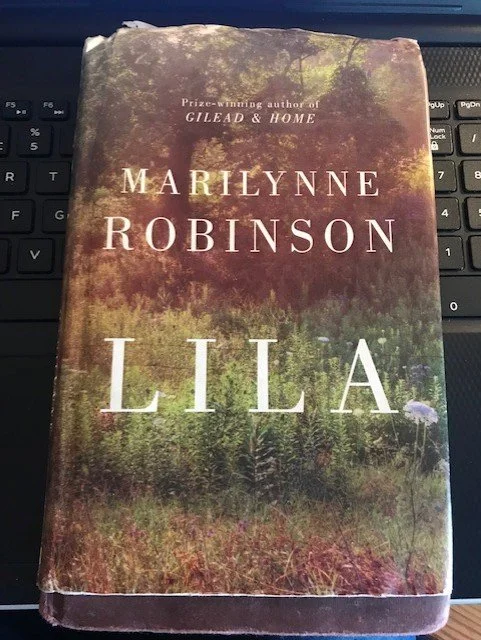
Much of the book is a detailed monologue of thoughts drifting from the past to the present and back again. There are no chapters. It’s almost a stream of consciousness but is saved, if that’s the right word, by a tight timeline; the journey could be described as from one baby in the past to another one in the present.
Although there are many bible references dispersed throughout the book and, of course, the perspective on the world through John Ames’s eyes as a church pastor, I found the references to the Christian faith incomplete and frustratingly incapable of conveying an answer to a fundamental question ‘What is a Christian?’ and its corollary, ‘How does someone become Christian?’
‘His body still had the habits of largeness and strength’
Whether purposefully or not, the sacramental perspective ie someone becomes a Christian when they are baptised (not what I understand from the New Testament), is introduced in the conversation between John Ames and his life-long friend Robert Boughton, the minister of another church in Gilead.
But Lila is not written as a Christian tract!
It is beautifully crafted. Some passages are as poetic as they are descriptive, and if you enjoy close detail and honesty about the human condition, this will enthral you. Speaking of John Ames, Lila (or is it the author, it’s not always easy or necessary to choose) is caught thinking, ‘His body still had the habits of largeness and strength’.
If you’re after action, adventure in the sense of fast talking, fast movement, this is not the book for you. There is plenty of action and adventure, but at a much slower pace, that’s all.
MA Creative Writing, Exeter UniversityDay 1
First lecture…only just made it!
First lecture at Exeter University for 48 years, having arrived here with dark hair in 1977, feeling rather lost, excited, and ready to smell the Chemistry labs for the first time.
Now, the hair colour has changed, it’s always a surprise if a dark hair hits the barber’s floor, but a similar mix of trepidation and excitement at switching disciplines and attempting to absorb what I can from my lecturers and fellow students.

Day 1 was so nearly a disaster.
Firstly, the sleep parking app decided it would not communicate with my banking app. After muttering – that didn’t help – and repeating the failure two or three times, I resorted to the card option. But that required confirmation from the bank, which it gave! Now with less time to reach the platform before the train was to arrive, I had to walk back to my car, put the old-time slip on the dashboard, and trog back to the station.
Upon arrival at the platform, the electronic scoreboard announced that my train had been cancelled.
Arghhh! With the lecture starting in 2 hours' time, I was forced to drive to Exeter (with an engine warning light on all the way and all the way back later), praying for a parking space.
There was one…one…left. I parked and walked into my lecture as if there had been zero hassles from bed to Writing Prose Workshop 1.
15, I think in the class. 4 blokes, 11 ladies. Varying ages. Probably every decade from 20s to 70s represented. Ice breaker wasn’t too difficult, a brief bio. Then, after a sausage roll and flat white break, a wide-ranging discussion about Truth using The Salt Path as a leaping off point.
C, opposite, a bloke, had looked at the background reading for the lecture – swine! – and was well away, having thought through the nature of truth in fiction and non-fiction. I feel as if I’m already languishing. There’s an award-winning literary student from Texas to my right who gets lost in her monologue…but respect to all who spoke up. Quite a few did. I did in fact. Nice open ethos in the room. I warmed to the lecturer.
I parked and walked into my lecture as if there had been zero hassles from bed to Writing Prose Workshop 1
After, I walked to the timetabling room and changed my Tuesday lecture to a Wednesday.
At the time, it made sense to put both lectures on one day instead of travelling twice a week. Upon reflection overnight, this was not the right decision as the train times leave no time on campus for trips to the library, timetabling, personal tutor, IT and so on.
So…some hassles, but so good to get underway.
A sunny and warm September day. Exeter is well known for its campus arboretum, squirrels and the like. It was, of course, swarming with energetic undergraduates, and the various coffee shops were doing a roaring trade. Although many were looking at mobiles or screens, there were a great deal of conversations going on. A good sign, I feel.
If I’m allowed to switch back to the original group, I’ll be very chuffed as I felt the lecturer was a good enabler; only saying the minimum to get everyone else thinking and participating.

The reading list: 6 books, 3 fictions, 1 creative non-fiction, and 1 memoir.
Writing Poetry today. 9am train. Hopefully no cancellations.
Sunrise amongst acorns
First frost and a sunrise walk
Lumpy and thick white
A surprising layer of ice
Clung to the windscreen
The clouds long since
Had slithered away
Accidentally like a
Duvet discarded
During the night

Ferreting, I find my
Woolly hat and gloves
Hidden away
While the acorns grew
And the horse chestnut
Spiky capsules
Fallen now, the summer sun
Has dried out the twigs
It is this blue-sky snap
That chills the bone and
Hunches the shoulders
A hope drilled in
Splitting the sheath
Rending the cage
Death running backwards
Life following on
Above the car park
Rises a hill and a trig point,
A freezing vantage point
Where water is arrested
And the wind howls
There are no trees here to witness
The broiling globe
Cast its first light
And fail to retrieve
The summer cauldron
And yet, zero degrees and less
Does its work, cracking
Open the seeds
The hidden hopes
And dared-for dreams…
…maybe this autumn?

The Cows of Winscombe IV 16th September: A Car, A Cow, and a Conversation
But first, a Trades Description announcement; if you are expecting a photo of several cows due to the title The Cows of Winscombe, this post will disappoint. It’s singular, not plural. One cow.
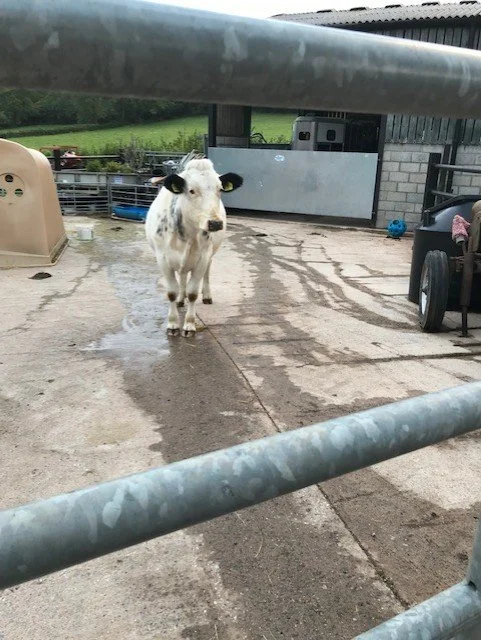
If cows can be demure, this one was!
By Midday
Guttering and drainage fixed. Hopefully, the damp walls can dry out.
As well as dealing with rain pouring down the front of the house rather than the traditional route, down a gutter, much of this week has been working my way through the e-jungle of registration at Exeter University. By midday yesterday, I had succeeded, and my laptop, via some Exeter App, informed me that I had passed Induction and could see my timetable.
With some apprehension, I opened up the timetable to find that I’d missed my first lecture. For those who have followed my attempts to breach the wall of e-communications at Exeter to start a Master's, 48 years after beginning my Chemistry degree in 1977, you’ll understand my comment to a friend: ‘nothing new then, straight back to 1977.’ Let’s just say early morning lectures and I didn’t see eye to eye.
This time around, I’m hoping to be better behaved.
4pm
A thud outside my front door and a cheerful delivery driver climbing back into his van as I opened the door to find another parcel, whilst muttering to myself, ‘What have I ordered now?’
But excitement was to follow. It was the Proof Copy of The Bait Digger, my debut novel, written at an age I should have known better.
By 4.15, cup of tea and a slab of dark chocolate in hand, I sat in the back garden, green pen raised to spot any mistakes. And found some. A French accent aigu had gone acute, and an apostrophe was missing, so it’s vital work.
5.30pm
Text my neighbour. ‘Fancy coming with me to drop my car off at the garage and walk back in the dark, the wind, and the rain?’ The reply, ‘Aww, sorry, am booked into a steam and a sauna. Thanks for asking.’ I sensed a wry smile.
But her sauna was cancelled, and for some strange reason, the idea of fighting the elements appealed, and off we went. It should have been about a 45-minute round trip. The wind was really kicking up. Great stuff, and even before sunset, it was getting dark. However conversation drifted to receiving my Proof Copy, and neighbour said unto me, ‘We should celebrate’. After a detour along some farm tracks, and passing the singular cow, we sat down with two glasses of wine at one of the best pubs in the universe - The Crown - and nattered on whilst the rain pounded down on the plastic corrugated sheet above our heads.

Her mobile phone torch is probably the reason we’re not still wandering around the footpaths of North Somerset as I sit here composing this post.
So, that’s it. A Car, A Cow, and a Conversation.
It’s funny how our days unfold.
I struggle with this verse:
‘And in Your book were written all the days ordained for me before one of them came to be’ Psalm 139v16
It smacks of an unavoidable preordained existence, when my experience is of randomness, occasionally very poor planning, laziness, dilemmas, highs and lows and so on.
‘Teach us to number our days so we may gain a heart of wisdom’ Ps 90v12
That sounds about right. Work to be done, then.
The Cows of Winscombe 13th September: Cows three days running? Really?
A third Cows of Winscombe reflection
Another unexpectedly sunny morning.
Boots on and with various disturbances in my innermost being (otherwise known as ‘things on my mind’), I set off intending to retrace a walk past the surgery and across fields to Shipham Lane. I’d even spent time searching for my glasses so I could see enough detail on an OS map to know where to find a particular footpath.
In the event my feet took me to a longer route, through Sidcot and up to the radio mast before descending to King’s Wood and on to the Strawberry Line to return home, 90 minutes later.
I did not expect to see cows.
I’ve walked this route a few times and only walked past sheep and lambs in the Spring. So it made me smile when I found some cows happily munching grass far enough away not to notice me gazing at them. The thought went through my head ‘that means I won’t be able to resist a third Cows in Winscombe blogpost’ and here we are.

Two of the uppermost ‘things on my mind’ I could name in specific terms. Better, though, to reflect on the bass notes. Most music is recognisable by its melody, the top notes, and the right hand on the piano. The left hand, which plays the bass notes, plays a background role. Without them, something’s missing, but it’s difficult to recognise the piece or the track simply from the bass alone. Two bands that buck that trend are The Police and Red Hot Chilli Peppers.
I digress.
So, it is tempting to comment on Charlie Kirk’s assassination, which was on my mind, probably like yours? And Exeter University. Also bothering me. But I won’t.
On Charlie Kirk, I will leave the floor to Barack Obama, who tweeted (if that’s still a verb?) on X:
We don’t yet know what motivated the person who shot and killed Charlie Kirk, but this kind of despicable violence has no place in our democracy. Michelle and I will be praying for Charlie’s family tonight, especially his wife Erika and their two young children.
On Exeter University, all I need to say in detail is that I’m looking forward, even though daunted, sitting at the feet of expert lecturers. It (an MA in Creative Writing) starts next week…and I still have some hoops to jump through.
What I will attempt to comment on re: Exeter is the difference between modes of communication and actual communication; the harmful drift from simplicity to false sophistication.
And, continuing a heavy theme, to articulate my concerns about suppression via polarisation as the background to Charlie Kirk’s assassination.
Well? How many of you have taken yourself off for a long walk because you’re carrying some bothersome thoughts that need some time to settle, or to emerge from the brain fog?

Hopefully, I won’t forget the cows and the countryside by the time I finish this. It was a beautiful walk. Another title I considered for this piece was ‘Beauty’. I hope I can link the above to beauty.
In recent years, the term ‘polarisation’ has become a popular term expressing deep concerns about the glue that holds societies together. In the UK, our recent flirtations with polarisation have been, I would argue, over whether to Remain or Leave the EU, and in the last two years over Israel/Gaza. In the States, the antagonism between MAGA and Antifa supporters (rarely reported in the UK) and similar left-right extremist groups and the two main political parties continues to be extremely unsettling.
Why deep concerns? Here’s my interim answer: polarisation leads to suppression.
In the UK, depending on whose company you were keeping, it was wise to keep schtum about your Brexit or Remain views, or your support for Brexit champion Boris or Remainer Cameron, or you’d be shouted down, shunned, ostracised, and vilified. (Even in churches, Christians were nervous about showing support for either side, depending on the political profile of their church, for fear of an unseemly row).
Fear of speaking out was palpable. Wisdom triumphed over Courage. The result: Suppression.
In the campaign to join the EU in 1972, arguments were put forcefully by both sides, but without rancour spilling over into societal unrest or an erosion in civil dialogue.
The glue that holds a democratic society together is free speech, freedom of association, freedom of assembly, freedom of the press, freedom of religion, and the right to a fair trial.
In conclusion, as much as I defend Charlie Kirk’s exercise of freedom of speech, I look to America to ensure that the man arrested for his assassination is given a fair trial.
Really, what is on trial is whether we want to live in a democracy or whether we will slip into fascism, either to the right or to the left. Since Mussolini, who coined the word ‘fascism’, and Hitler, we have associated ‘fascism’ with the far right, but it can be equally associated with the far left. The characteristics of fascism include dictatorial leadership, forcible suppression of opposition, and subordination of individual interests for the perceived interest of the nation or race.
Why deep concerns? Here’s my interim answer: polarisation leads to suppression
Tragically, we have witnessed democracies tumble into the fascism of Hitler’s far-right National Socialism, and then the far-left version in Communist East Germany in post-war Europe. Dictatorships that ruthlessly silenced all opposition and free speech.
Beauty? The freedoms we have taken for granted in the UK – and the West in general - are as beautiful as the air we breathe, the blue sky above, and the sweet smell of autumn. The bible says we should think on these things. It’s good advice.

Let’s just say that my experience of joining Exeter University with its sophisticated e-management of umpteen Apps, email log-ons, an avalanche of communication, and, with less than a week to go before I sit in a lecture theatre here, are the things I don’t know:
1. My timetable
2. Who my lecturers are
3. Where to go
4. The number of days per week I need to be on campus
5. Access to a personal tutor
Here’s my point.
The avalanche of communication with well-designed webpages, links to opportunities, and so on, has relegated the essential information, as above, to a lower league. I have the impression of busyness; an overworked admin staff desperately trying to keep this complex show of e-communication on the road so that, heaven forbid, it never falls beneath the presentational standards of competing institutions.
Meanwhile, I need to know the above. Really, that’s all I need to know.
This disease is not Exeter University-specific. It’s widespread. Sophistication has replaced Simplicity, with the result that priorities are obscured and lost.
Sometimes progress is an inversion of the meaning of the word.
In 1975, if I wanted a doctor’s appointment, I would travel to the surgery, take a board with a number from a hook, and wait until my number came up. Simple. No forms to fill in, no website to log on, no admin staff needed, no telephone calls. During the night, a doctor was on call. Every day. Local. Reached by a landline telephone call.
It wasn’t perfect, of course, and had to expand as Whitstable’s population grew, but simplicity has been replaced by false sophistication.
The beauty of simplicity is that it is democratic; everyone, young and old, understands how to access the information they need. False sophistication leads to a divided and unequal society where those who can navigate the sophistication become a mobile e-elite and those who struggle are discriminated against and, all too easily, fall through the cracks.
St Paul wrote the following words:
‘Finally, brothers, whatever things are noble, whatever things are just, whatever things are pure, whatever things are lovely, whatever things are of good report, if there is any virtue, and if there is anything praiseworthy – meditate on these things.’
The walk in the beautiful countryside near Winscombe this morning allowed me to meditate on the type of society I hope we can maintain. Personally, I hope the walk has helped me from getting too drawn into commenting on the awful assassination of Charlie Kirk, or the specific frustrations surrounding starting a Master’s at Exeter. I hope I have been able to reflect on how good and wholesome a society can be if it upholds the above-mentioned freedoms; freedoms I have more or less taken for granted, and that I want my grandchildren to enjoy without fear.
He Took Me There
Hovering in the background are two New Testament verses…Romans 6v6 and Galatians 2v20
At my age, I’ll shed this skin
By Christmas
Honestly, when you look at me
Over the bread sauce
I’ll not be the man I used to be
A strange twist of newness
The replacement looking
Older by the day
Some parts are famously temporary
Wobbly teeth hanging by death threads
Nails, already not really us
Our breath, a sojourner at best
But the real you and me,
Living amalgams of all that has passed
Organic unions with our brokenness,
Our crimes, our guilt, our shame
Jealousies, pride, lust
Ambition, our hurt lockers
Can these death notes
Be peeled away like the teeth
To leave us new again?
Sunday by Sunday
The priests intone
O Lamb of God
Who takest away the sin of the world
Have mercy on us
Did the Lamb of God excise
Our sufferings and put them in
A divine supermarket trolley?
Removing our grief and sorrows
Far away, leaving us innocent?

Hauntingly we sing
Were you there
When they crucified my Lord?
Oh! Sometimes it causes me to tremble
No more so than now
When I can offer the only answer
Looking out at His mother
At Magdalene, at the soldiers
At those gathered, and beyond
Through His eyes
Yes, I was there
He took me there
Not just my sufferings
Separated from me, no,
The Suffering One,
He took me there
It is finished, I am finished
Now, at Christmas
When I look at you
I’ll be peering from inside
The resurrection and the life
Ah, don’t you worry about my aging skin
It’s the oldest trick in the book
Just you wait
The Cows of Winscombe 12th September: Running in the Light
It was supposed to be raining, but the sun shone
I hadn’t written yesterday’s Cows of Winscombe post with any intention to turn it into a series, but that may be what’s transpiring.
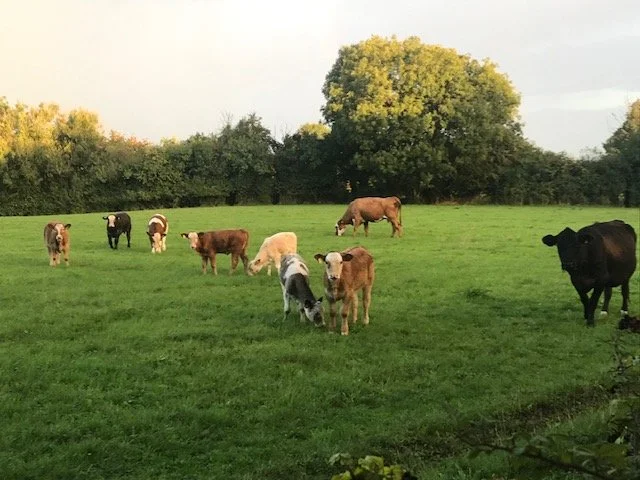
The day so far.
At approximately 7 a.m. I donned my ear buds and headed to The Strawberry Line, a disused railway line, for an early morning run. In fact, 7 a.m. for me is quite a late start, but I woke up later than usual.
The forecast was for rain, so I was mentally prepared for a soaking. Not a drop of rain fell. Clouds were moving slowly across the sky from the SW, but the sun shone.
Normally, I listen to a podcast to accompany my sweaty efforts; this morning, I listened to Pete Grieg addressing NC25, a Christian Conference, speaking about the Quiet Revival that has hit the headlines in recent months. It was excellent, funny (naked in a glass-sided shopping centre lift made me laugh out loud), informative, and an appropriate ‘wake-up’ message for an early morning run.
But that’s not what I want to write about.
I moved here approximately 6 months ago, and I realised I was surprised to find myself running in the same soft morning light as in March/April. Not as funny as Pete Grieg’s mishap in the lift, but it made me chuckle. ‘Of course! Doh!’ was how I reacted.
The Earth looked at ease with itself. All was well. It was like an unexpected gift
April 1st Sunrise: 6.36
October 1st Sunrise: 7.01
It doesn’t match perfectly, due to the alignment of the planet with respect to the Sun and the equator, but it’s near enough. And gorgeous.
And, as you can see, I ran past more cows. Today’s cows were illuminated in those soft sunrise rays. I felt calm. They looked calm. The Earth looked at ease with itself. All was well. It was like an unexpected gift, remember, I was expecting to be soaked through, this was like darkness into light, defeat into victory, turmoil into peace…poetically speaking.
If that’s a tad melodramatic, so be it, but I enjoyed the run, stopping every so often to pick a succulent blackberry or take a photo of the light falling on cows, a bridge, and a disused, rusting farm trailer.

For those reading this of a spiritual disposition, you will understand why this morning’s run in the light reminded me of David’s Psalm 30v5
Weeping may last for the night,
But a shout of joy comes in the morning

The Cows of Winscombe 11th September: between a bull and a field of cows
My friends? The Cows of Winscombe
One of my normal early morning running and walking routes across fields and footpaths has an in-built risk of encountering the cows of Winscombe.
Last week, my route was blocked by four or five large Friesians standing guard by the fence, so I couldn’t clamber over…nor did I particularly want to. Or, taking a shortcut, I found myself in a field I thought was cow-empty, only to find a small group of about fifteen Guernsey cows (I think), three of whom were headbutting each other.

With about fifty yards to the exit, they started to take more of an interest in me than each other or the grass and started running in my direction, making a din, mooing and bellows. A friendly morning greeting?
This morning, upon reaching a concrete block over a stream and a standard aluminium gate, I was faced with a field with another fifteen or so cows with heavily laden udders munching their way in my direction. They seemed to be quite peaceful – no headbutting – but to get to the gate on the other side of the field would mean walking through the middle of the small herd.
I was about to turn back when I heard a very loud snort and bellow. A large bull had entered the field in which I was standing.
So, one bull behind and fifteen cows ahead. What to do?
I’d been standing at the gate watching the cows for a few minutes. One had wandered over to me to say hello and moved off peacefully, so off I went walking slowly. The fact that I’m writing this suggests, correctly, that these cows were more interested in snaffling the dewy grass and nettles from the field than bothering with me, and I made it to the gate without any trouble.

Cows are rather strange and lovely animals. There’s a mournful, ‘I’m too heavy’, look about them, a resigned acceptance of their lot, and a peculiar combination of bony outcrops and massive flesh. Joy seems to be on hold. They engage a sense of sympathy in me; I hope they get milked soon. It all looks a tad uncomfortable lolloping around with udders fit to burst, cloven hooves standing in wet, muddy fields, loaded with excessive heaviness.
I didn’t study the bull for too long.
In contrast, each cell in the bull’s body seems to be a world saturated with a longing to do something dreadful or drastic, even if it is servicing every cow within sight and over the horizon, or reminding me of my puny humanity.
The matador in me seems to have flown the country.
