Welcome to my blog...whatever image springs to mind, be it a hippopotamus, Tigger, red-haired Highland cattle, or a simple kitchen table, 'Unless a Seed' is a four-legged creature. My hope is that having read a Book Review, a Poem, or a What is a Christian? or some random post in Everything Else, you will be kind enough to leave a comment or a short reply. And I hope you enjoy reading its contents

What is a Christian?

Book, Podcast, Film, and Blog Reviews

Poetry

For Writers, Writing and Everything Else
The Punchy Epistle – James (ii) Main Course: Job
The Main Course: Job, patience in suffering, hanging in there when purpose is obscured
This is not a scholarly look at the Epistle of James. It’s not an investigation into authorship, manuscripts, historicity, debates over canonicity, or a re-hash of Luther’s famous dislike of its contents.
What I have in mind is a four-course meal, or more accurately, a three-course meal, with two starters.
If the Starters were Abraham and Rahab, the Main course is Job
‘…take the prophets who spoke in the name of the Lord as an example of suffering and patience - indeed, we count them blessed who endure. You have heard of the perseverance of Job and seen the end intended by the Lord – that the Lord is very compassionate and merciful.’
In the previous verse, James had indulged in some straight talking,
‘Do not grumble and moan against one another lest you be condemned – Behold the judge is standing at the door!’
Earlier still, he had urged them to do the opposite,
‘If you really fulfill the royal law ‘You shall love your neighbour as yourself’, you do well’
It is useful to remember the context of the letter. He wrote his epistle to the ‘twelve tribes scattered abroad’; Jewish believers who had been persecuted and scattered as the Jewish authorities tried to stamp out what they considered to be a subversive threat to the state and their own privileged positions within that political system.
In addition to the normal run-of-the-mill reasons we all encounter in life, that cause us to be grumpy, complaining, or angry, even, these Christians were being hounded, arrested, excluded from the synagogue, work, and family life. If anyone had reason to grumble and moan, they had.
Their particular dose of suffering came from external circumstances that had turned against them – like Job.
In both cases, the spiritual foundation of the suffering was satanic. In Job’s case, Satan had asked permission from God to cause Job to suffer, and Satan’s request was granted. Job loses his oxen and donkeys, his sheep, his camels, and his children.
However, the Lord blessed the latter part of Job's life more than he lost. Later, he had ten thousand sheep, had seven sons and three daughters, and lived to be a hundred and forty.
James’s meditation on Job’s life is that the Lord is ‘very compassionate and merciful’ and urges his readers to consider the purpose of Job’s suffering, that somehow it led to blessing and that however satanic was the origin of the suffering, God’s blessings were greater.
Equally, when the church (i.e. the early Jewish believers James was writing to) was harassed and scattered, suffering the loss and deprivation, it looked as if their enemies had the upper hand, but God’s plan included an encounter with Saul en route to arrest Christians in Damascus. God called Saul/Paul to be an apostle to the Gentiles…and here we are, billions of believers later, twenty-one centuries later.
The Punch turns out to be a double punch. First the suffering, then the blessing.
The question James poses us, however, is one that can only be answered in our hearts. In the middle of suffering, how is your heart? Is it singing? Is it singing that ‘the Lord is very compassionate and merciful’ even if you’re singing with tears pouring down your face. Is your confession still that the Lord is good…to you. Or have you resorted to filling your days blaming others, especially brothers and sisters in Christ, ‘…don’t grumble against one another…’
In the aftermath of 9/11, Matt Redman wrote the song Blessed Be Your Name based on Job’s experience. It coincided with a particularly dark time for me. Still to this day, I can barely get the words out. Not because of the darkness, but for His goodness in it and since.
There are many versions on YouTube. This one was performed during Covid. Apt, I think.
Blessed Be Your Name
In the land that is plentiful
Where Your streams of abundance flow
Blessed be Your name
Blessed Be Your name
When I'm found in the desert place
Though I walk through the wilderness
Blessed Be Your name
Every blessing You pour out
I'll turn back to praise
When the darkness closes in, Lord
Still, I will say
Blessed be the name of the Lord
Blessed be Your name
Blessed be the name of the Lord
Blessed be Your glorious name
Blessed be Your name
When the sun's shining down on me
When the world's 'all as it should be'
Blessed be Your name
Blessed be Your name
On the road marked with suffering
Though there's pain in the offering
Blessed be Your name
Every blessing You pour out
I'll turn back to praise
When the darkness closes in, Lord
Still I will say
Blessed be the name of the Lord
Looking Down
Autumn in August?
‘Like a ton of bricks’
Overstates that dull sense, the
Mild dent of disappointment
No sooner, it seems
I mourned the passing
Of July
Than it’s Friday
The twenty-second
Of August
And I’m walking
Alongside sunrises
And sunsets
The days shortening
The temperature dropping
Crisp leaves turning
Tomorrow has come
It crept in, craftily,
Like a morning mist
Falling golden leaves
Apples beaming red
Soil smelling sweet
There’s a lot
To be said for
Looking down

The Punchy Epistle – James (i) Starters: Abraham and Rahab
James - a 3-course meal. Starters.
This is not a scholarly look at the Epistle of James. It’s not an investigation into authorship, manuscripts, historicity, debates over canonicity, or a re-hash of Luther’s famous dislike of its contents.
What I have in mind is a four-course meal, or more accurately, a three-course meal, with two starters.

Whenever we read the NT or OT scriptures it’s worth bearing in mind the following verse from Hebrews:
‘…the word which they heard did not profit them, not being mixed with faith…’ 4v2
The scholarly approach to scripture is vital. We need literary and linguistic experts to build upon our knowledge of the Greek, Hebrew, and Aramaic languages to enhance the accuracy of bible translations to give the correct meaning of the text. But none of that will ‘profit’ the scholar unless he or she has faith to believe the translated word.
James may have been one of Jesus’s brothers; we don’t know. What we may safely assume is that he was Jewish and was writing to Jewish believers. He refers to Abraham as ‘our father’ 2v21 and states that his intended audience was the ‘twelve tribes scattered abroad’ 1v1. We know from Acts that Jewish Christians were hounded and persecuted by Saul/Paul and others, and ‘scattered throughout the regions of Judea and Samaria’ Acts 8v1 and that the persecution extended as far as Damascus and then pursued Paul and others around the Jewish diaspora from Jerusalem to Rome.
The author, evidently, was steeped in the scriptures - what we call the Old Testament.
Our 3-course meal comes from the OT. James refers to Abraham and Rahab - our two starters; Job as our main; Elijah as our dessert.
Starters: Abraham and Rahab
We seem to be past masters at consigning just about everything into separate categories.
From an early age, it is by learning the differences between objects and feelings, that we make sense of the world. The Sun and the Moon. An ant and a giraffe. And so on. Then it becomes more subtle: the yoke and the white of the egg, and the shell. Distinct yet not truly separate. What James is describing here is a deeper connection between two words, faith and works, and arguing against the false notion that they belong to different categories.
James is contradicting someone who has mentally separated ‘faith’ from ‘works’.
What is faith? James doesn’t offer us a dictionary definition; he illustrates his answer with Abraham, the patriarch, then Rahab, the prostitute.
God spoke to Abraham on two occasions about two different events. The first occasion was a call to leave his father’s house and go into a land that God would show him. Secondly, that he and Sarah would have a son, despite their respective ages; Abraham was 100 and Sarah, 90.
His faith in God’s word to leave his father’s house led him to get up and start walking. Then we have the birth of Isaac. The bible does not teach us that this was due to an ‘immaculate conception’. The implications are clear enough.
Rahab was a prostitute who took in Joshua’s spies. She believed two things. Firstly, that her salvation and the salvation of her family would not be secured by the wisdom of the city elders, who had decided to close the gates to the city and wait out the coming storm of the invading Israelis. She saw that her salvation lay with the ‘enemy’, with Israel. Her faith led her to hide Joshua’s two spies and then escape with Joshua’s help.
Again, her faith and her actions, or ‘works’, as James puts it, were inseparable, or as he concludes, ‘faith by itself if it does not have works, is dead’ and ‘as the body without the spirit is dead, so faith without works is dead also’.
The Punch
Final point. Everything I have written up to this point may satisfy us intellectually, but James doesn’t let us off the hook.
‘If a brother is naked or destitute of daily food and you say ‘depart in peace, be warmed, and filled’ but do not give them what they need, what good is that!’
This echoes John’s statement: ‘whoever has this world’s good but sees his brother in need and shuts up his heart from him, how does the love of God abide in him? My little children, let us not love in word…but in deed and in truth’.
If we truly have faith, our lives will be a demonstration of that faith. Neither Abraham nor Rahab was perfect. Abraham tried to do God’s will and produce the promised son via Sarah’s maid, Hagar, and Ishmael was born. The bible is disarmingly honest. None of its heroes get it right all the time, with the exception of Jesus.
We don’t know the circumstances that led Rahab into prostitution, but what we do know is that God delivered her not only from Jericho but into a new life, free of prostitution, in Israel, and she became the great-great-grandmother of David.
The News w/b Sunday 17th August: Three Card Trick – Hiroshima, Hamas, Hurricane Erin
The Three Hs: Hiroshima, Hamas, Hurricane Erin
If I were a magician, I’d be saying ‘pick a card’, but I’m not, so it’s three paragraphs on the above The Three Hs that have been astride the media in the past few days.

Hiroshima Genbaku Dome - somehow survived the blast directly below the explosion
1. Hiroshima
On August 6th, 1945, the Enola Gay, a B29 bomber released the ‘Little Boy’, an atom bomb, exploding at a height of 1900 ft above Hiroshima, instantly killing 70,000, some of whom were school children on their way to school. I’ve been listening to BBC R4’s John Hersey’s Hiroshima to mark the 80th Anniversary of the bombing (of Hiroshima and Nagasaki) and the consequent surrender of the Japanese to bring the war to a close. My parents lived through WWII. My father was a colonel in the US Army, and my mother, English, worked for the US Army. (Yes, you can put two and two together). Little was said about the war in the Far East; their involvement was restricted to serving the Allies’ defeat of Nazi Germany. Wisdom, the bible says, is known by its fruit. So, constructing an ethical lens to peer into the past to form a sound judgement about the rights and wrongs of using such destructive force calls on skills that I don’t believe I possess. If the fruit was ending the war, all I can offer is that this must be brought into the weighing scales of whatever ethical lens you are using to judge Hiroshima and Nagasaki.
2. Hamas

Jerusalem - still longing to fulfil its name ‘city of peace’. The bible urges us to pray for the peace of Jerusalem. No more so than now.
I have written a few times about Hamas. To my mind, they are no better than Hitler’s Nazi thugs. Hamas have long since disregarded any value in the sanctity of life and consider their sworn enemies – the Jews in Israel – with the same irrational hatred that Hitler employed against the Jews…vermin that need to be eradicated. Hamas’s murderous attack on October 7th 2023 against unarmed civilians in kibbutzim villages and at the Nova music festival, was beneath contempt. Whatever their grievances, justified or not, that led to stooping so low cannot be employed in justifying such a barbaric assault. They have brought upon their own heads, and the lives of Gazans they were elected to serve, such utter horror - and still they refuse to surrender and hand over the hostages that were taken by their armed gangs in order to end the war and the endless suffering of Gazans. Their violations of basic human rights, disregard of international law, war crimes, and their vows to destroy the State of Israel make them undigestible. In the same way as we worry, ethically, about the Enola Gay operation to end WWII in Japan, we wring our hands at Israel’s military operation to remove Hamas and liberate the hostages. And we should. At least in Israel, the proof, almost, of a healthy society, is that Jews in their tens of thousands are permitted to protest against Netanyahu’s military campaign without fear of reprisal, whereas, across the border in Gaza, anti-Hamas protests by Gazans are ruthlessly suppressed.
3. Hurricane Erin

‘A 600 mile wall of rain’ and other dramatic headlines are a welcome break from reports from war-torn Gaza and Ukraine, as journalists seek out other news in August and spend an inordinate amount of time blue-sky thinking (yes, I know), trying to come up with the most eye-catching headlines. For me, ‘A 600 mile wall of rain’ wins hands down! Alas, all the tabloids seem to be carrying this phrase, so, sadly, I cannot award the trophy to any one journalist. Hurricane Erin, a tropical storm at the moment on the other side of the Atlantic, is likely to be great disappointment to those who are desperate for dramatic weather, but that is no defence against the newspaper proprietors' need to sell print, albeit electronic print these days. As Mark Twain said ‘Never let truth get in the way of a good story’ especially in pre-autumnal August. We press on.
Hebrews - Back to the Burning Bush Report #8 Do Christians go to Church? Well…yes and no.
Church? Yes…but not as we know it
The account of Moses’s distraction by a bush that appeared to be burning but never consumed is well known. The initial distraction quickly transformed into a holy encounter with God, Moses removed his shoes and walked barefoot on holy ground.
This is as typical as it is unique. Something gets our attention and before we know it, we’re grappling with a depth of thought that carries us towards God…or God comes close to us.
I’m reading through Hebrews in the New Testament (my money is on Paul as the author, but the authorship isn’t known).
This series is like a journalist reporting on scenes he’s been sent to comment on.
Report #7 – Do Christians go to Church?
‘…you have come to Mount Zion, to the city of the living God, the heavenly Jerusalem, to….angels…to God…’ Hebrews 12 v22,23
It’s Sunday morning, 8.28 to be precise, and I’m intending to ‘go to church’. The service starts at 10.30 and will last approximately an hour after which there might be tea/coffee/cakes and convivial conversation.
You know the drill.
At the time of writing Hebrews, it is unlikely that this Jewish community of believers would have met in a ‘church building’ and we have no knowledge of how they would have passed the time when they had gathered. It’s unlikely it would have been a Sunday – that was a working day in most of the Roman Empire.

All the paraphernalia we associate too easily with the word ‘church’ may well have been noticeably absent. Congregational singing, hymns, songs, a ‘worship band’, a variety of instruments, amplification, a dress code, notices, collections, liturgy, regular preaching…the list goes on. It took centuries for our present version of ‘church’ to settle into its traditions.
A Christian is someone in whom God the Holy Spirit has taken up residence.
‘If anyone does not have the Spirit of Christ, he is not His’ Rom 8 v 9
So, when Christians ‘go to church’ it is a meeting of individuals in whom God the Holy Spirit is indwelling. Perhaps picture each Christian as a light bulb switched on. So, when Christians gather, the light becomes greater.
The essence of verses 22,23 shatters any notion of ‘going to church’ being a man-led event. It is a meeting with God, the living God.
Is God capable of leading the meeting? Wel…erm…yes. Leaders, whether our tradition calls them pastors, Vicars, priests, elders, or ministers, should be believers who know what it is to be ‘led by the Spirit’ so they can model to the congregation what being ‘led by the Spirit’ means in life and when the church gathers together.
Does this mean we have to abandon all structure, pull down our buildings, disrupt all plans, and disband any form of leadership?
It’s subtle and yet sharp. You may have read of when Uzzah put his hand out to steady the cart:
‘Then the anger of the LORD was aroused against Uzza, and He struck him because he put his hand to the ark; and he died there before God’ 1 Chronicles 13:10
The priests learnt that their task was to carry the presence of the Lord, not use their strength and abilities.
All of us, as the book of Hebrews has taught us, are priests of the order of Melchizedek – carrying the presence of the power of an endless life. When we meet, therefore, we should be carrying the presence of God into the meeting. No one can predict what God will do amongst His people when they meet.
But the Spirit can be grieved by leaders who, like Uzzah, put their hand out to steady the ark. Death follows. Life disappears from the meeting. You are left with the husk, not the grain, or, as the New Testament puts it ‘the outward form of godliness but denying the power’.
There is only one solution. Like a grain of wheat, we must be willing to go into the ground and die to any notion that we are in control or have any role in ‘keeping the show on the road’. This is the risk of true faith. What that looks like precisely no one can know. But you’ll know. Switching fuel tanks from you to God is deeply personal. You’ll know.
When I eventually ‘go to church’ this morning, it will be with this mentality. Carrying the presence of God like this is not dependent on our circumstances. We weep with those who weep and rejoice with those who are rejoicing. Jesus was ‘anointed with gladness above his companions’, but also a ‘man of sorrows acquainted with grief’, but whatever condition He was in, He carried the presence of God.
He had peace. On occasions, he had healing to give away. Sometimes a parable to share. When he was physically shattered, He met a woman at a well, and God showed Him personal details of her life, the fruit of which was the conversion of a Samaritan village.
To conclude. Do Christians go to church? If you’re a believer, reading this, and about to go to church this morning, whether a leader or not, let us be careful not to be like Uzzah, rather die to any notion that ‘we’ are in control of events. Let us lay down our ‘roles’, if we have any, and as the verse above says, lift our eyes up to God…and be expectant. And if we have no particular role, to ‘see’ that we are here, just like any of those who are more prominently ‘leaders’ to worship the living God.
We are on holy ground. Let us take off our shoes.
Rosa Pendulina and me, John
Coffee break in the sun, interrupted by Rosa Pendulina
Sat inside now
Listening to a neighbour’s
Mower thrash through the straw
I wonder why?
This is not a summer for grass,
Green belongs to a bygone age

Came in when my flesh
Resembled melted lard
And when the supply
Of dark chocolate slabs
Had run low, the chapter
Abandoned, unfinished
And after I’d felt guilty for
Finger flicking an
Appealing shield bug
From my knee
And after the coffee-swimming
Wasp had stopped its writhing
Despite the mini summer drama
Of the previous fifteen minutes
I could not walk past Rosa
Her red cheeks and green dress
Catapulted me from the Iowa
Of the book to the here and now
The shield bug may not
Even have landed
When time escaped its boundary
And the needs of the day
Were found relegated.
Pendulina had swung me
From the temporal to the eternal
From the imaginary to the image
From my paltry love
To the all-consuming fire
The burning that is judgement
And mercy upon mercy
That found its mark
In a life laid down:
The ‘Nevertheless’ man
The ‘Woman, behold your son’ man
The ‘Son, behold your mother’ man
A man named John
Hebrews - Back to the Burning Bush Report #7 The Awful Truth – biblical heroes are satanically flawed…and yet
Rebekah and the serpent in the Garden…similar? Jacob and Eve…similar? Really?
The account of Moses’s distraction by a bush that appeared to be burning but never consumed is well known. The initial distraction quickly transformed into a holy encounter with God, Moses removed his shoes and walked barefoot on holy ground.
This is as typical as it is unique. Something gets our attention and before we know it, we’re grappling with a depth of thought that carries us towards God…or God comes close to us.
I’m reading through Hebrews in the New Testament (my money is on Paul as the author, but the authorship isn’t known).
This series is like a journalist reporting on scenes he’s been sent to comment on.

Report #7 – The Awful Truth
‘…godless…Esau, who for one morsel of food sold his birthright…afterward, when he wanted to inherit the blessing, he was rejected…he found no place for repentance, though he sought it diligently with tears.’ 12v16,17
When I was challenged to examine the evidence for the existence of Jesus and the resurrection and to read the New Testament, I was shocked by what I found. Apart from Jesus, none of his followers, especially Peter, were written up favourably. There was no airbrushing. Pride, fear, arrogance, lying, betrayal, cowardice, bitterness…you name it, it’s writ large in the ‘saints’ of the Old and New Testaments.
In Hebrews, we find reference to the sorry tale of Esau.
In the Old testament God is referred to as ‘The God of Abraham, Isaac, and Jacob’.
Isaac’s firstborn son was Esau, who, therefore, was in line to inherit the promises and blessings of God to Abraham of the formation of a new nation. But Jacob (later renamed Israel), his twin brother, who had been born moments after Esau, usurped him…twice. First to give up his birthright and then, when Isaac was dying, out of his inheritance and blessings.
The real criminals in this story are Jacob and his mother Rebekah. The bible reveals both as conniving deceivers.
Genesis 25 records that after the twins were born ‘the boys grew. Esau was a skilful hunter. Jacob was mild. Isaac loved Esau but Rebekah loved Jacob’. That love for Jacob, twisted itself into rebellion, deceit, and selfish ambition.
Family life was not harmonious: ‘When Esau was forty…he took wives…and they were a grief of mind to Isaac and Rebekah’ 26v34,35
Into that set of circumstances, Rebekah saw an opportunity and struck. ‘Rebekah took the choice clothes of her elder son, Esau, and put them on Jacob’, who wore them into his old father’s presence, deceived his father into thinking he was Esau, and received the blessing that should have been given to Esau.

For a bowl of stew, Esau gave up his birthright
The course of history was changed in those moments. The nation promised to Abraham should have come from Esau not Jacob, but Rebekah actions were as devious and cunning as the serpent had been in the Graden of Eden.
‘Now the serpent was more cunning than any beast of the field’ Gen 3v1
‘So when the woman saw that the tree was good for food, pleasant to the eyes, and would make one wise, she took of the fruit and ate’ v6
If we are shocked to find that our bible heroes, including Abraham, Isaac, and Jacob…and Rebekah, were so deeply – and satanically - flawed, we should not be. They acted out their fallen natures just like the serpent and then Adam and Eve.
Paul, writing to the church in Ephesus, wrote, ‘And you were dead in trespasses and sins…you once walked according to the…prince of the power of the air, the spirit who now works in the sons of disobedience…and were children of wrath’ 2v2v1,2
This is the awful truth of spiritual condition of mankind and every man and woman. It is the reason why we cannot effect our own salvation. Every political and philosophical model of utopia has failed to reform human nature; Capitalism and Communism are powerless to control greed. The need to be saved, rescued, delivered, set free…and brought back into a right relationship with God, our neighbours and ourselves is real.
Remarkably, God was able to work out his purposes through Abraham, Isaac, and Jacob…due to their faith, not their nature, the hints and clues are already there in the story of their failures to suggest that God had something planned that would spring us from that ‘In-Adam-sin-prison’ that Charles Wesley famously wrote:
Long my imprisoned spirit lay,
Fast bound in sin and nature’s night;
Thine eye diffused a quick’ning ray—
I woke, the dung.eon flamed with light;
My chains fell off, my heart was free,
I rose, went forth, and followed Thee
Even in Rebekah’s scheming, she couldn’t help but tell the story prophetically of what has been made real for us now if we have believed and been transferred from Adam to Christ.
‘Rebekah took the choice clothes of her elder son, Esau, and put them on Jacob’
In Isaac’s eyes, Jacob had become Esau, the elder son, the inheritor…just we have, in God’s eyes, been clothed with Christ (Gal 3v27) and have become heirs of God, joint-heirs with the Son (Rom 8 v17).
In the new covenant we are given a new heart, a new spirit, and the Holy Spirit (Ez 36v26). We become new creations, the old has gone and the new has come (2Cor5v17).
Learning to operate in this world clothed with Christ is our calling, learning to walk just as Jesus walked (1John 2v6). Learning what it is to ‘only do what we see the Father doing’, learning to ‘walk in the Spirit’. St Peter wrote that we have become ‘participators in the divine nature’ (2Pet 1v4).
We are on holy ground.
Jacob, whose name means supplanter, after years of self-centred living, found himself on holy ground, at the brook of Jabbok, wrestling with the angel of God, leaving that place with a limp, and his name changed to Israel, Prince with God. He had spent years as a satanically flawed individual. From that point on he lived as the Prince of God he was named to be.
His story is our story, if we want it to be.
_____________________________
A book recommendation: Lance Lambert’s book ‘Jacob I Have Loved’ is excellent and has far more to say about Jacob’s transformation to Israel and its relevance for us.
Hebrews - Back to the Burning Bush Report #6 The Faith of Rahab: Climbing Over Our Cultural Walls
Lot to learn from Rahab. The harlot. When faith comes our identity shapeshifts.
The account of Moses’s distraction by a bush that appeared to be burning but never consumed is well known. The initial distraction quickly transformed into a holy encounter with God, Moses removed his shoes and walked barefoot on holy ground.
This is as typical as it is unique. Something gets our attention and before we know it, we’re grappling with a depth of thought that carries us towards God…or God comes close to us.
I’m reading through Hebrews in the New Testament (my money is on Paul as the author, but the authorship isn’t known).
This series is like a journalist reporting on scenes he’s been sent to comment on.
Report 4 – The Faith of Rahab
‘By faith, the harlot Rahab did not perish with those who did not believe’ 11v31
I’ll get to summarising the story of Rahab in a minute. But I feel I need to issue a health warning. I’m going to relate this report to the horror of the Hamas/Israel conflict, to the suffering of Gaza and Israel. Or try to.

Of course, you may well have at the back of your mind that the two territories in question, Gaza and Israel, are not a million miles away from the older conflict referred to in these Old Testament verses that occurred when the Israeli army encircled Jericho, now situated on the West Bank.
You can read the account of Rahab hiding Joshua’s spies in Joshua chapter 2.
Israel, by that time, amounting to maybe 2 million on the move, had amassed a reputation as an overwhelming invading force, having seen off two kings just the other side of the Jordan and the river, their last line of defence, had dried up allowing them to pass on and confront the city of Jericho; their reputation had preceded them.
‘As soon as we heard these things our hearts melted, neither did there remain any courage in anyone…because of the Lord your God’ 2v11
‘Jericho was securely shut up because of the children of Israel; none went out and none came in’ 6v11
Even in these two simple verses, we see a crucial difference. Rahab, a prostitute, didn’t see Israel as an overwhelming human tsunami coming their way, her focus was on the spiritual reality behind their astonishing victories, and the River Jordan drying up, stating to the spies that this was ‘because of the Lord your God’.

That led to a radically different response to the leaders of the city. Instead of trying to preserve her identity, her culture, her way of life, her familiar surroundings, and her livelihood, she climbed over the mental and cultural wall the city leaders had imposed on the inhabitants of Jericho by closing the gates, securely.
She implored the spies,
‘Now therefore, I beg you, swear to me by the Lord…you will…spare my father, mother, my brother, my sister, all that I have and deliver our lives from death’ 2 v12,13
If you know how the story unfolds, you’ll know that Rahab and her family were saved and Jericho with all its inhabitants perished.
‘By faith, Rahab…’
Along with the rest of Jericho’s masses Rahab had reacted initially with fear, but when the spies arrived and told her their story of all that God had done for Israel, she ‘heard’ the word which created ‘faith’ in her and so her world changed…at first invisibly on the inside and then, extraordinarily, in her actions, her rescue, and her legacy of faith.
She had climbed over the wall of her own people’s limited thinking bound up with fear. How things would have fared is only they had believed and acted differently. Faith is life or death.
Gaza. And Israel. Then us.
Whatever the legitimacy of the claims of injustice at the hands of Israel in Gaza, the West Bank, and territories in Palestine previously held by Palestinians before 1948 the word of God cannot be clearer,
‘I will bless those who bless you and I will curse those who curse you’ Gen 12v3
The choice that the leadership of Hamas and similar groups have made are quite different to the leaders in Jericho. Rather than be imprisoned by fear, they are engaged in opposing Israel by foul means or fair. Well, foul, not fair, in fact.
Incredibly, though, despite all that has happened and continues to happen in Gaza there are those, like Rahab, who view the events in the world quite differently and whose hearts are ready to bless, not curse.
Equally true in Israel. There are those who are able to climb over the walls of fear and hatred and are ready to bless not curse.
As with everything to do with God and His world, what we believe is vital. Jesus said much the same thing ‘bless those who persecute you’. The victory over hate and fear occurs deep within the heart. Whether it’s action or attitude that comes first, these are only symptoms of the deeper work…of faith…of what we believe.
How easy it is to comment on macropolitics. How much harder when it comes to our own cultural boundaries, safe spaces, comfort zones, and traditions that serve to separate us from those God calls our neighbours.
I look back on times when I have been more like Lot’s wife, a pillar of salt, or ‘petrified’ and paralysed by fear instead of having faith in God and confronting elephants in the room. And I can look upon other times when the word of God created faith in my heart, enabling me to risk vulnerability, unlike Jericho, remaining all locked up and seemingly safe. It’s a false safety.
We have a lot to learn from the ‘harlot Rahab’.
p.s. For those interested, Rahab’s legacy was not simply to be recorded in the Old and New Testaments, but to be included in the royal line of King David. She was David’s great-great-grandmother.
Lesson from a cider orchard
An encounter with an apple tree that took me to the heart of this, my website, www.unlessaseed.com, an unexpected return home
Early morning. Felt like autumn.
August, still revving her engines
But the air was nipping and
Something like frost coated the grass
Between the careless brook
And ripening trees.
The dawn sun rose to contradict
The air. My shoulders wore warm.

Trees held in orchard rows
Unaware of the benevolence
Ruling their lives;
Even their sensation of breezes
Of dark nights, and scorching days
Of thunder, and gentle rain
Of the inner strain,
The compulsion to swell
Twinkling eyes cast
To their neighbours
Luxuriating in the
On-rush of beauty
Green bullets learning to
Blush and sway in the wind
Looking down with
Scorn on the fallen

Grounded in degrees of decay
Telltale brown, soft
With a fermented scent
Rising with the dew-frost.
Here, not up there,
Is rapture, dark seeds
Falling to the ground
To die, to escape
Hebrews - Back to the Burning Bush Report #5 Invisibility of faith
The worldview of the bible is not only that the world was made by God through the ‘God said’ of Genesis but is being shaped by hearing the word of God…the invisibility of faith
The account of Moses’s distraction by a bush that appeared to be burning but never consumed is well known. The initial distraction quickly transformed into a holy encounter with God, Moses removed his shoes and walked barefoot on holy ground.
This is as typical as it is unique. Something gets our attention and before we know it, we’re grappling with a depth of thought that carries us towards God…or God comes close to us.

I’m reading through Hebrews in the New Testament (my money is on Paul as the author, but the authorship isn’t known).
This series is like a journalist reporting on scenes he’s been sent to comment on.
Report 4 – Invisibility of faith
‘Faith is…the evidence of things unseen…the worlds were framed by the word of God so that the things that are seen were not made of things that are visible’ Heb 11v1,2
Where are we with science? With Physics? On the macro level, we have the mysteries of the Big Bang and black holes, where matter and energy are intimately connected. And on the microscopic level, we have subatomic particles popping in and out of quantum fields. So, even in Physics, the relationship between the visible and the invisible isn’t dissimilar to the author of Hebrews’ assertion about the origin of ‘stuff’.
Poets, of course, have been swimming in these waters from time immemorial.
The question that confronts us in terms of biblical revelation, as opposed to a scientific or poetic exploration, is ‘is it true?’
Jesus, quoting Deuteronomy 8v3, said ‘Man shall not live by bread alone but by every word that proceeds from the mouth of God’ Mt 4v4
Do you? Do I?
Before reading the opening verses in Hebrews 11 the other day, I had always seen the references to the ‘word of God framing the worlds’ and ‘things seen being made from things unseen’ in v1 and v2 as referring to creation and disconnected from the fairly chronological list of individuals showing great faith from v3 onwards.
Better, I propose, to see verses 1 and 2 as foundational understanding of how reality works and the list from v3 as evidence that the revolutionary thinking of the Bible about faith is true…not just philosophically, theologically, or intellectually but in the very stuff of day-to-day living.
The biblical worldview is the world is shaped when the word of God is revealed to an individual who hears it, believes it, and then builds their life around it, so that what was invisible (no one can ‘see’ or ‘touch’ the word of God originally spoken), creates a real space-time event in human history.
And that this is normal. And we are called to live this way. This is how to live as a fully human being in connection, in relationship with the living God.
‘Noah, being divinely warned of things not yet seen …was moved with godly fear and prepared an ark’ v7
‘Abraham…was called to go to a place he would receive as an inheritance…and he went out not knowing where he was going’ v8
No one could see the warning given to Noah or the word spoken to Abraham. But the visible world and its history have been shaped by their responses to the invisible word that created invisible faith in each individual.
It is exactly the same now.
We are duped when we think ‘faith’ is something we ‘should have’ and act as if we have it. I’ll give two examples from my own experience to illustrate how this works – and doesn’t!

During a worship service, a man asked me to pray for him. He was quite young, in his 20s, and his hair had fallen out. I prayed for him. A few years later, I saw him, still bald. I had made a schoolboy error. I agreed to pray for him at best from compassion, at worst from politeness…after all, I’m British and it would have been rude to refuse!
On another occasion, as a leader of a small group, I led the group in prayer for a young woman who had been diagnosed with cysts on her ovary, preventing her from becoming pregnant. Months passed, and there was no change.
The same schoolboy error.
I went back to the group and confessed that I had led the group to pray on the pretence that I had faith. I felt it was my duty as the leader to have faith. But I had none. Only a vague hope. I said to the group, ‘Let’s start again’. During the time we set apart for prayer, one member heard from God that the woman would be healed by Christmas. She was. And went on to have children.
As Paul taught, ‘faith comes from hearing, and hearing from the word of God’.
Or, as Jesus quoted from Deuteronomy ‘Man shall not live by bread alone, but by every word that proceeds from the mouth of God.’
If we want faith, we should ask to hear the word of God. Maybe then, like Noah, we’ll be moved by godly fear and build something visible in the world from the invisibility of our faith.
Hebrews - Back to the Burning Bush Report #4 Melchizedek
Melchizedek…the author of Hebrews has reached his goal…to share with His Jewish audience how the mysterious Melchizedek figure is key to their spiritual maturity…and ours
The account of Moses’s distraction by a bush that appeared to be burning but never consumed is well known. The initial distraction quickly transformed into a holy encounter with God, Moses removed his shoes and walked barefoot on holy ground.

This is as typical as it is unique. Something gets our attention and before we know it, we’re grappling with a depth of thought that carries us towards God…or God comes close to us.
I’m reading through Hebrews in the New Testament (my money is on Paul as the author, but the authorship isn’t known).
This series is like a journalist reporting on scenes he’s been sent to comment on.
Report 4 – Melchizedek
‘In the likeness of Melchizedek…another priest has come, not according to the law…but according to the power of an endless life’ 7v15,16
Hebrews 7 and subsequent chapters are a Old Testament bible study led by the unknown author of the letter. It’s fascinating to follow his interpretation the Old Testament scriptures concerning Melchizedek.
Please, go ahead, dive in, and enjoy it to the full. Better still, perhaps read Romans and Hebrews in tandem and become so immersed in both that you end up letting the gospel bind you forever to the freedom it offers.
The purpose of this post, though, is not to summarise the bible study carried out by the author, but to fix our attention on the purpose of the letter.
The author is urging his Jewish brothers and sisters in Christ to push on, and push on specifically in Christ to maturity, sometimes translated as perfection, and not to fall back into the hands of the Law of Moses and re-embrace Judaism, but to keep their faith alive in the Messiah risen from the dead.
He asserts in 7v11 that maturity/perfection cannot be attained under or through the law, ‘If perfection were through the Levitical priesthood under which the people received the Law, what need would there be for the priesthood according to the order of Melchizedek?’
David had prophesied in Ps110v4 ‘The Lord has sworn and will not relent, You are a priest forever according to the order of Melchizedek’ referring to the coming Messiah who would replace the Levitical priesthood with his own Melchizedek order priesthood.
The key phrase in this Report #4 is ‘the power of an endless life’, we could, in fact, reduce that further to ‘endless life’.
Every Christian believer in Christ is baptised into this endless life. It is our source of hope, and it is true whatever our circumstances. Endless life is far, far more than simply lasting forever as if time were the preoccupation of the Messiah.
He has the power to bring us to maturity, body, mind, and spirit.

Jesus modelled this for us:
‘And the child (Jesus) grew and became strong in spirit, filled with wisdom and the grace of God was upon Him’ Luke 2v40
‘And Jesus increased in wisdom and stature, and in favour with God and men’ v52
Later, of course, this would be amended to include opposition from other men, and ultimately his arrest, interrogation, torture, crucifixion, and death.
Dark days, weakness, sin, Satan – we continue to experience the reality of all these things, but none of them undermine or even touch the reality of being included in the Melchizedek order as priests in Christ, not powered by our own abilities and efforts but by the power of His endless life.
In fact, it is often by overcoming our weaknesses, setbacks, disappointments, shortcomings, and sufferings through Christ that we prove to be the stepping stones we needed.
Once again, we are standing on holy ground. Reading on from chapter 7 we learn that Jesus is standing in the true holy of holies, in heaven, and that we have been placed in Him…in His holiness.
When we have our eyes opened to see where we truly are, in the holy of holies in Christ, our response is to remove our shoes…removing anything that has become a barrier to His holiness. We are to walk here in contact with His holiness and let His holiness rub along the soles of our feet.
True Christianity is born in this intimacy. What we do in this world must, like with Moses, find its origin here, on holy ground.
A Two Books Review: The Spark of My Womb, B. Coil The Gift of Being Yourself, David G. Benner
A Two Books Review - two very different books dealing with overcoming brokenness and the search for wholeness
These two books are like looking at the same subject matter but through different ends of the telescope! And even as I wrote that sentence, I’m wondering if we’re tackling two books exploring the same subject matter – coming to terms with, making friends with - loving yourself – but through different ends of different telescopes.

B.Coil has written a vivid and imaginative fiction which is deliberately semi-autobiographical and tackles the subject of overcoming trauma en route to wholeness via mysticism, psychotherapy, and psychedelics, whereas David Benner points his readers towards a similar, to discovering our ‘true-selves-in-Christ’ via gospel meditation.
I loved both books.
The Spark of My Womb often has a light touch, is humorous, with a fire motif running through it like the letters in a stick of rock. Its raw honesty and depth of compassion made reading compelling.
The Gift of Being Yourself was equally engaging, entirely theoretical but sheds light in every chapter like a good firework display, where the careful academic approach is forgotten once you are drawn into the transformational truth that Brenner’s argument that the gospel is not among us simply to re-connect us with God as a loving heavenly Father, but to re-connect us with ourselves.
Some detail.
Spark is very female-centric and has 5 main characters. Or maybe 6 if you include the candle.
Amy, a 39-year-old depressive and OCD sufferer, whose therapist, Lyz, has summed her up as someone who suffers from a ‘chronic, sometimes, debilitating, anxiety that centres around ‘your’ lack of self-worth’ almost on a whim decides to travel to London, ‘I know what I need: a paid for London vacation in which I clear my aura, become whole, and eat all the gluten’. She finds her way to Dr Lauren, who runs self-healing retreats in a tree house and uses psilocybin, a psychedelic, in her treatments.

Meanwhile, London (a person, not the place) is off to meet Buddhist Peggy, who styles herself as an ‘Expert Guide’ and also uses psychedelics. London says of herself, ‘I can not fathom a life without my triggers, I can not imagine an existence where I do not have to cater to my traumas.’ And we learn that her traumas include her mother dying when she was 6, her childhood house burning down, and having a stillborn baby in her late twenties.
The book travels with all four women, including the therapists, in their respective search for wholeness. Spark ends with an intriguing and satisfying twist for its resolution.
If Spark is grounded in an ill-defined New Age/Buddhist spirituality, The Gift is profoundly rooted in biblical Christianity with an emphasis on what Benner describes as ‘Spirit-guided meditation on the gospels’ where ‘Spirit’ refers to God, the Holy Spirit.
Benner leans heavily on Trappist Monk, Thomas Merton’s adage that ‘If I find Him (God) I will find myself and if I find my true self I will find Him’ and 4th/5th Century theologian, Augustine’s prayer ‘Grant, Lord, that I may know myself that I may know thee’.
To illustrate this journey to knowing God and therefore finding oneself, Benner takes a close look at Peter, the apostle, and how his knowledge of Jesus grew as did his discovery of himself.
He tracks Peter from the initial ‘Follow me’ invitation, through walking on the water and sinking, and on to his bold assertion that he would follow Jesus come what may, whom he now knew as Messiah (Christ). Then his failure in his denial of knowing Christ after Jesus’s arrest. Courage and lack of courage, fruitful preaching and personal failure, all come to a climax in meeting Jesus on the beach after the resurrection, when he learns more about Jesus’s capacity to forgive, and, specifically, to forgive him and recommission him.

In a passage that is surprisingly similar in analysis to a similar observation in Spark, Benner writes that the person we call ‘I’ is really a ‘family of part-selves’ and that ‘Christian spirituality involves…exposing (our part-selves) to God’s love and letting Him weave into the new person He is making’. And, in Spark, Coil speaks through her character Amy, who is bemoaning that a book she is writing seems to belong to numerous genres and then realises ‘I realised my novel is a reflection of me. I have always been at the tiny parts of everything’ and then speaks of her hope that her encounter with Dr Lauren will result in ‘integration’, another word for wholeness.
Whereas Coil, through Spark, advocates a combination of psychotherapy, chemically assisted perhaps, Benner, himself a psychotherapist and spiritual director, testifies that ‘spending time with Jesus in gospel meditation has…put flesh on…God, who I have been seeking to know’
Two very different books. Two very different routes to wholeness from brokenness, it’s over to the reader to assess each approach.
Hebrews - Back to the Burning Bush Report #3
Report #3 takes a look at ‘repentance from dead works’ and gives the phrase a much needed makeover, or overhaul
The account of Moses’s distraction by a bush that appeared to be burning but never consumed is well known. The initial distraction quickly transformed into a holy encounter with God, Moses removed his shoes and walked barefoot on holy ground.
This is as typical as it is unique. Something gets our attention and before we know it we’re grappling with a depth of thought that carries us towards God…or God comes close to us.

I’m reading through Hebrews in the New Testament (my money is on Paul as the author, but the authorship isn’t known).
This series is like a journalist reporting on scenes he’s been sent to comment on.
Report 3 – repentance as a living stone in the foundation of believers…not before we become Christians
‘let us go on to perfection, not laying again the foundation of repentance from dead works and of faith towards God’ Heb 6 v 1
That word Repentance. Such a bad image. Bad press. Bad ‘optics’. In reality perhaps the sweetest word in the English language. Repentance is that sweet spot, that sweet moment, when our pride, anger, bitterness, indignation, guilt, shame, jealousy is too heavy a burden to carry, and we collapse under the weight of it…and, finally, take it off. In taking it off, we confess, we pour it all out to God or another person. It paves the way for peace and reconciliation, for an embrace, for love and friendship to blossom once more.

When John the Baptist, Jesus, and then Peter and countless preachers since have spoken, the first words on their lips are ‘Repent…and believe’. It has a dual meaning. One is, as above, to lay down all our burdens, to come out from behind our fig leaves and stand naked before God to receive His forgiveness and kindness and love. The second meaning is more mental, to change our thinking…about God Himself. Often from a tyrannical, angry, authority figure forever disapproving and full of wrath towards a God who is love and reaching out to us to invite us into His kingdom.
If that is one of the steps wrapped in the experience of becoming a Christian, that is NOT what this verse is referring to.
The context of the whole letter is to encourage Jewish believers to press on in Christ to spiritual maturity…to ‘perfection’… and not to slip back under the Law. It is important, therefore, to realise that in the life of a believer there are some living foundation stones – including ‘repentance from dead works’ - that START when someone believes and CONTINUE in the life of the believer.
This letter, after all, is written to believers, not those considering following Christ!
Given that that is true, what are the ‘dead works’ that require repentance?
In the simplest terms, a dead work is anything that has not been borne from faith, anything that is not directed by the Spirit, but its origins lie in the ‘flesh’ that is the soul acting independently of the Holy Spirit-our spirit communion.
For example, you might have felt called into leading worship by the Spirit and confirmed by those around you in church. A good start, you’re being led by the Spirit.
But then you go about the task relying on your musical ability, your organisation strengths, your influence in the church to assemble a team, and your imagination or poetic thinking to compliment the teaching with a series of songs that illustrate the word.
to lay down all our burdens, to come out from behind our fig leaves and stand naked before God to receive His forgiveness and kindness and love
None of the above is overtly ‘sinful’, who could fault it? But it has zilch to do with your calling, or the way ‘faith’ operates in the kingdom and in that sweet communion between God and us.
Eventually God convicts you that you’ve gone ‘off piste’ and ended up in the flesh. So, your living foundation kicks in, you know what to do, you lay all that effort down, you unburden yourself from the weight of it all; you repent of a dead work. And in doing so, you open yourself up to fresh faith in God. The God who called you will also equip you.
You still have your musical ability and your natural talents to organise songs and a band, but now everything has changed. Rather than relying on these things, you are now moved by the wind and worship in spirit and truth. You end up infecting everyone near you, your band, and more importantly the congregation to do likewise. No longer is it a series of songs that touches solely the mind and emotions, but the people are led deeper, into the presence of God Himself, to worship in spirt and truth.
In other words, God can differentiate between ‘dead works’ and those that bring life. It’s like pruning an apple tree or a rose bush: for the sake of better fruit, a wise gardener will prune what looks like perfectly healthy branches. The gardener knows, however, time has come to cut it out.
Isn’t it easy to continue to do x,y,z, out of duty, politeness, or enthusiasm…but not led by the Spirit? This is not a recipe for laziness, or passivity, the writer, after all, is urging them on, but as led by the Spirit, not by the flesh, not by our ideas in some independent spirit, in a frenzy of works that do not find their origin in God.
My shoes are off…I’m walking on holy ground
My shoes are off. I’m walking on holy ground. I dare not do anything that isn’t from His Spirit or I make a mockery of calling Christ ‘Lord’, but, if I do, I know he will draw me back to that sweet spot of repentance from dead works and renewed faith. True faith has a wonderful aroma, like freshly baked bread. There’s no mistaking it.
They say
They say…trips off the tongue often missing the point
They say a poem should
Spit like fat on a red-hot pan
Etna’s secrets outpoured

They say a poet
Sinks into hell and
Flies with the angels
Is as weighed down
With endless joy
As with sorrow, they say
But they mistake fire
For a hand on the latch
Opening the heart
Unseen moments
When all you can say
Is, ‘The door’s open’
Hebrews - Back to the Burning Bush
Report 2 on Hebrews…Sabbaths, rest, two-edged swords
The account of Moses’s distraction by a bush that appeared to be burning but never consumed is well known. The initial distraction quickly transformed into a holy encounter with God, Moses removed his shoes and walked barefoot on holy ground.

This is as typical as it is unique. Something gets our attention and before we know it we’re grappling with a depth of thought that carries us towards God…or God comes close to us.
I’m reading through Hebrews in the New Testament (my money is on Paul as the author, but the authorship isn’t known).
This series is like a journalist reporting on scenes he’s been sent to comment on.
Report Two takes us to two verses in chapter 4.
‘For he who has entered His rest has himself also ceased from his works as God from His’ v10
‘For the word of God is living and powerful, sharper than any two-edged sword, piercing even to the division of soul and spirit, joints and marrow, and is a discerner of the thoughts and intents of the heart’ v 12
It is clear from Paul’s epistles, especially to the Galatians, that as believers we are not bound by the Law of Moses, which includes Sabbath observance i.e. no work from sunset on Friday evening to sunset on Saturday. For Jewish believers this is radical. It’s one thing to have private convictions, but failing to celebrate Sabbath within the context of Jewish culture is to challenge the traditional rhythms of family and community life and could easily be interpreted as neglect rather than freedom. Of course, Paul would have preached that Jewish believers are as free to celebrate the Sabbath as not…but that whatever they do, they should do in honour of Lord, Jesus the Messiah. For Gentile believers, who never had celebrated the Jewish Sabbath, this was never an issue, but Hebrews was written to Jewish believers who were always tempted not to stick out like a sore thumb, and return to Judaism with all its cultural comforts, to be bound again by the Law of Moses and the traditions of the elders.
In the early decades, after the resurrection and Pentecost, the apostles and believers were mainly Jewish believers. By the second century, however, the majority of believers were Gentiles and worship meetings shifted from the Sabbath to Sunday.
Many Christian groups, since those days, have equated Sundays, the day of the resurrection, with the Sabbath. Up until the 1970s in Britain, Sunday was a ‘day of rest’. The vast majority of shops were closed. It was a quiet day. No football, no sport, no work.
But none of these outward conventions, traditions, or outward observances scratch the surface of what is meant in verse 12.
The ‘rest’ that is spoken of in v10 is designed to be a permanent state of mind and experience of every believer. Not an outward Sabbath, but an inward, inner rest that is obtained when faith is operating.
The opposite to faith is a striving, desperate attempt to achieve, to be significant, to make our mark, to ‘work’ at life. In its most refined form, this coalesces, especially for Jews, around a hopeless quest for righteousness through obedience to the Law.
But the writer of Hebrews writes that when we ‘cease from our works’ we enter His rest, God’s rest. Out of that ‘rest’ comes all things. Jesus said ‘I do only what I see my Father in heaven doing’. It is just like this. Jesus did nothing from his own strength, resources, or abilities…but as God worked through Him.
This is radical Christianity!
By all means, meet on Resurrection Sundays and give glory to God, sing your heart out to God, shout your Amens, receive bread and wine, weep with those who weep, and rejoice with those who are rejoicing, be fed by preaching, teaching, and prophesying. This is all good…but it may not be the ’rest’ that is calling to you. By all means, stop your outer work for one day a week and call it Sabbath - in 30+ years as a secondary school teacher, I did no work on Sundays, but I didn’t confuse outward observance with the totality of the ’Sabbath rest’ that is spoken about in verse 10.
Let me give a simple example of how I was taught this.

A long time ago, I was hitchhiking from Plymouth to Exeter and needed to get home by 6 pm. I tried every trick in the book, but no one was stopping. Somehow, I knew this was a test of faith…not in my ability to attract a list, but in God Himself. I can remember laughing to myself as I ‘ceased from my work.’ Minutes later, someone stopped and not only gave me a lift towards Exeter, but diverted out of his way and delivered me to my front door. As I walked from his car to the front door, church bells announced the time: 6pm precisely.
‘For the word of God is living and powerful, sharper than any two-edged sword, piercing even to the division of soul and spirit, joints and marrow, and is a discerner of the thoughts and intents of the heart’ v 12
In the above example, the word of God – in part by His Spirit communing directly with my spirit and via verse 10 – pierced between my soulish attempt to hitchhike and reach my destination on time. The soul is composed of our thinking, our emotions and our will, vital components of who we are, our personalities. Our souls are great servants but not great masters. That is reserved for the spirit-Spirit communion between God and us, the place where the living word of God pierces.
As the scripture says, ‘it is the entrance of His word that gives light’, not the existence of the word, not a black bible, not the finest of preaching, not the evangelical doctrine of the infallibility, inerrancy, and inspiration of scripture.
Only the Holy Spirit can take the written word of God and thrust it into our spirit so that we ‘know’ that the word is living and powerful and not a dusty academic thesis for our minds to feed on alone.
In those moments on the road from Plymouth to Exeter, my spirit was filled with faith, and my soul found its ‘rest’, its thoughts and intents exposed: the intent was good, but the thoughts had been about how I could achieve the result, not God. In His love and mercy, I learnt an important lesson…to which I have had to return; discipleship deepens.
You may consider that my example of hitchhiking is trivial in comparison with deeper challenges we all face from time to time. Of course, you are right. It is. But often it is the lessons we learn in small episodes of life that stand us in good stead when the storms come. Let us not despise the day of small things (Zech 4v10).
We stand on holy ground.
Hebrews - Back to the Burning Bush
A journalist reports on a scene, in this series, I’ll be reporting on various verses in the New Testament book of Hebrews
The account of Moses’s distraction by a bush that appeared to be burning but never consumed is well known. The initial distraction quickly transformed into a holy encounter with God, Moses removed his shoes and walked barefoot on holy ground.
This is as typical as it is unique. Something gets our attention and before we know it we’re grappling with a depth of thought that carries us towards God…or God comes close to us.

I’m reading through Hebrews in the New Testament (my money is on Paul as the author, but the authorship isn’t known).
This series is like a journalist reporting on scenes he’s been sent to comment on.
Report One looks at the opening verses in chapter 2
‘How shall we escape if we neglect so great a salvation which at the first began to be spoken by the Lord and was confirmed to us by those who heard Him. God also bearing witness both with signs and wonders, with various miracles, and gifts (or distributions) of the Holy Spirit according to His will for He has not put the world to come, of which we speak, in subjection to angels.’
For intellectual study, you may be drawn into the importance of unravelling the timelines discussed in these verses. And it is important and should not be shirked. Apart from never wanting to avoid the truth, the contrast between what happened in the past what is and what is to come is of paramount importance to the writer of Hebrews. The whole letter is written to a group of Jewish believers who were under immense pressure to return to the past, to being Jews under Moses, under the Law and not pressing forward in Christ.
The writer is pleading with them to press on to maturity in Christ (read the end of chapter 5 and the start of chapter 6).
But the heart of this passage contains a line that seems to be almost thrown in as an afterthought…but for us in our generation and context in many western churches, whether liberal or evangelical are like the burning bush.
God also bearing witness both with signs and wonders, with various miracles, and gifts (or distributions) of the Holy Spirit
I was discussing Christianity with a friend of mine whose image of Christianity is all about following rules, regulations, good works, and religious rituals. Such a travesty. So far removed from the Jesus we encounter in the gospels, or the disciples preaching the good news (‘gospel’) after the resurrection and baptism in the Spirit at Pentecost.
Normal Christianity is summarised in these verses.
at the first began to be spoken by the Lord and was confirmed to us by those who heard Him. God also bearing witness both with signs and wonders, with various miracles, and gifts (or distributions) of the Holy Spirit
Jesus preached ‘repent and believe because the kingdom of God is within reach’. After the resurrection, the disciples and believers repeated the message and, just as miracles became the norm in Jesus’ ministry so too with the disciples.
This is true Christianity. We preach or proclaim the good news, and God bears witness with signs, wonders, and miracles.
Moses had no power of his own. But God’s power was seen acting through him.
So…it’s easy for us to get all worked up over the interpretation of timelines and the theological implications of each verse…but we need to take off our intellectual shoes and realise we’re on holy ground. Only God can bear witness in signs and wonders and miracles. Let’s get this dimension back in church, then we can discuss eschatology.
we need to take off our intellectual shoes and realise we’re on holy ground
The only thing that bothered Moses in those moments wasn’t his own history, or the destination of Israel, but loosening his laces, hopping on one foot as he hurried to remove his other shoe and standing on holy ground.
First things first. And here it is the ministry of the Holy Spirit.
Two Cats, Deux Chats
In France an elegant cat sitting in a cafe planter. In England, a graceful grey feline rests in a pram…are they in some form of telepathic cat-conversation that fails to recognise international borders?
En franҫais, je m’appelle Bleu, but
In England, I do what only a cat can do
Contort my limbs, forever cleansing
Foreigners to our feline world
Cannot distinguish between the
Beginning and the end of things
I am Blue
By an ancient telepathy,
A domesticated feral spirit
I commune with
An inscrutable snow-white
Handful of pure sophistication
Whose role in life - life in the Ardèche -
Is to stretch, yawn, and wait for food
Though separated, we are one.
If mere sons of Adam
Unburden their hearts in words
We self-carers transmit
Do Not Disturb messages
By extending a claw, yawning
Or…slowly…walking away…
English Blue, purring, curls into
A circle of bliss…in a pram
Whilst the French sophisticat,
Commandeering a plot
Under the green bamboo shoots
Of a café planter, laps up
The attention of the midday Sun

Their eyes, if open, speak
Of a wisdom lost to the ages
Of contentment. Of trust.
Or bringing tokens
To remind the world:
Behind their languid exterior
Lies a classy night hunter
Annoyed by a fence
Yes, I know, poetry should celebrate beauty, nature, God, love, wonder…but today, I’m annoyed by a fence.
It’s early, dew lies on the grass
My pores are aptly named
Perspiration from a heightened
Post-run euphoria falls freely,
I’m en route to the welcome
Deluge of a fiery shower
And, across the road,
Shouting, I’d say, stands proud
A new featureless fence

Evoking an unexpected
Rage, a vomit of distaste
I am propelled, it seems
In microseconds
Tunnelling in time
Back to the life of a distant tree
Of distinction
Listening to an intermittent
Chainsaw drawing near
The tree’s soul withdrawing
To its roots and the soil
Resigning its fate
Into the hands
Of a woodsman with
Sweet and salty
Sweat on his brow
We are unlikely twins
He and I
And who lives behind this
Perfectly panelled, knotless
Interlocking
Guantanamo-orange prison?
Dead cells of a former forest
Standing at eternal attention
Upright, yearning for weather
To crease the horror of its
Nailed-in uniformity
Do I hear a low moan?
A prayer pleading to rot
Into the soil? Another
To shatter in a sudden blast
Of Arctic or Atlantic wind?
Or for seeds to germinate
Climbers, or weeds
To grow up and cover the
Dreadful flat nakedness?
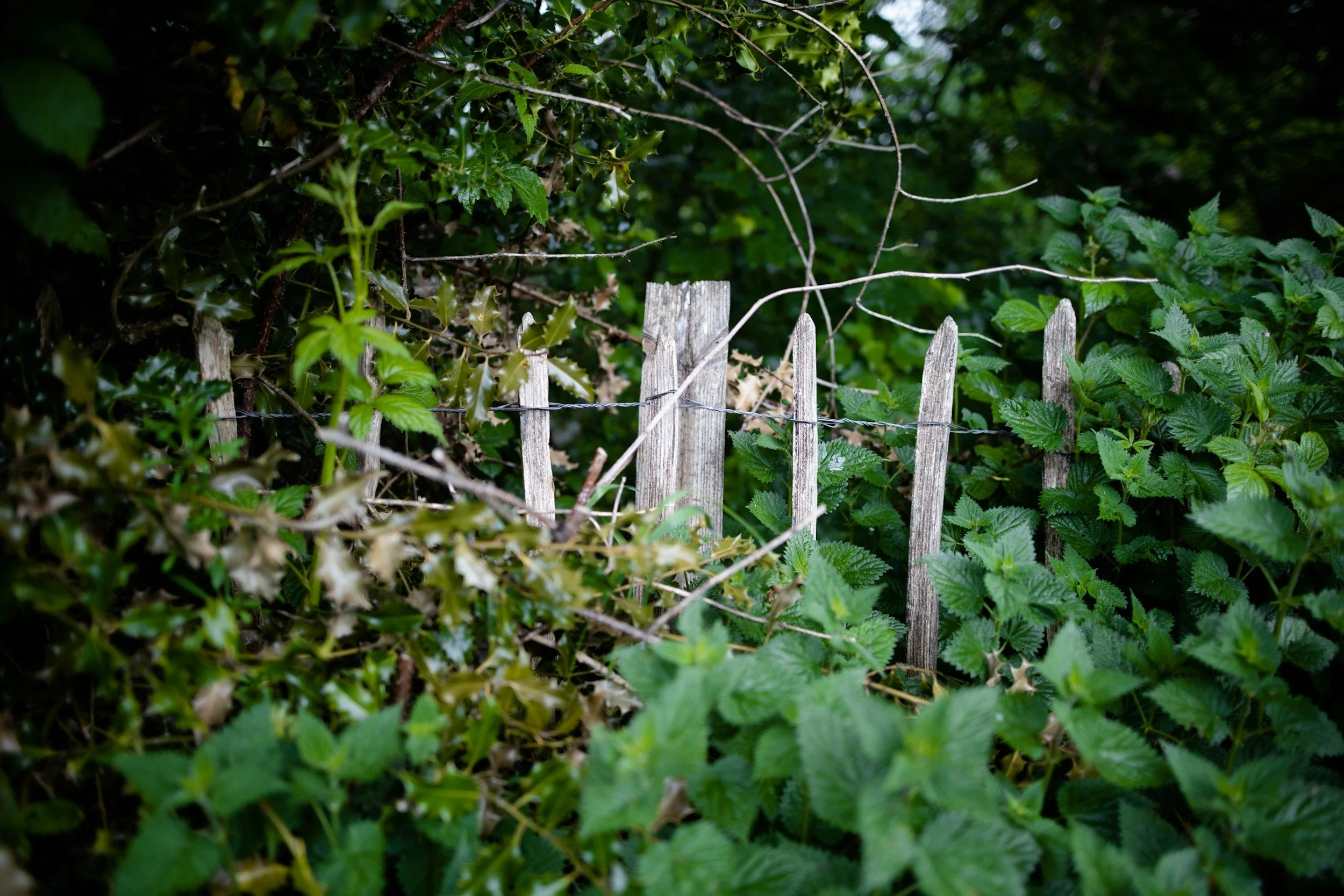
I can think of only
One course of action:
Evisceration
Deep calling to deep
But I am tempted
To catalyse its panels’
Slothful return to nature,
And call down lightning
The Guy Fawkes in me smirks
Camino 3 days on the trail Day 5: Friday 18th July 2025
Camino: Monistrol D’Allier to Saugues
Monistrol D’Allier to Saugues
The forecast was for very high temperatures over 30oC, so, with a steep climb from Monistrol ahead, I elected to depart by 7am before breakfast, and leave Paul to meet his brother, Mark, and friend Barney when they arrive a couple of hours later.

I enjoyed walking in the cool of the early morning, walking mostly in shade, due to the forest lining the steep hill. Walking on my own was fine; my frequent practice at home, a time to collect my thoughts in a different way than in conversation with Paul.
First major stop was with a yellow house (no other houses are painted; all just stone and mortar so it stands out) at the bottom/of an incline, a few yards beyond a standard Camino WC wooden shed. The loo had a pedal which had to be pressed 5 times to operate a conveyor belt to remove all the waste; clever. No running water required.
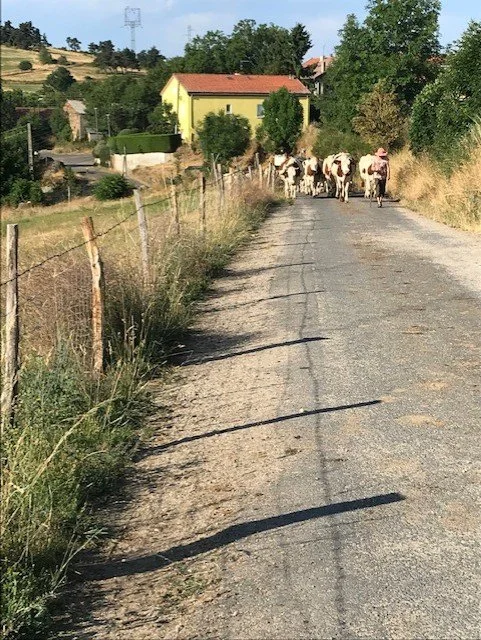
A woman was leading a small herd of cows up the road, so I stood to one side to allow them to saunter past. Two dogs and the farmer on a buggy at the rear made sure there were no stragglers.
It’s 10am now, and the heat is pouring down. Sun cream on. I’m glad I started early. WhatsApp texts tell me that Paul, Mark, and Barney have met and are making good progress up the hill.
I meet the same cheerful Franciscan mob again and end up discovering that they’re being transported by minibus everywhere and only walking short sections…hardly in keeping with the hardy pilgrims of yesteryear! I receive another blessing and a gift of a silver St Francis, and they’re gone, dust flying from the tyres of their minibus on the road to Saugues only 2.6km away.

I reach the hill overlooking Saugues with its array of totem poles…and a roadside shack selling food and drinks. I have a coffee, remove shirt to dry off, and set off down the long, steep hill into Saugues. Reaching the bottom, I realise I’ve left my walking pole at the shack. Nothing for it but to slog back up.
Reaching Saugues, which appears to be a metropolis compared to the rural remoteness of the past three days, I’m aware of people bustling around, barely looking at each other, from shop to shop. Why this unfriendliness? Maybe it’s simply a mathematical function of crowd density; you can’t say ‘Bonjour!’ to everyone, but the absence of smiles is noticeable.
I retreat to the church to cool off.

Eventually, I find fellow Camino walkers tucking into coffees and crepes at a café and join them. A married couple and a female friend. An hour or so later, Paul, Mark, and Barney arrive just as the others are leaving; an efficient handover!
Good to be reunited with Paul and to meet his brother and Barney. We swap tales until I saunter off to buy a postcard and to flop down at the bus stop waiting for the Compostel’ Bus us at 4pm.
I move just a few yards away from the shelter to a bench in the shade with a slight breeze coming up from the road below. It’s significantly cooler. A French Camino walker joins me. He’s at a personal crossroads, using his time on the trail to think through what to do for the best for others, including his wife of three years and their daughter. He’s clearly facing a difficult decision. I have my guesses, but there’s no need to know the details; one recognises a mid-life crisis when one sees it so clearly. I mention Richard Rohr’s Falling Upwards.
This is a typical conversation on the Camino. Scratch the surface and there’s often deeper reasons for becoming a pilgrim…we all carry our own load. He only had two days on the Camino and acknowledged that it wasn’t sufficient, but maybe a useful stepping stone – he’d missed his wedding anniversary to be on the walk.
Behind the scenes, Tim J. has been booking a BlaBla car on my behalf. The transfer from the bus to the BlaBla works seamlessly: the bus arrives in Le Puy at 5.15. I walk to the Ibis, go to loo, freshen up a little, change shirt, collect the smaller rucksack left at the hotel, and walk across to find the BlaBla driver, Sabina, in the railway station with her friend Elidi. Sabina is all smiles, and we are driving away shortly after 5.30.
They’ve been on the Camino for ten days, reaching Conques.
Much conversation in spurts. Sabina is coy about her reason for being on the Camino, limiting her answer to ‘Love’ with a smile. Elidi is, like me, accompanying her friend. It turns out that Elidi is off work due to a frozen shoulder. I swap my story.
The conversation turns theological after a while, and at the end of the journey, I ask Sabrina to place her hand on Elidi’s shoulder whilst I say a quick prayer for healing.
Transfer to Tim, who’s arrived to drive me back to his house and to meet Evelyne.
My Camino adventure is over.
Yes, I would like to do more. Maybe as in the film, The Way, to start at the Pyrenees, but the Two Moors walk may be the next walking challenge, across Dartmoor and Exmoor.

Camino 3 days on the trail Day 2: Thursday 17th July 2025
Day 2 on the Camino: Montbonnet to Monistrol D’Allier
Monbonnet to Monistrol D’Allier
Communal breakfast and away, I think by 9.
What I’m failing to record are the conversations on the road and in the non-Camino hours with Paul and others. They are, of course, wide ranging. Sometimes serious or personal matters, and also trivial, funny, and bizarre. I suspect I’m relaxing into this new way of spending time.
Photos of the beautiful scenery, buildings, philosophical notes in toilets, fellow travellers are recorded.

Leaving the gite we immediately went the wrong way. Doubled back and then missed a turning. We ended up walking along a main road, tempted to do so by red and white bollards. Small red and white signs direct walkers along the Camino. Feeling very silly, realising our error, we walked for a few km on the road before taking a path back to the official Camino path to Monistrol D’Allier.
Next stop was a delightful corner in a village with a boulangerie and a bar. Nice thing about France: you can sit outside with a beer from the bar and eat the food you’ve bought elsewhere. Far better than English etiquette, that prevents such a heinous crime.

Met a happy group of seven or eight young men being led by a Catholic ‘father’ dressed in a long black cassock and a young Franciscan in his brown robes and ropes, who gave us a professional blessing at the chapel high up on a rock at Rochegude.
And on to impressive Monistrol D’Allier. Impressive due to a series of bridges allowing transport and people to cross deep ravines, looking down to a winding river…and a beach dotted with people. Walking across the iron bridge constructed by Eiffel, we arrived at ‘Le Repos du Pelerin’ gite and were shown to our room. Rucksacks are not to be left in rooms, so we unpack the minimum and put rucksacks in an outer hallway, strip down to shorts, and head off to the river for a swim. It’s difficult to convey just how refreshing it is after pouring with sweat mile after mile to immerse oneself in a flowing river and swim. The water is cool; not freezing.

Back to the gite for the evening meal at 7. Six of us who had crossed on the route shared a bottle of wine and endless chatter, sometimes theological – Philip Junior, being a recent convert, challenging the agnosticism of Philip Senior with onlookers making their own contributions. Most comments seem to be about man searching for God. I posed the alternative; that God is searching for us, and it is us that attempt to hide.

As darkness fell, the evening came to a close.