Welcome to my blog...whatever image springs to mind, be it a hippopotamus, Tigger, red-haired Highland cattle, or a simple kitchen table, 'Unless a Seed' is a four-legged creature. My hope is that having read a Book Review, a Poem, or a What is a Christian? or some random post in Everything Else, you will be kind enough to leave a comment or a short reply. And I hope you enjoy reading its contents

What is a Christian?

Book, Podcast, Film, and Blog Reviews

Poetry

For Writers, Writing and Everything Else
Dad-daughter 10K challenge 2024-2025…Post X11 May 11th 2025 Final Post: Bristol 10K
The day has finally arrived - Bristol 10K
The day has finally arrived. The Bristol 10K start was 8.30 a.m. and Rachel, in London, ran an equivalent 10K around Hackney’s Victoria Park at 10.45.
The culmination of our dual efforts to prepare for a 10K in 2025.

All along, the aim was to be a provocation to each other. Maybe a better word, though too mushy, is an ‘encouragement’, especially in the darker and colder wintry months.
Yes, I will report our separate times innabit, but there’s more to running than the Sports watch strapped to your wrist, or, in my case, Strava on mobile, stuffed in pocket.
The Bristol 10K is like a mass gathering of eagles or vultures (take your pick) diving on their prey. More than ten thousand descend on the city centre, streaming from all points of the compass, with running numbers and Zone colours safety pinned to running vests and t-shirts.
Not sure why, but I was placed in the faster Orange Zone, so spent the whole 10K being overtaken by faster runners rather than overtaking. You’ll hear many telling the same story that ‘adrenaline on the day sees you round’ or ‘the atmosphere is so great, you get carried along by the cheering crowds’; I don’t want to douse these descriptions in cold water, but when you’re struggling to keep going after 7K (like me) cheering crowds such thoughts, I found, are pushed to the rear of one’s consciousness!
The weather has been stupefyingly wonderful throughout April and May. Wall to wall sunshine. But that meant, even by 8.30, it was rather warm. Too warm perhaps…but even warmer in Hackney when Daut 3 set off.
Stats
Dad: 59.50
Rachel: 57.08
So, hats off to Rachel! And to her the bragging rights belong!
However, I’m rather chuffed. My three aims (i) run without stopping (ii) under my age (iii) under 60’ if possible.
If you’re thinking I waited under the finishing gantry to just shave the 60’ mark…nope. Anyone watching would have seen a different story etched on my sweaty brow.
My ‘no beer, no bread’ fast is over. A cold Guinness was had upon reaching home
My ‘no beer, no bread’ fast is over. A cold Guinness was had upon reaching home.
Cheers, everybody! I’ve enjoyed seeing how widely spread these bog-posts have been read, and I hope you’ve been entertained and, just maybe, they’ve pushed you to find those old trainers and give a Parkrun a go, or a local 10K…or further.
The final word, though, I will give to Eric Liddell, the athlete who starred in the 1981 film Chariots of Fire – I can only very faintly add my Amens:
‘I believe God made me for a purpose, but He also made me fast! And when I run I feel His pleasure’
MG – The End
Funny what parting with an inanimate ‘thing’ can do to one
My 1997 MG. Sold. 8.20 a.m.
Resplendent in racing green
Apart from the peeling lacquer
And the electrical faults
And the worn tyres. Selling
Took more from me than I
Knew I had
It is not the carburettor
Or the mid-engine warmth
Or its throaty roar
Nor is it the lack of suspension
Or inability to take on fuel
Except at dribble-pace
After all is said and done
It was a chariot of the gods
A carrier of persons
Of a bride, of long friends
Of Sir Gaffa to Calais
It is like us
A material courier
Of immaterial riches
Of inestimable worth
And so the ache
I unexpectedly felt
Is as real as the wind
As truly solid
And impervious
As a sigh
My bank balance of joy
Felt diminished, and yet
In its depletion
There is no emptying
No, our losses leave us
As intact as the equator
Joined to all who lose
“Out! Out! Out!” Anti-Hamas Protests in Gaza bring some hope.
Gaza-Israel conflict…signs of hope?
It is 8am on Thursday morning. I have just returned from a morning walk across fields and footpaths. It was full of beauty and charm, but surprisingly cold, and I’m downing a cup of tea to warm up and have two jumpers on.
During the walk, I listened to Saturday’s edition of BBC Radio 4’s From Our Own Correspondent. The main report was from Gaza and Israel, and it gave me a glimmer of hope that this ghastly and grisly conflict might be drawing to a close.
The report was classic BBC. It told a fundamental truth wrapped up in an editorial attempt to be unbiased. It failed, and thankfully so, because the comparisons between Israel and Gaza proved to be compelling rather than the similarities.

The premise for the programme was to compare and contrast the protests in Israel with those in Gaza. In Israel, mainly in Tel Aviv, street protests against Netanyahu’s military strategy call upon the government to do everything to return the 59 hostages remaining in Gaza. In Gaza, there are now also anti-Hamas protests, demanding Hamas to relinquish their grip on power, shouting “Out! Out! Out!” referring to Hamas not the Israeli Defence Force (IDF) Hamas' iron grip on Gaza is slowly slipping as residents protest - Hamas' iron grip on Gaza is slowly slipping as residents protest - BBC News
The comparison between the protests in Israel and Gaza, however, highlights the truth, that Hamas is a cruel and heartless organisation that is not only responsible for the despicable atrocity on Oct 7th, 2023 murdering unarmed Israeli civilians in a kibbutz and at the Nova music festival, but intimidating its own population, suppressing dissent through imprisonment, torture, and murder. Israel, by contrast, is a democracy and dissent and public protest carries no threat of false imprisonment, torture, or elimination.
Gazan’s, once too afraid to speak against Hamas, are now doing so, so desperate are they to end the suffering brought on their heads by Hamas’s attack and subsequent declaration of intent to repeat such attacks, continuing rocket fire into Israel, resisting the IDF, refusal to return the hostages, and, ultimately, their refusal to lay down their weapons, surrender, and leave.
But now, Gazan’s are rising against Hamas, I might have grown cold on my walk, not having taken a jumper, but my heart and blood, chilled by events in Gaza and Israel, has begun to thaw.
Hamas, as I have written before, should hang their heads in shame and leave Gaza
Hamas, as I have written before, should hang their heads in shame and leave Gaza. Whether or not one believes in the Palestinian cause, their actions on Oct 7th and since then disqualify them from holding power. They must go. And all the hostages must be returned. Iran, which has funded and backed Hamas, is primarily responsible for rebuilding Gaza, but its poisonous anti-Israeli policies preclude it from any political process in Gaza after the war.
The lie undermining the Palestinian cause is that the only way to achieve justice is to oppose Israel, politically and militarily. The bible, however, teaches a different course altogether…and one that takes enormous faith.
To Abraham, God said:
‘I will make you a great nation…I will bless you…and you shall be a blessing, I will bless those who bless you and curse him who curses you’ Genesis 12v1-3
Is Israel perfect? No. Is it a hostile neighbour? Yes, some groups within Israel are like Nabal, Abigail’s husband, a scoundrel, evil and wicked (1Sam 25) and who view the Palestinians as impediments, obstacles in their way to recreate an Israel that mirrors the shouts of pro-Palestinian marchers ‘From the River to the Sea’.
Nevertheless, the word of God slices through all these objections and places a challenge at the door of Palestinians, Tehran, Damascus, London, and Washington: ‘Will you bless Israel or curse Israel?’
In conclusion, my heart was warmed. Some hope again circulating in my body and mind that the present conflict will end. Hamas has to go. But what will replace them? And what spirit will inhabit them? What attitude will they have towards Israel?
On that hinges the future of Palestinian prosperity and Palestinian-Israeli relations for the next generation.
Do they want God’s blessing or Tehran’s?
Romans 12 and the autonomous self
The Word is in, the word is out…
I don’t know how many times I’ve read Paul’s letter to the Romans, but the slightly worn and discoloured edges of its pages in my bible give the game away. And yet I can’t say it’s my ‘favourite’ New Testament book. If pressed, I’d opt for 2 Corinthians, but that’s a subject for another day.
This morning, after I’d slogged round a 10K run, showered, recovered with a cuppa and a bowl of cereal, I sat down at my desk to read Romans chapter 12 – I’ve been reading through the New Testament more or less a chapter a day, and R12 happens to be the next one up.

Morning routine
So I read its familiar verses. And then saw something I hadn’t before. That’s what this short sketch will attempt to explore.
Paul’s route to writing Romans 12 is strangely different from the route the average Westerner in 21st Century has taken before reading Romans 12.
The aim of this post is a little like the spider in the bath. Can we climb out of our own cultural/philosophical bath to have a peek over the rim into Paul’s world…and thereby ‘see’ Romans 12 from a new perspective?
If we accept for the moment that what we perceive as the Universe came about many billions of years ago as a result of the Big Bang, we can equally propose that our Western culture has arisen from a Big Bang of Greek philosophical thinking, upgraded in the Enlightenment via its apostles such as Descartes (1596 – 1650) and Locke (1632 – 1704), and their philosophical offspring or disciples Voltaire (1694 – 1778), and Immanuel Kant (1724 – 1804).
Just as we occupy the space-time continuum after-glow of the Big Bang, so we are we living in the after-glow of the Enlightenment Big Bang…despite the efforts of post-modern deconstruction.
Central tenets of the Enlightenment include Rationalism, Empiricism, the Autonomous self, self-respect, and self-love. Famous quotes may help bridge the gap between these vague assertions and the reality of our daily lives and influences upon our thinking.
Descartes – ‘I think therefore I am’
Locke – ‘Every man has a property in his own person. This, nobody has a right to but himself’
Voltaire – ‘The pursuit of pleasure must be the goal of every rational person’
Kant – ‘Enlightenment is man's leaving his self-caused immaturity. Immaturity is the incapacity to use one's intelligence without the guidance of another. Such immaturity is self-caused if it is not caused by lack of intelligence, but by lack of determination and courage to use one's intelligence without being guided by another. Sapere Aude! Have the courage to use your own intelligence! is therefore the motto of the enlightenment’
From this era came the French Revolution (‘Liberté, égalité, fraternité ) and the War of Independence resulting in the creation of the United States whose tagline in the Declaration of Independence: ‘We hold these truths to be self-evident, that all men are created equal, that they are endowed by their Creator with certain unalienable Rights, that among these are Life, Liberty and the pursuit of Happiness’. The difference between the France that emerged from the Revolution was largely atheistic but tolerant of Catholic and Protestant Christianity, America was a Christian nation but tolerant towards other faiths and none. Nevertheless, all Western nations have been moulded by the creeds proposed in the Enlightenment, its light falling full square on individual liberty and individual autonomy.
‘No man is an island entire of itself; every man is a piece of the continent, a part of the main…any man’s death diminishes me, because I am involved in mankind’
We are fooling ourselves if we believe we have arrived in 2025 without the past three or four centuries of philosophical thought influencing what we take for granted. Or worse, we think this generation has not been derived from the past.
St Paul, in the First Century, knew nothing about Rationalism or Empiricism, and the ideas of an independent self were as alien to him as they are to the most basic biblical world-views.
For Paul, the existence of an independent self is an illusion, and to pursue such an aim is to court trouble in the form of anxiety, anguish, and mental health as we end up fighting against our true nature…which is not to be independent. John Donne, the poet and priest, was a critic of the Enlightenment’s more extreme exponents: ‘No man is an island entire of itself; every man is a piece of the continent, a part of the main…any man’s death diminishes me, because I am involved in mankind.’
If Donne could see that we are involved in mankind, St Paul goes further and asks a more searching question; a question that makes no sense to us, so imbued are we with rational thought and the cult of the individual. The question St Paul asks is ‘Who are you in?’
And Paul is not alone. Jesus also.
It takes some mental re-engineering to even understand what being ‘in’ someone means. If we want to be generous towards the Enlightenment, we can certainly say it represented an improvement over the forms of authority that had become authoritarian by nature. Concepts such as the divine right of kings, absolute monarchy, papacy, aristocracy, and superstition were overturned and replaced by empirical data and observation as the basis of knowledge, and the exaltation of faith in reason over faith in God.
‘I am in the Father, and the Father in Me’ John 14v11
‘I am the vine and you are the branches. He who abides in Me and I in him, bears much fruit’ John 15v5
‘I do not pray for these alone, but also for those that will believe in Me through their word…that they may be one just as We are one: I in them and You in Me’ John 17v20f
‘It is because of God that you are in Christ Jesus…’ 1 Cor 1v30
‘As in Adam all die, so in Christ all are made alive’ 1 Cor 15v22
‘…our fathers were…all baptised into Moses in the cloud and he sea’ 1 Cor 10v1,2
‘…baptised into Christ Jesus…’ Rom 6v3
The human body is made up of trillions upon trillions of individual cells, each of whom are entirely unique, having their own function and contribution to the body. Imagine interviewing one cell and asking, ‘Are you alive?’ The answer would be a definite ‘Yes’. Ask, Whose life are you alive with?’, and despite their unique individual contribution to the body, the true answer is the name of the person in whom they live. So all the cells in my body are alive, not with their own life but with mine. And my life is a composite of all the life in each of my cells. Every cell in me is in John Stevens and John Stevens is in every cell.
So, when we say we are ‘in Christ’ it means that we are (a) not living an independent life (b) our life is the life of Christ (c) we are living in a community with others (d) therefore we share and participate in the history of the person in whom we are ‘in’.
This explains why Paul can say ‘I was crucified with Christ, it is no longer I who live but Christ lives in me, the life I now live in the flesh I live by the faith of the Son of God who loved me and gave himself for me’ Gal 2v20
To Romans 12.
This morning the familiar words of Romans 12 were as they had always been, but it struck me with fresh force that this chapter is both autobiographical and entirely as a result of the transformation that occurred in and through Paul by being placed in Christ.
True doctrine cannot be separated from the person in whom the source of the doctrine has taken root i.e. Christ himself.
Listen to the drama in Paul’s words:
‘Bless those who persecute you; bless and do not curse’ v 14
I can only imagine the emotion Paul experienced as he felt compelled by the Spirit of Christ to write those words; apostolic words from the great persecutor of the church. And maybe, when the risen Jesus confronted Saul of Tarsus on the road to Damascus and said ‘you are kicking against the goads’ the goads that pierced Paul over and over again were the verbal or material blessings he received from those Christians he cruelly dragged off to prison or worse, were killed at his command.
‘If your enemy is hungry feed him, if he is thirsty give him a drink for in so doing you will heap coals of fire on his head’ v 20
This was Paul’s experience in his pre-Christian days as the persecutor and his experience as a persecuted apostle of Christ, sharing in His sufferings.
‘Do not be overcome by evil, but overcome evil with good’ v 21
If one verse sums up Paul’s autobiography it is this.
To use the current vogue, Romans 12 is Paul’s ‘lived experience’ rather than a cobbled-together list of theoretical statements.
The point, though, of Romans 12 is that all believers, Jews or Gentiles, are in their own after-glow from the Big Bang of conversion to Christ, or, as the bible puts it, being placed ‘in Christ’.
To conclude, there is no autonomous self. It’s an illusion. We are either ‘in Adam’ and still hooked up to the liar in the long grass, saturated in an Enlightenment deception, and trying to achieve something that will wear us ragged, or, through the love of God in Christ, we can be reconnected with God, who places us in Christ, and begin to live His life, as characterised by Paul’s revolutionary statements in Romans 12.
Book Review: Joe Marler – Loose Head Confessions of an (Un)professional rugby player, Joe Marler Penguin – 2020
A must read…a moving and hilarious account of one of England’s best
‘One day a coach said about my mood swings, ‘Joe you have the capacity to do good or evil.’ Hi jinks and positivity one moment – making teammates laugh, raising the energy in the room…then crash…miserable as sin, sniping and lashing out. But it wasn’t the old red mist. It was more like black mist. Gloom, despondency. I had no idea where it had come from.’
The Guardian Review comment ‘Very Funny’ printed on the front cover, is, of course, the truth, but not the whole truth and nothing but the truth. Not by a long chalk.
Joe Marler – Loose Head is an autobiography of a great Lions and England and beloved Quins rugby player up until 2020. If he writes a follow-up dealing with the 2020-2025 years before his retirement from Quins, put me down on the wait-list.
I should declare some self-interest. I’m a Quins fan…but have arrived to that calling very late in the day. That story for another day.

I was – and this is slightly embarrassing - loose head prop for Simon Langton Boys’ School 1975/1976 and played appalling poor rugby in the backs for Canterbury Vths and VIths the following year. I was 5’9” and 10st10lbs. An immense threat to…no-one. My short rugby career came to a shuddering halt during trials for Exeter University when I made the terrible mistake of running with the ball…I became the ball…the air squeezed out of my lungs caught between opposition forwards and my lot, all twice my size and strength. I lasted about 10 minutes and left knowing what I should have known all along…I should have been scrum-half…or stuck with golf, or chess.
OK, so, to the book.
Joe Marler has lit up the rugby scene with his outrageous haircuts, cheeky persona on the pitch, and terrible red-mist moments. He has played in one of the most bruising positions in world sport at the highest level representing England in the 2019 World Cup Final and momentous victories with the Lions.
But the absolute joy of this book is its courageous and often, very funny, honesty. It’s not been plain sailing for Joe Marler, the hard man, often bawling his eyes out as he deals with Joe Marler the human being.
Joe Marler – Loose Head takes you behind the scenes into the locker room, dubious initiation ceremonies, alcohol-induced craziness, sharing rooms and lives on tour, naked wrestling with Johnny May, his relationship with Eddy Jones, desperate depression, occasional violence, a marriage to Daisy that very nearly imploded, recovery, and advocate for CALM (Campaign Against Living Miserably).
Along the way, your swear word lexicon will be given a work-out and I wouldn’t be surprised if you find the tears falling, but you will also laugh out loud - more than weep, and – Oh Dear! – you will reminisce about your own changing room past, Ralgex spray, the smell of the soil of the pitch, the crunch of battle, and all things rugby - and start searching for your long unused and mould-infused rugby boots.
I thoroughly enjoyed reading Joe Marler – Loose Head. Instead of reading, It felt as if the man himself was talking to you, a natural flowing style, but that didn’t diminish the book’s punch, but enabled Marler to articulate all the above – as Joe Marler not as a ***** biographer who knows ******** about rugby, not to quote him, but you get the drift.
Final comment: there is a great collection of b&w photos in the middle of the book that spans Marler’s life from under 5s to 2020.
A must read.
Dad-daughter 10K challenge 2024-2025… Post X1 May 4th 7 days until Bristol 10K 11th May 2025
Mind games…mind and body communication…good and bad
Today my mind is elsewhere. Daughter 2, not Rachel, is getting married and I need to be in the right place at the right time later this morning, all suited and booted.
Nevertheless, with a week to go until the Bristol 10K, I can file perhaps my final Dad-daughter post until the post-10K report next Sunday.

I have no Rachel data to share, but did meet up with her and the rest of the family involved in the rehearsal yesterday and can report that she looks far more athletic than I.
‘Perception is reality’ is one of those phrases that out there that the unthinking nodding masses who delight in traversing life without stopping to ponder…Oh Dear! Grumpy old man speech underway, beware. Of course, there is some truth in such a statement; ‘mind games’ in sport is big business even if wrapped up in more professional speak as ‘Sports Psychology’.
On a very amateur level, we all know how true this is. Even the bible says in a note of reality ‘as a man thinks so he is’.
For me, the last week is a case in point. Whether I have been hiding a distracting set of emotions in the build-up to daut 2’s wedding or not, I don’t know, but what I do know is that I haven’t managed to complete a mid-week run, pulling up from a 10K after 6K and after 4K in a 5K run.
And yesterday, after halfway round the Parkrun, my mind and body were presenting every good reason under the sun why I should stop and slope off home.
Fortunately another voice prevailed which went something like ‘In a week, you’ll be running a 10K…you can’t cave in after a measly 2.5K…get a move on’. Maybe it was Mr Tutt, my old sergeant-major school PE teacher, back from the dead, but it worked…I did make it to the end.
Perception is reality - is it?
I was sure it was an embarrassingly slow time considering I have the 10K next week…but to my delight it was better than feared at 28:26….AND I’d like you to know, I was 1st in my age category! There were 6 of us stumbling round old enough to know better.
So…is perception reality? I thought I’d run out of gas. I also thought I was running slower than 30’ for 5K.
All one can really conclude, is that I’m loosing my grip on reality…but then a proud dad about to give away his daughter is surely entitled to some inner-entropy!
The Stones Cry Out
First swim of the year…so so cold…so invigorating
It’s early May
Apples are the size
Of a small toenail
And Beer beach
In the baking hot sun
Beckons the unwary
Into its bone-cold water
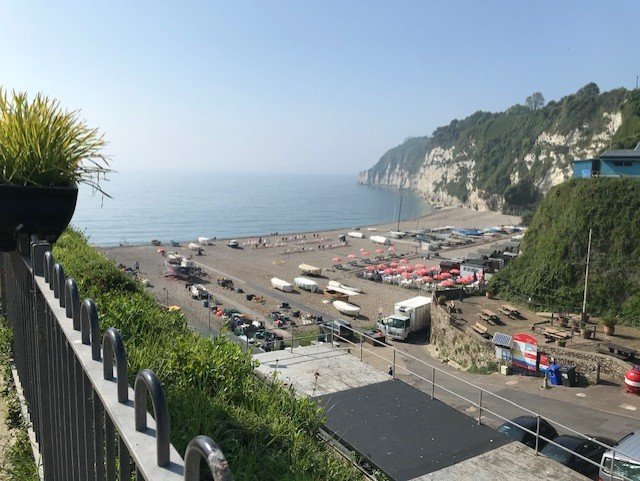
Beer Beach
Three boys, liberated
From their school desks
Two on a paddle board
Just out of reach from
The pebble-launching third
Summer heat making sense
Of male madness
Older ladies,
Impervious to the cold
Slipping in and out of the
Incoming tide
Perhaps unlike mermaids
And yet…
Perception is so deceiving
We’re butterflies on an oak
Raindrops on a hotplate
Temporary distillations
Imprinted on priestly stones
Hearing our confessions
Seemingly unmoved
Their tears fall as autumn rain
Can Opener
Splodgy fountain pens, blunt sharpeners, rusty can openers…but when you find The One…
Like other domestica:
Ink-filled pens
Sharpeners, staplers,
And can openers
You can travel for years
Before you meet The One
Then, in a moment,
The metal lid yields
A smooth easy incision
And what was beneath
Is open to the blue sky

A blade, disguised
As a music chord
A Monet, a mime, a
Dancer’s move,
A line in a love song
And I’m sliced open
Spilling the light
You’ve been packing
Inside
Little did I know, I am
A suitcase for the Almighty
On His travels
Until he finds you
The Pope’s funeral…Conclave…and Saints Saints? Who are you?
The Pope, Conclave, and Saints…let’s get topical
With the Vatican and her cardinals in full dress for the Pope Francis’s funeral and the Conclave, the world watches on, waiting for the white smoke announcing that there is a ‘winner’ and the Roman Catholic cardinals have elected a new pope.

We are about to be re-educated with Catholic terminology, ecclesiastical ranks, historical traditions…but essentially, the Cardinals are locked away (Conclave means ‘with’ a ‘key’) and someone has been given a Chemistry kit comprising of potassium chlorate, lactose, and chloroform resin to produces the white smoke when ignited.
(The recent film, Conclave, is an excellent re-enactment of the previous conclave resulting in the election of Pope Francis. Well worth a watch. Perhaps an even better film on Roman Catholic popery is The Two Popes).
One of the features of the Roman Catholic church is not only how it elects popes but who exactly qualifies to be canonized as a Saint.
Some facts:
• Only 83 of the 266 Popes have been canonized as saints
• The first 35 Popes were all canonized as saints
• During Pope Francis’s reign, he recognised 942 saints including the 813 Martyrs of Otranto
Roman Catholic doctrine regarding saints:
Catholics believe in the ‘communion of saints’ and that extends to those believers who have died as baptised members of the church. In other words the church - according to Roman Catholics - comprises of all who have been baptised, usually as infants, currently alive or have already died.
From among general ‘saints’, the Catholic church recognises that some have shown remarkable holiness or have miracles ascribed to them and are ‘venerated’ as Saints…not to be worshipped but neither simply as good examples to follow. These Saints are believed to be interceding in heaven for the church – the ‘communion of saints’ being more like a dual carriageway of communication than worship.
…the essence of the New Covenant/New Testament is the tearing down of all barriers between God and man…
What does the New Testament say about saints.
1. All believers are addressed as ‘saints’ e.g. Romans 1v 7 ‘To all who are in Rome, beloved of God, called saints’ 1 Cor 1 v 2 ‘to the church of God, to those sanctified in Christ Jesus, called saints’ 2 Cor 1v1 ‘to all the saints who are in Achaia’ Eph ‘to the saints who are in Ephesus’ Philip 1 v 1 ‘to all the saints in Christ Jesus who are in Philippi’ Col 1 v 2 ‘To the saints…in Christ…in Colossae
2. The Greek word ‘hagios’ translated ‘saints’ is the word used for ‘holy’ or ‘holiness’ and literally means ‘set apart’. God is holy. He is ‘other’. He is not a man. It includes moral purity, of course, truth and goodness, true righteousness.
3. Believers are therefore called ‘saints’ because they are ‘in Christ Jesus’ who is holy…not due to any innate holiness or goodness they may possess
4. Baptism in water does not baptise us into Christ. The phrase ‘baptised into Christ Jesus’ e.g. Romans 6 v 3 is a description of what happens when someone becomes a believer. In 1 Cor 1 v 30 we read ‘…of Him are you in Christ Jesus’. In other words, it is God who baptises us into Christ Jesus, it is an invisible, spiritual union that has occurred. Baptists and Catholics, and all between these extremes, need to come to terms with the fact that in Romans 6 there is no mention of water!
Is it right to venerate some saints as Saints with a capital S?
What Catholics (and Orthodox churches) do ceremonially, Protestants do by reputation, without the label Saint or St.
The danger of veneration is to deflect our direct communion with God through Christ by the Spirit towards communing with the saints in heaven and placing intermediaries in between ourselves as believers and God Himself whereas the essence of the New Covenant/New Testament is the tearing down of all barriers between God and man so that we are restored to direct communion with God, thereby rendering any intermediaries as unnecessary.
The danger of refusing labels is unreality. The truth is that many Protestants recognise some believers have led incredible Christian lives and, depending on one’s line up of heroes of the faith, we are all cheered on by ‘such a cloud of witnesses’ Heb 12v1.

Here’s some of mine: the Wesley brothers and George Whitfield, Hudson Taylor, CT Studd, George Muller, Rees Howells, Richard Wurmbrandt, Bonhoeffer, Watchman Nee, Brother Andrew, John Wimber, Colin Urquhart, and many others.
Nevertheless, the New Testament makes no distinction between ‘saints’, and it expressly teaches that through Christ’s death, resurrection, and ascension, we have been restored to direct communion with God; no intermediaries are required.
To answer the question – Saints? Who are you?
If you believe that Jesus rose from the dead and have committed yourself to Him, God has baptised you into Christ Jesus.
If that’s genuinely true, you need to be baptised in water to signify to the Lord and the world what God has done for you: that He has baptised you into Christ and thereby declared you as holy, as set apart for God, as a ‘saint’ in whatever village, town, or city that you live in.
And you need to be baptised in the Spirit – Jesus is the baptiser in the Spirit - so that, from now on, you are learning to trust in His life, His holiness to run like a river through you, bringing life wherever it flows, in you and through you to the world.
Final Comments
Roman Catholics believe that present day popes are in a direct line of apostolic succession dating back to St Peter – hence St Peter’s Basilica in Rome.
Whether you believe that or not, what has been recorded in Acts Chapter 2 is the first sermon after the resurrection, by St Peter, in Jerusalem as the Jews gathered for the Feast of Pentecost.
After he had preached about the resurrection of Jesus the crowd, ‘cut to the heart’, asked what they should do. Peter’s reply was:
‘Repent, and let every one of you be baptized on the Name of Jesus the Messiah (Christ), for the forgiveness of sins, and you shall receive the gift of the Holy Spirit’ v 38
The message is the same to day as it was on the Day of Pentecost.
Missing the Changing Room? `
Do I miss the changing room, the locker room? Some thoughts.
Hot feet leaving their memory
Sweated on the cool tiles
White towels discarded
Steam from the showers
Percolating through
To where silence
And speech own the floor

It is here that boys become men
The place of the pubescent
Two-finger cough
To check something unknown
Of early pubes and armpit odour
Voices cracking, showers
Avoided in the uncertainty
Pre-match rituals
Are conceived here
One hangs his knotted tie
On the lower hook
Another sits, unfocussed
As hopes and fears
Take him, like a dream
Older now, the Ralgex owner
Takes his position
Gumshield in
The huddle, the shout
Louder than the opponents
The knee drives
The clatter of hooves on the floor
Finally, the locker room
Can relax, for nigh on an hour
‘Til the animated, injured
Swearing horde
Returns, jubilant or jaded
Weary, but rejuvenated
With a joke or a fierce captain
Finally, the survivors
Of the second-half return
To the steam, to the undressing
To the exaggerated stories
To the towels, the crisp shirt
To the bar, with a black eye
And blooded manhood

Dad-daughter 10K challenge 2024-2025…Post X 21st April 2 weeks + 6 days until Bristol 10K, 11th May, 2025
Getting ever closer…training has been stepped up…has it worked?
Since my last report, in which I seem to remember committing to run 10Ks every other day, nine days have passed.
The purpose of this post, therefore, is to maintain personal motivation through public accountability and possible humiliation.
Thus far:
Strawberry Line (South)15th April 10.06 km in 57:22
Strawberry Line (North) 17th April 10.02 km in 62:15
Strawberry Line (North) 20th April 9.02km in 54:04
A commentary
Yes, you needn’t say anything. Again, I’m getting worse the more I plod/run…’training’ is an exaggeration. But hang on, the truth is stranger than the data.
Run 1. After about 3K Strava is sent into the nether world of the Shute Shelve tunnel, and at pre-dawn, it is ink-black and I’m reduced to walking for fear of tripping over and making more of a fool of myself than running through a pitch-black tunnel in the first place. SO…the 57 minutes is as accurate as counting the number of humpback whales in the Atlantic, or predicting the length of a Premiership football match after VAR officials have read through the FA Handbook on handball…

Run 2. Strava is clever. This was ‘moving time’. I stopped, or was stopped, arrested by a tree here and a gate there gorgeously painted by the soft-dawn rays. Photos followed. Actual time was longer. But I’m unlikely to stop to take photos during the Bristol 10K. Am I?
Run 3. Was going well, or so I thought. But I conked out at 9K, having felt weary for the previous one or two kilometres.
‘If I was a betting man’ - I’m restricted to the Grand National and The Masters in some years, and rarely win a penny - I’d think twice before betting on myself to break 60 minutes, but I’ll give it a go.
The Bristol Course looks mean. That ‘orrible hill near the end and city-centre cobbles are designed to inject despondency and despair as the clock speeds up and the feet slow. Maybe that’s all in the mind? Well, maybe. But it’s in my mind.
Rachel…has gone to ground. Her previous recorded 5K at 26:44 equates to approx. 10K pace of 53:30 is far too fast, and my fears that she has peaked too soon…are impossible to verify. The latest press release from the R Training Camp is that her 2025 10K event will not be the Bristol…we await news.
The theory that Dad’s ‘every-other-day’ commitment to running 10Ks has rattled the young pretender is definitely worthy of further investigation.
For now, all I shall do is continue to plod up and down the Strawberry Line in hope that mind and body might talk to each other and cheer each other on.
Podcasts have included: Elizabeth Day’s How to Fail with Sally Philips was excellent…funny and honest. David Pawson’s Unlocking the Bible on John’s gospel was really good. And I quite like listening to Alistair Campbell and Rory Stewart as they squirm in the Trump era on The Rest is Politics.
Two weeks and six days.
Oh boy!
Easter Saturday
Easter Saturday - the quiet day…not much to say?
My early morning routine hasn’t varied a great deal for decades. It is far from remarkable but serves to get body, soul, and spirit unclogged from the inactivity of the night.
It is as follows: wake up with or without alarm, bathroom, exercises, kettle on, Radio 4, tea bag in cup, make cup of tea, pour cereal into bowl, add milk to tea and cereal, and retire to my study, write yesterday’s events and reflections in a journal, open bible and read a chapter, pray, finish breakfast, and attack whatever is top of the TTD list.
And every other day, an early morning run is inserted between exercises and kettle on.
Today it all went off-piste.
I woke up at 4 but thought it was 5. Five o’clock would have been ideal. The intention was to sneak in a 10K and pick up the rest of the routine before getting into the day, getting the house ready for an invasion of daughters and grandchildren. Poked head outside to find it was ridiculously dark, cold, and wet. Realised it was 4 not 5. Decided to postpone run by an hour. Listening to a podcast, I lay down on the settee…and woke up at 7am, too late for the run.

Grumpily, I picked up rest of the routine.
And read Isaiah 61.
Jesus quoted Isaiah 61 at the start of his ministry, having returned from the wilderness temptations and encounter with the devil in the power of the Holy Spirit.
‘The Spirit of the Lord God is upon me’, He quoted to his home town synagogue congregation in Nazareth, ‘because the Lord has anointed me to preach good news to the poor. He has sent Me to heal the broken-hearted. To proclaim liberty to the captives, the recovery of sight to the blind, and the opening of the prison to those who are bound.’
It is a prelude to and an explanation of the remarkable miracles of healing and deliverance that accompanied Jesus’ ministry, often to the poorest in Israel’s society.
What struck me today, Easter Saturday, was the contrast between the heady days of large crowds and astounding miracles, and the solitary body of Jesus lying in the grave, alone, the crowds having departed, and the disciples abandoning him through fear of the Romans.
We remember Easter Friday, Christ’s arrest, interrogation the night before, the crucifixion, and burial and we celebrate Easter Day, Sunday, to mark the resurrection, the stone rolled away, the appearance of Jesus to Mary Magdalene, the other women, and then Peter and John and the disciples, the two disciples on the road to Emmaus, and doubting Thomas. Death defeated, Jesus stands amongst them and says ‘Peace’ and eats fish. He is not a ghost, the disciples fearing their own insanity are not imagining the resurrection; he eats fish and struggles with the bones.
But Easter Saturday?
This morning, when I thought about Easter Saturday, my initial thought was of darkness. The sealed tomb, of course, would have been dark, and if not stone cold, then far from warm. A few years ago, I stooped into the tomb in Jerusalem that fits the description and location of Jesus’ burial site. It was a blisteringly hot day, but cool in the tomb.
Dark, and still. The suffering of the cross, at last, was over. It seems there is nothing to say. An inert, deafening silence characterises Easter Saturday.
The disciples, maybe 120 men and women, are in shock, hiding in various locations in Jerusalem, unsure about what to do. It’s the Sabbath, of course, so inactivity deepens as the hours pass. Waves of grief, confusion, and fear, percolate through the minds and bodies of those whose hope had been shattered. Only days before, Jesus had ridden into Jerusalem with the crowds singing ‘Hosannah! The king of Israel’.
He is not a ghost, the disciples fearing their own insanity are not imagining the resurrection; he eats fish and struggles with the bones
As I sat here, with my cup of tea and cereal, reading Isaiah 61 and musing on the contrast between the crowds and a single body alone in a grave, a clue emerged in the final verses of the chapter like a doorway into the divine wisdom. A glimpse of light in the grim reality of the crucifixion and death of an innocent Man.
Like an overstuffed suitcase, Isaiah 61 is crammed with good news. The poor, the broken-hearted, the blind, the trapped…all are blessed individually and the whole nation of Israel is being repaired…imagine that…’they shall repair the ruined cities’ v4. And it seemed as if everything was on track for national renewal, but just at the last moment, the anticipated Isaiah fulfilment seemed to fall apart and go into reverse. One moment Jesus is riding into Jerusalem, the crowds proclaiming Him as the King of Israel - the clash between Jesus and the authorities had long been brewing - but the authorities suddenly get the upper hand, and the dream was dismantled and crushed.
But did they?
The clue is in the final verse:
‘For, as the earth brings forth its bud. As the garden causes the things sown in it to spring forth, so the Lord God will cause righteousness and praise to spring forth before all the nations’
So, the question is ‘how does a garden cause the things sown to spring forth?’ And the answer is simple. It is in the word ‘sown’. A seed falls into the ground.
Now Jesus’ parable makes sense:
‘The hour has come that the Son of Man should be glorified. Truly I say to you, unless a grain of wheat, a seed, falls into the ground and dies, it remains alone; but if it dies, it produces much fruit’ John 12 v 23,24
The route to the glory, to the fruitfulness, to the national repair, was not to be Jesus the King of Israel triumphing over Herod, and then Rome, but as a seed, to die…the divine secret revealed all around us in every garden, orchard, vineyard, allotment, veg patch, flowerpot, if we have eyes to see.
It’s a different way to run a kingdom
Easter Saturday. Jesus, dead and buried, not only to be raised as one individual, but just as one apple pip can germinate to create a whole tree, a tree that produces many thousands of apples containing similar pips, or seeds, every year, so Jesus’s death would lead to many thousands, millions in fact, of similar seeds…the life of each believer.
This is true Christianity. This is the Easter hope. Not just that ‘death is not the end’. Not just that the resurrection of Christ is a historical fact, or that Jesus ate fish, but that Jesus is being reproduced in us if we have faith to believe what He has done for us and we abandon our futile attempts to be good…or evil.
To finish.
It’s been a while since I sowed any seeds. The next time I do, I will remember Easter Saturday, and how the whole world is being populated by fruit from one seed. It’s a different way to run a kingdom.

The 5 states of consciousness…in one University lecture
Yes. It is. In case you were asking. Historically accurate.
Lecture Hall 2 at 5.15: d-d transitions: Complex Ions Lecturer: KK
It started Oh! So well
Chirpy and animated
Like a chimpanzee on heat
Crisp, narrow-lined A4 note pad
Primed, a new page,
Date written, pen poised
Front row

Thirty minutes in and
Handwriting is punctuated
And decorated with
Unlikely doodles, the margin
A play area for eyes in boxes
Looking back at me
Words on copper complexes
Missed
A stifled jaw-breaking
Face-contorting yawn hidden,
One hopes, from the lecturer,
A mere chalk-throwing distance away
I have dropped my pen, twice
Head propped in the palm
Of my left hand
My recording continues
Never deviating from the voice
All is well, except my eyes closed
Five minutes ago
My copious notes; a diagonal line,
Like an erratic urination
Falling, bottom right

Waking in an in-between state
Blissful in one
Embarrassed in the other
My heavy head collapsing
Into two worlds
I am surely, am I not
Schrödinger’s cat?
How to Eat a Hot Cross Bun
Hot Cross Bun season - there are rules!
You might contend, with deep conviction, that there is no manual, no dictate, no regulation, or statute that exists to distinguish between those who know how and those who do not know how to eat a hot cross bun.
But, if you are one of those who know how, then you are compelled by an equally deep conviction to share your knowledge gleaned from those who have gone before with those who do not.

This distinction is on a par with those whose toes curl if milk is added after the tea is poured or are troubled by fellow travellers who care not to use a fork when with cake, or who’s inner peace is disturbed if male MPs enter the chamber unadorned with a jacket, or worse, lacking a tie.
Here are the twelve members of the Hot Cross Bun jury:
1. Eat only hot when still springy – they are not fit for use as shot putts or cannonballs
2. Employ your best blade to slice each bun accurately into two halves – ensuring that both sides are toasted at the same rate. Incongruency is disappointing
3. Discard the grill in favour of a toaster – the horror of uneven, burnt, or worse, an underdone hot cross bun is more avoidable with using a toaster
4. Toasted hot cross buns are to be caught mid-air as they are propelled vertically, perfectly toasted, from the toaster
5. Butter always; other spreads are banished and not even to be mentioned
6. Generosity is compulsory, especially in the butter department. The added slab of butter has to be thick enough so you can watch it melt. Thin-spread instantly-melted butter is not a thing of beauty
7. No talking. If you are in the company of others, they must abide by this rule. Eating whilst eyes are closed is worthy of bonus points
8. Jam is contentious. Applications to use jam should be lodged with the master or mistress of ceremonies well in in advance of entry into the toaster

9. Never repair the hot cross bun so that it resembles a bun. This is a strictly ‘two-halves’ ritual
10. The final bite should be savoured whilst there is sufficient heat in the bun to keep the butter melted
11. The purpose of eating a hot cross bun is to enter into prayer, meditation, peace and stillness. By all means sit in a church pew and do likewise, but once you have permitted yourself hot-cross-bun-time, church can travel with you
12. Hot cross buns only taste of hot cross buns in the run up to Easter. If you don’t know why, there are no words
If you are looking at the members of the jury, wondering whether the judge will take a majority vote, please be advised that eleven out of twelve simply will not allow you to graduate from the do not know hows to the know hows.
Standards must be maintained.
The 2026 examination season starts, as in previous years, on Ash Wednesday, the day after Shrove Tuesday, otherwise known as Pancake Day. ‘How to Eat a Pancake’ will follow shortly
Dad-daughter 10K challenge 2024-2025…Post IX 12th April 29 Days until Bristol 10K, 11th May, 2025
29 days to go before the Bristol 10K…Dad-daughter run Parkruns. R in London, Dad in Axminster/Cheddar
New home tucked under the picturesque Mendips called for a Google search to locate the nearest Saturday morning Parkrun.
I arrived at Axminster/Cheddar reservoir car park whilst there was still a nip in the air, wearing a woolly hat, soon discarded as the sun did its work. The route, fairly flat, winds its way around the reservoir then diverts along the Starwberry Line – the track of a disused railway line. Twice round, and then a short run across a playing field to the finish.
Trying not to look as exhausted as I feel. Lungs busting. My head tells me the scenery is unbeatable but the perpetual attempt to run at my limit tends to concentrate the mind on the next step, rather than appreciating the natural beauty al around the course.

I did pray. And it was fairly corny. ‘They that wait on the Lord shall renew their strength…will run and not be weary’ from Isaiah.
Meanwhile, in London, unbeknownst to me, daughter Rachel was hearing the starting claxon at exactly the same time, 9am, and propelling herself around another Parkrun, Victoria Park, Hackney.
There the similarity ends.
My time: 28:33
Rachel’s: 26:44
So, again, it’s well-done R. An impressive time!
With 29 days to go before the Bristol10K, what should be done? My intention is to shift gears in terms of distance, if not pace, from 5K to 10K two or three times a week. We’ll see.
Encouragement in life is as necessary as turkeys at Christmas. But where do we get encouragement from? It’s all a bit slippery, can’t be timetabled, and it’s not something that can be tamed…but neither is it completely random as if it’s just out of reach and subject to the whims of a capricious Universe or mischievous divine hand.
So, I take encouragement from looking back at my previous three 5K runs and the moderate improvement in times from almost 30’ to 28’30’’ ish - not a trend that should concern R…but I’m pushing!
I haven’t mentioned podcasts in recent posts. And neither can I today. Strava on knocked out my phone’s ambidextrous capabilities: it can’t handle Strava and YouTube videos at the same time. I had planned to listen to Jordan Peterson’s ARC conference speech whilst making my way round the course; doing so would have masked my wheezing at least from me! Alas, I had to wait until the car journey home for JP to let rip in my lug ‘ole.
Encouragement in life is as necessary as turkeys at Christmas. But where do we get encouragement from?
For me, JP is like a skilled physician; he’s taken the pulse of American and Western society and discerned its ills, its malfunctions, and, like a good professional, gives solemn warnings about the inevitable destination of the Western world if it continues to ignore the warnings. He can stare into your soul from the platform and deliver the direst of prognoses and leave you hungry for a cure.
But here is precisely the moment when I depart from JP. Good on diagnosis/prognosis, but I’m off for a second opinion…not about the diagnosis but the cure. The route back to health.
Enough, enough! This is a blog about running and the co-aim of a daughter and a dad to run a 10K in 2025.
But that’s the trouble with runners, especially slower runners like me, it gives you time to think…and when the legs are sending a message to the brain to Stop, to pray.
Dad-daughter 10K challenge 2024-2025…Post VIII 7th April 34 Days until Bristol 10K, 11th May, 2025
34 Days to go…yikes!
Yikes, Bristol 10K is closing in fast.
Since the last post, I have moved house, and this has seriously set back my plans to reach peak performance as we head into the closing stages. Or…maybe this is good. the peak, re-set for the day of the 10K?
If you’re sensing one of those ‘Oh! I seem to be getting slower not faster’ posts, you’d not be wrong.
This morning, just before sunrise, I set off for a swift 5K along the Strawberry Line from Winscombe north towards Yatton, the sun rising to my right. In the pre-dawn light, an illusion of speed took hold. I thought I was going well, especially after a lay-off to grapple with endless cardboard boxes and awkward furniture.

But Strava doesn’t lie.
5K in 29’56”
Meanwhile, daughter Rachel not only is averaging a faster pace, she is restricting herself to running 10Ks which, to me, feels like a marathon at the moment.
Her recent distances/times include:
April 5th 9.42 km 5:29 min/km
March 29th 10.03km 5.34 min/km
In other words, a projected time of 55’ for 10K…with Dad lagging behind, maybe breaking 60’
Of course, this NOT a competition.
Time is not everything. The weather for the past fortnight has been unbelievably sunny, cool, and still – ideal running conditions. And for walks. Yesterday’s hike was a 10K up Shute Hill and back to Winscombe via (posh) Sidcot. The Mendips at its best.

Back to this morning’s run, accompanied by Desert Island Discs with Cindi Lauper of ‘Girls Only Want To Have Fun-damental rights’ and how ‘True Colours’ became the LGBTQ+ anthem and the origin of the 6-coloured rainbow Pride flag first waved at a concert to honour a friend, Gregory who died from AIDS way back when.
For those that know me, you’d fall off your horse if I was to wave a Pride Flag…but…what is important in all these matters is compassion, and True Colours hits the target and some.
Those of a certain vintage, like me, will recall the tragedy of AIDS that ripped through LA initially before devastating the homosexual and heterosexual world. I remember a friend who spent time in Uganda asking why, in the bush villages, there were only children and grandparents. The lady guide pointed at the mounds of earth between the mud-huts. Graves for the parents. AIDS.
It was a great life story and interview interlaced by a great variety of musical choices from Sachmo to Maria Callas, and a great rendition of Hound Dog by Big Mama Thornton.
To conclude.
34 days to go. The ‘no-bread, no booze’ diet is more or less still in place. I suppose I ought to do some running now.
As for Rachel…calm down!
A Waiting
Poetry, that mysterious current, peering
Into the history of a London Brick
The hands that handled it
The swear words that blessed it
The rocks that bore it, is
Reduced to an arid river bed,
A trickle, maybe

Exposing the rounded pebbles, granules and grains
And hereabouts a lack of discarded prams
Or supermarket trolleys
Here, the sky and the earth speak
Kindly to each other as scorching sunbeams
Do their work
And take the riverbed into a sabbath of sorts
A waiting
As am I. Head down function
Has usurped music, art, feeling.
I once walked along the Stour
With no shoes, in and out of reeds and
Left-over shallow pools
From the days of rain
A temporary lapse, that’s all
So, here I am
Standing where the stream was
Looking to the heavens
Waiting for a cloud
The size of man’s fist
That’s all I need, Lord, signs of
A torrent on its way
I Wonder what Abraham Did
Abraham, car MOT, downsizing…read on
What on Earth has moving to Winscombe to do with Abraham of the Old Testament?
In my head, quite a lot.
This is Day 5 of life in Winscombe. At this precise moment I’ve found my way to Lillypool Café, Shipham whilst my Astra is subjected to an MOT. Even that journey, from garage to café, exemplifies the move from city to country, walking as I did along footpaths and fast roads with no pavements, hanging onto sturdy branches as cars swept by. But surrounded by gorgeous frost covered fields, hillocks and birdsong.

Conversation at the garage:
‘How long, roughly?’
‘About 10.30. The café’s in the dip. Not much of a signal. Walk left, along the road.’
Not much of a signal is dead right. And where the new house is sat.
To my right, a bacon sarnie and a flat white, a warm radiator behind me, and good WiFi. Perfect.
Here’s a quick summary of Abram’s, later renamed Abraham, journey of faith. In Genesis 12 we read that ‘God had said ‘Get out of your country, leave your father’s house, and to a land I will show you’. Let’s assume that Abram heard this during his childhood, growing up in the city of Ur, Chaldea, 200 miles south of present day Baghdad, Iraq. Whether he told his parents we don’t know but Terah, his father, decided to emigrate to Canaan but fell short, settling in Haran, in present day Turkey. At some point whilst living in Haran, God spoke to Abram and said ‘Now, Abram, it’s time to go.’
Abram was 75 years old, was probably enjoying family life in Haran, he had a choice, to obey and have faith that God would lead him, step by step into a new land, with Sarai, his 65 year old wife.
If you’re thinking ‘OK, I can see some parallels, but…’ you’d be right. The purpose of this post is not to equate my minuscule adventure 30 miles south with Abraham’s 1200 mile overland emigration.
The point is downsizing. And what that forces you to do.
I suspect that Abram was living quite comfortably in Haran, surrounded by sheep and an extended family, albeit also with the continual grief of his brother, Haran’s premature death, a grief so deep that Terah named the place where they stopped after his son.
In order for Abram to leave he had to (i) tell his mother and father God had told him to leave his father’s house and (ii) decide what to take and what not to take.
Some camels, perhaps, some belongings strapped to the camels. And how many items from his father’s house would he take?
Leaving doesn’t imply a lack of love or affection. At all. Hearing the voice of God is one thing. Exciting, maybe, but it has to be planted in the real world. I’m sure there was an emotional cost to cutting ties with his father and family.
Even Jesus had to leave his Father’s house to come to be born in a cattle feeding trough.
Abraham, Jesus…me?
Downsizing to a much smaller house has led to almost countless decisions of what to take and what to jettison. Five days in, and this process is nowhere near ended. Trips to Cheddar tip, Cheddar car boot sale, and copious use of black sacks crammed into the bin for this morning’s collection are likely to be repeated until surfaces are clear and cupboard doors can close easily.
That’s the physical.
Even Jesus had to leave his Father’s house to come to be born in a cattle feeding trough
For example, I’ve retained a painted picture-carving made by German P-o-Ws and resented to my father in WWII but reluctantly discarded some other paintings owned by him.
But there’s a spiritual dimension to ‘leave your father’s house’ that has been in place prior to moving geographically.
Abraham learnt everything he knew in his father’s house. Spiritually, I have learnt everything I know from my father’s house – which could be identified as a cocktail of Non-conformist/Charismatic/Evangelical Christianity. I was brought up in the Church of England. Faith was not spoken about, it seemed to be all about conformity to outward ritual. Nevertheless, it gave me a bible literacy of sorts, even if it was a parody of the New Testament, and it was during a Sunday Communion service that, whilst reciting the Creed, I truly believed for the first time and became a truly committed Christian. From that point on, just shy of my 18th birthday, I have experienced Christianity as part of three Charismatic churches, one in Kent, then Exeter, and for the past 36 years, in Bristol.
But I have left my father’s house. The literal geographical move is part of that process but the main action has been going on privately in what the bible calls the ‘inner man’.
Terah, Abraham’s father, fell short of the word to his son and settled in Haran. In a similar way, the temptation confronting what were the radical pioneering charismatic apostolic churches that have sprung up all over the UK in the past 75 years is whether to settle or push on to the Promised Land.
Theologically, there are two battles.
· The first is a lack of conformity to the word, the word as summed up in Rom 6v6, Gal 2v20, and Col 3v3
· The second is conformity to the world and permitting in church, those things proscribed as ‘abominations’ in the eyes of God
Culturally, there are signs that what was a movement founded on the baptism in the Holy Spirit and the power of the Spirit, is relying on well-rehearsed, professionally produced worship that all-but prevents any use of the gifts of Spirit as stipulated in scripture. Most churches are led by one leader, not overseen by an eldership; the New Testament norm being plurality of leadership. Spontaneity and the leading of the Spirit has been discarded in favour of organisation. Churches are strangled in red-tape, policies, rotas, and are financially burdened employing staff to keep the whole show on the road. Exhaustion is commonplace. Spiritual aridity is a sign that all’s not well.
The whole edifice is heading for a mid-life crisis and may finish in an end-of-life hospice on life support…unless it wakes up, repents, and walks free of the slavery it has formed around itself, like Gulliver, however unintentionally.

When Nicodemus came to Jesus at night, Jesus expressed surprise, (perhaps tongue in cheek?) that Nicodemus ‘a teacher of Israel’ didn’t know what Jesus was talking about he spoke about being born again by the Spirit as a prerequisite of seeing the kingdom of God. What is less well taught is what Jesus said next:
‘The wind blows where it will…so is everyone born of the Spirit’ John 3v8
There is a liberty here that is immediately under threat if we ‘settle’ and fall asleep.
In the Old Testament, the men were required by the law of Moses to attend three annual feasts: Passover, Pentecost, and Tabernacles.
My car, 2009 Vauxhall Astra is undergoing its annual MOT and service. The three feasts were designed very much like an MOT and service, to keep Israel spiritually healthy, and yet they were a prophetic signpost to the fulfilment in Christ, in the New Testament. The letter to Hebrews makes it plain that the Old Testament Temple worship was a ‘shadow’ of the reality of the new covenant/New Testament reality that should be our church reality.
Passover – Christ, the Lamb of God sacrificed for us, not to redeem us from slavery in Egypt but to set us free from slavery to sin, enslaved as we were in Adam to the tree of the knowledge of good and evil. We have been delivered from Adam, we were included in Christ’s death ‘we were crucified with Christ’ Gal 2v20 and placed in Christ so we partake of the tree of life ‘the life we now live in the flesh we live by the faith of the Son of God’ Gal 2v20
Pentecost – Jesus told the apostles and those with them to wait in Jerusalem until the Holy Spirit was poured out in power…this is the new normal, and when these ‘wind-blown’ born-again believers meet to worship, there is no power on Earth that can imitate the liberty of the Spirit, or should
Tabernacles – Jews today celebrate Tabernacles meeting under rooves of overlapping branches from four types of woods which are open to the sky. It is to remind the Jews of their voyage through the desert to the Promised Land. For us, in Christ, we are being led by the Spirit…together…and our rooves should be open to the heaven so that as we gather ‘unto Him’ His glory can fill the church, the new normal for church. It is a collective body of Christ experience. Even though each believer is blown by the Spirit, these gatherings are more like murmurations of starlings or the flight of wild geese where one after the other are leading the direction, than a predictable pre-determined experience. As Paul prayed, ‘Unto Him, glory in the church through Christ Jesus throughout all ages’ Eph 3v21
It may be an oversimplification to state that evangelical churches restrict their theology to Passover, that Charismatic churches add Pentecost, and that Tabernacles lies ahead of us, but what is true is that if Israel relied on all three feasts we need to press into all three in their New Testament fulfilment…and not settle for one or two out of three.
Let us, me included, hand ourselves over to God for an MOT and service. Let Him run Passover, Pentecost, and Tabernacles through us, before we set off on wherever the wind may blow you next, as you leave your father’s house. It’s settling, like Terah, or pushing on and being ‘of the faith of Abraham’.
What has moving to Winscombe to do with Abraham? It is a visual aid.
Late March
In a late afternoon break, I walked down the road to buy 4 pints of milk. The soft late afternoon light and the stillness did its work.
Outside
Where the soft, late afternoon light
Bathes the world in stillness
A stillness in which, crows perch
On road signs to clean their beaks
Ready for the next kill
Birds are few and small
Winged insects are waiting
For the cooler air an hour away
Stilled, I breathe the sweet Spring air
Inside
Inside
The house, all are sharp rectangles
Edges of boxes, packed
With a soul’s accumulations
Accretions that speak back to me
Needing reassurance perhaps
Of original love. Will you keep me?
The mug with the broken handle
My father’s sand wedge
Leaning against the shed door
Outside
Outside
The Sun is painting the sky
It is the end
Below the horizon
Out of sight, it does its best work
Like Julian of Norwich
Or Franz Kafka
When all its former glory
Is extinguished and
Stripped away, then I go
Inside

‘This is NOT that’ Purpose: taking a peek beyond the horizon of evangelical/charismatic church culture…and to leave for a Promised Land
If we are ‘of the faith of Abraham’, what does pioneering Abraham-style and leaving our father’s house look like?
My story
You can skip this part if you wish.
The bible, Vicars, CofE church services, including Sundays with my parents, hymn singing, carols, christening, and later, confirmation and receiving communion – all of that formed a mild backdrop to my childhood.
Consciously, from the age of about 6, I was a fan of Jesus. Anyone who could walk on water had my attention. But it was also his fierce opposition to hypocrisy and his love for the outcasts, especially lepers, that put Jesus in top spot above other heroes such as Cassius Clay (later Ali), or William Tell, Robin Hood, or (curiously), the Pied Piper of Hamelin
When I looked around at the Sunday services, however, the emphasis on outward values – dressing correctly, kneeling when told to, prayers for the sick but no miracles, making sure you had some money for the collection, Vicars, vergers, and choir boys dressed up and positioned in the holier parts of the church, nearest the altar beyond, which only the Priest could venture, all of this seemed to be so distant from the Jesus of the New Testament.
As a boy I added this up silently and concluded ‘This is NOT that’. ‘This’ ie everything that seemed to be called ‘church’ was nothing like the Jesus in the New Testament. Jesus wore no fancy clothes, emphasised the heart, performed miracles, and lived a life of zero demarcation between himself and the people…there were no altars.
My ‘This is NOT that’ critique was a peak beyond the church culture that grew up around what was affectionally called ‘nominal’ Christianity. At the time, a survey showed that 80% of Church of England bishops did not believe in the bodily resurrection of Jesus. No wonder, then, that the church I experienced did not exhibit the faith of Jesus himself.
Jesus wore no fancy clothes, emphasised the heart, performed miracles, and lived a life of zero demarcation between himself and the people…there were no altars.
For me, the result was full-blown agnosticism.
The church, at least the church I had attended, the general bible reading, hymn singing culture that pervaded schools as well as church, had granted me with a clear view of Jesus, but left me believing that the New Testament was no more than a series of well-intentioned fictions about an ideal figure, not a flesh and bones Messiah of history, let alone resurrection. I was disillusioned. I had so many questions.
One day, I was 15, I was alone pondering on Judgement Day. To say I railed at God would be overstating it but I lodged my complaint, more as a lawyer than an enraged football fan. I presented my argument that ‘to judge me is inherently unfair. I haven’t sufficient evidence to know whether You exist’. I also felt somewhat silly presenting my arguments to an invisible Judge that I did not believe existed.
Looking back, I’d say that God heard.
Less than two years later I met my first true Christian, and all my questions started to pour out. The problem was that she had answers and if she didn’t, she pointed me to books eventually challenging me to study the source material, the New Testament itself. As the evidence piled up my arguments were progressively dismantled.

The moment of ‘conversion’ had an amusing twist. I was attending Holy Communion in the church that I had first felt ‘This is NOT that’. For several years, I had refused to say the Creed as I didn’t truly believe, but on this occasion, as I opened my mouth to say the words ‘I believe in God, the Father Almighty…’ I believed. There was no drama, no tears, no rushing to the front of a Billy Graham-style rally…but peace, and a sense of leaving agnosticism behind like the early disciples left their nets.
The churches I have attended since that moment have been full of individuals who are genuine believers. There’s no emphasis on outward show, there are testimonies of miracles and answered prayers, of God being real, no special clothes to demarcate ‘priests’ – everyone is considered to be a priest…because the faith is genuine the ‘outward forms’ are a product, largely, of the ‘heart’ not rules and regulations. It’s more like the Jesus of the NT.
But this is NOT that.
When Peter stood up on the Day of Pentecost to address the crowd, he quoted Joel’s prophecy Acts 2v14-21 and concluded: ‘This is that which was spoken by the prophet Joel’ v 16.
Not everything in Joel’s prophecy was fulfilled in those minutes and hours: there were no wonders in the heaven above, the sun was not turned into darkness and so on, nevertheless Peter was able to say ‘This IS that’ in other words, what the crowd were witnessing was the pouring out of the Holy Spirit. It matched.
When we look at the believing church today, we should be able to say This is That, this church experience that you are in matches the New Testament.
Here are a few observations we can make from that first Pentecost:
1. The Holy Spirit was doing the work – Peter was explaining what God was doing
2. Although Peter spoke, he was not the designated leader, he was one of the apostles and there were about 120 disciples, men and women who had flames above their heads, and were speaking in the languages of those who were in Jerusalem for Pentecost
3. The crowd’s reaction. They were divided – some thought it was all bonkers and accused the disciples of being drunk, not true, but it was the best that they could come up with! The others ‘were cut to the heart and said to Peter and the rest of the apostles ‘What shall we do?’ Peter’s answer was ‘Repent, be baptised, and you shall receive the Holy Spirit’.
Even at that very young age, in my childhood, I was taking a peak beyond ‘nominal Christianity’ and desiring a Promised Land. Falteringly, after my confession of the Creed and the repentance of agnosticism and new faith in Christ, I was baptised and later received the Holy Spirit. I became a fully signed-up member of what was affectionately called ‘the Charismatic Movement’ which later morphed into a mix of Revival and Restoration movements and gave birth to thousands if not millions of churches built on the three observations as above.

Baptism
In recent years, I have found that much of the charismatic movement can be characterised in one word Terah.
Terah was Abraham’s father. He uprooted the family, including his son Abraham, from Ur to travel to Canaan over 1000 miles. It was a bold move, to leave the security of all he had known to adventure to a new land. But he fell short and settled in Haran, just over halfway.
God, however, had spoken to Abram as a child:
‘Now the Lord had said to Abram: Get out of your country, from your family, from your father’s house to a land that I will show you’ Gen 12v1
At some point, after Terah had settled in Haran, the time had come to leave his father’s house…and he left.
Paul, in his letter to the Romans, writes that we are ‘of the faith of Abraham’ Rom 4v16. Terah’s faith took him so far, but he stopped. What had been a wild adventure, a trek, a pilgrimage, a journey, was over. The pioneer had become a settler. No doubt, Terah carved out a comfortable existence for himself and other family members – but it was characterised by predictable routines rather than the unknown. The faith of Abraham is the faith of a pioneer, not sure where he is going but confident that God knows.
The question is have we settled? Are we comfortable? Has church become routine and predictable, liturgical?
1. Are we explaining what the Holy Spirit is doing when we gather or have we replaced the Holy Spirit with well-rehearsed and efficient man-managed services?
2. Are we led by one designated leader? Even on day one of the church, leadership was a function of the apostles, plural. The crowd asked Peter and the rest of the apostles questions, not just Peter. Throughout Acts and the New Testament letters the apostles appointed elders – never one man – those who were carrying the life of Christ to such an extent that they had food to offer
3. Repent, be baptised, and receive the Holy Spirit is a formula and is not a formula! You cannot mimic true faith. Repentance can only truly occur if you remove your hand from the steering wheel and have put your faith in God to steer you into the future. You don’t become a driverless car, but you hand over to a new driver, God Himself. Baptised. It was a shocking image for Jews to be baptised; that was reserved for Gentiles to become Jews, to wash away their former Gentile identity and become true Jews – a practice still carried out today. Baptism represents leaving behind your former identity (for me agnosticism) and saying to the world, I have a new identity in Christ. Receive the gift of the Holy Spirit – if you read the New Testament accounts of those who received the Holy Spirit, beginning with the apostles on the Day of Pentecost, the gift is accompanied by unusual signs such as speaking in other languages, or prophesying. If you widen your study to include the Old Testament you will see a variety of experiences. The real question here is not formulaic but how thirsty are you?
The real question here is…how thirsty are you?
As a participator in Nominal Christianity, I was confirmed in the Church of England aged 14. The bishop laid his hands on my head after I had confessed my faith in Jesus as Lord, and I was supposed to have received the Holy Spirit. It was a sham. I lied about having faith in Jesus as Lord – as did everyone else being confirmed. And none of us received the gift of the Spirit.
Many Evangelical churches to this day refuse to incorporate the baptism of the Holy Spirit in their doctrines and therefore their disciples are limited to two out of the three answers Peter and the apostles gave to those asking ‘What shall we do?’ It is tragic withholding.
If you’re in a Charismatic church – good – at least you have the doctrine (unless you have slipped back into evangelicalism) but if your ministry has become routine your disciples will receive what you have – routine, a replica of the reality. At least the crowd on the Day of Pentecost could see with their own eyes twelve apostles full of the Holy Spirit, as blown away by what God had done, was doing, as they were! ‘This’, Peter said, ‘is that’.

Taking a peek beyond the horizon
The pioneers of the charismatic movement in the UK have all died: Smith Wigglesworth, David Watson, Colin Urquhart, David Pawson, Gerald Coates, Michael Harper, Bryn Jones, Arthur Wallis and others and a host of International preachers such as Yongghi Cho, John Wimber, and David Wilkerson.
They all left, or were rejected by, nominal or evangelical churches to form new expressions of church, mostly as churches beyond historic denominations and a few within established denominations.
Looking ahead:
1. Doctrine: If the rediscovery of the baptism of the Holy Spirit gave birth to the Pentecostal and Charismatic movements, getting to grips with Romans 6&7 and Gal 2v20 ‘I have been crucified with Christ, it is no longer I who live but Christ’ is vital
2. Leadership: elders, not a single leader. The Holy Spirit is in control. Elders and other mature members of a church are examples of individuals who are baptised – wringing wet – with the Holy Spirit and therefore their meetings cannot be routine. Peter hadn’t planned what to say. Worship is as unpredictable as the wind. No one day with Jesus was the same as the day before. One moment he’s interrupted by someone breaking through the roof, the next he’s standing in a boat teaching, or dealing with Peter, or pounding out his Woes to the Pharisees, or in Jerusalem facing crucifixion
3. Parable. If new wine, new wineskins was the parable that spoke in a living way in the pioneering days of the charismatic movement, the parable of the fruitful grain of wheat (John 12 v 20-24) is as poignant now. Unless we are willing, like seeds to be planted in the ground and die, we will not see the reproduction of seeds as in the parable – we will remain alone. In the middle of this parable is the biological knowledge that seeds die. They shrivel up and die. They are used up. They are food for the future plant, unrecognisable in comparison with what has gone before. And that new plant’s purpose is to grow identical seed…which has, in turn, to go into the ground and die and so the parable lives on. The Pentecostal and charismatic pioneers were like seeds that were willing to be taken out of their seed-packet-churches, to be put into the ground to die, but in dying to all that they had known, they germinated and grew into the incredible variety of charismatic churches that have arisen in almost every city across the globe. But now, those charismatic churches have become like seed packets with thousands of members…many of them hearing the word of the Lord to Abraham ‘leave your father’s house’…it’s time to leave the charismatic church model and let God take us to a new promised land. This is not a time to settle.
Prophetically.
• Single leaders will die to single leadership, seeing with fresh conviction that Jesus is Lord, the Holy Spirit leads meetings, and that elders are appointed not to replace the Holy Spirit but as ones who know what it is to be wet through with the Spirit and able to teach and embody, amongst other facets of the gospel, Gal 2v20.
• Worship is in the Spirit; it is as unpredictable as the wind – 1 Cor 14v26
• A Rachel generation – Rachel died in childbirth naming her son Ben-Omi (Son of my sorrow) but Isaac renamed him Benjamin (son of my right hand). Whilst there will be grief for those leaving their father’s house, the charismatic churches, in which they have learnt everything they know, the fruit will be the formation of churches that have a new authority, like a son of my right hand, they will rule but from a position of true intimacy with the Father.
Lastly, Terah continued until he died (Gen 11v32) reproducing his lineage in Haran.
These new ‘Rachel-generation’ churches will emerge, but the ones left behind, New Frontiers, Kingdom Faith, Salt and Light, plus the historic denominations continue. Like reproduces like. The Church of England will stagger on, the Methodists and Baptists likewise.
Dissatisfaction with believers in charismatic churches will force many to retreat into the hands of evangelical churches – at least the word is preached there, even if it’s not fresh out of the oven.
The choice is always present. The faith of Terah or the faith of Abraham?