Welcome to my blog...whatever image springs to mind, be it a hippopotamus, Tigger, red-haired Highland cattle, or a simple kitchen table, 'Unless a Seed' is a four-legged creature. My hope is that having read a Book Review, a Poem, or a What is a Christian? or some random post in Everything Else, you will be kind enough to leave a comment or a short reply. And I hope you enjoy reading its contents

What is a Christian?

Book, Podcast, Film, and Blog Reviews

Poetry

For Writers, Writing and Everything Else
The Moon
Can anything more be said about the Moon?
Maybe not! True originality is hard to come by.

That precious tidal-rinser of our shores
That soft illuminator of tall trees
And horses’ manes at dusk
A constant reminder
Of other worlds
Above ours
An educator,
A lone adventurer,
Buffeted and pockmarked
Carrying a history of glory
Her surface illuminated by the Sun
Yet suffering the suffering of the defenceless
The Moon is you, is me, is all
Who have or are to live
And shine out
Unknowing of the next impact
The soldier next to you decapitated
Or the spouse who suddenly is not there
Cratered yet rolling on
I could never
Shake
It off, this
Shock-cratered
Life, scattering the light
In all directions to all nations
All creeds, convictions, cultures
It is the Moon that guides us home
Paris ’24 – 11th July. It’s not just professional sportsmen and women…
Paris-24 essential back-up
I am a true amateur. The amateur image is a ‘normal’ everyday man or woman holding down a full-time job, maybe children to juggle, shopping to do, holidays to save up for, the dentist to avoid, the deny all hygienists oxygen.
The thought of an ordinary pleb having a back-up system of physios, sports psychologists, weights, ice baths, and so on, just to don your shorts and stumble outdoors…is as unlikely as it is often quite true.

This 65-year-old has just spent an hour being manipulated by an osteopath, tomorrow I have a physio appointment, then a muscular-skeletal doctor’s advice about choosing either surgery or steroid injections following an MRI on my left foot.
As for sports psychology…I would, of course, but I can’t afford it.
All this just to get out and try and run sub-30’ 5K and maybe sub-25’ 5K before the leaves turn yellow and maybe a sub-55’ 10K before roasting chestnuts and thinking about sprouts.
That will leave 6 months to beat the 10K qualifying time of 27 minutes.
Maybe I need to sign up for the Sports Psychologist after all, if only for pre-Olympic-failure-counselling?
The Pendeen Ashes 2013
A mustard pot filled with the ashes of a jigsaw?
The mythology surrounding the mustard pot filled with the remains, the ashes, of a 100 piece jigsaw has its genesis in a shopping expedition prior to Xmas 2022.

A jigsaw of an appropriately Christmas-themed collection of sprouts finally had its opening during the early days of the family escape to Pendeen, Cornwall in the first week of July 2023.
Whereupon it was discovered that not only were the pieces all individually unique and shaped randomly without any straight edges…but fiendishly…double-sided. Not in the Christmas spirit one bit!
A decision was made to incinerate the impossible puzzle and consign its ashes to an urn or similar and to be preserved as a prize for the winner of the annual holiday quiz of equivalent.
The ashes now reside in an unused mustard pot but may move to a more secure location in the near future.
Until the Summer of ’24.
Book Review: Hannah Coulter by Wendell Berry
Set in small town Kentucky Wendell Berry’s novel immerses his readers in a way of life and how it has changed over the decades since 1940 through the eyes of Hannah Coulter from her youth into her late seventies. An excellent read.
If you’re looking for a novel that captures a sense of true community – and contentedness in a way of life – but without sentimentality, utopianism, or undue reserve, Hannah Coulter may fit the bill.
Set in the fictitious farming community of Port William, a small town in Kentucky, from 1940, through the Second World War, to the turn of the 21st Century, the novel revolves around the loves and losses of Hannah Coulter from her youth to her late seventies. As the narrator, she tells the story of her family and romantic life through the post-War decades as farming and much else in American society changes around her.

Initially, not having read any of his other books, I didn’t realise that Wendell Berry, the author, is male.
If you’re reading this, you’ll almost certainly know that (a) I also have a Y chromosome and (b) I’m attempting to write an historical fiction novel. But the realisation that a ‘he’ was writing from a female perspective – and doing so so convincingly, was definitely one of those ‘tipping my hat’ moments to an author who knows exactly what he doing – a master of his craft.
(If you read Hannah Coulter, you’ll reach page 71, ‘We were looking at each other…’. You may think differently but surely this is an authentic woman’s voice?)
Wendell Berry is drawn into imagining Hannah’s thoughts as an older woman and catches her reminiscing, putting her thoughts into words. For example, when thinking about the shared mentality of the farming community around Port William she says:
‘Members of Port William aren’t trying to “get someplace”.
They think they are someplace.’
In two small sentences, Wendell Berry’s message: that it’s people, not what people are doing and achieving, that have true value, comes to the surface.
The cast includes Hannah Coulter (née Steadman), Virgil Feltner, Nathan Coulter, Danny Branch, Will Branch, and Wheeler Catlett
186 Pages, Counterpoint
Follow Me
The call of God can sound so mysterious and unknowable but no more so than a woman carrying an unborn child, or farmer sniffing the rain on a day without clouds, or a surfer waiting for the wave…when these things happen, you know.
Can I hear His voice calling me?
Must I leave myself once again?
Who is this Man?
Follow Me is all He said
Why look for the living among the dead?
What is it about this Man I cannot refuse?
A king wearing no crown that I can see
A prophet His message His flesh
A priest offering Himself
Beckoning me
Can I hear His voice calling me?
Must I leave myself once again?
Who is this Man?
Follow Me is all He said
Why look for the living among the dead?
I don’t deserve Your look I want to say
But His river of mercy is too strong
Undoing all that is wrong
Offering His hand to pull me from the waves
Drowning here I cannot stay
Can I hear His voice calling me?
Must I leave myself once again?
Who is this Man?
Follow Me is all He said
Why look for the living among the dead?
I wanted to kneel, but He said walk
I wanted to walk, He said swim
I wanted to swim, He said fly
I wanted to stay low
But He set me on high
Can I hear His voice calling me?
Must I leave myself once again?
Who is this Man?
Follow Me is all He said
Why look for the living among the dead?
Book Review: Jane Eyre, Charlotte Brontë
Jane Eyre by Charlotte Brontë
Why, you may well ask, am I writing a book review for such a well-known and well-read book?
Spoiler alert: I suggest you read Jane Eyre before finding out too much in this blog!
First and foremost, to counter Elizabeth Rigby’s ludicrous criticism that Jane Eyre is an ‘anti-Christian’ novel. Criticism which, ironically, sheds a great deal of light on moribund Christianity in England that has suppressed true faith in England for centuries…bound up as it often is in formal, cold, religious traditions so unlike the Jesus of the gospels leaving many in Britain and the West generally, admiring Jesus but not church.

Brontë sets about uprooting false notions about Christianity in three key relationships, firstly exposing the cruel hypocrisy of Mr Brocklehurst, Jane Eyre’s headmaster at Lowood, who abuses his authority using scripture merely to control pupils whilst feathering his own nest, then with Helen Burns, Jane Eyre’s friend, and, finally, the off-course cleric, St John Rivers.
When Brocklehurst challenges Jane about her behaviour and how it could lead her to hell, he asks ‘What must you do to avoid it?’ Jane’s reply, dripping with sarcasm, is ‘I must keep in good health and not die’. Wonderful.
Later Jane finds her first true friend in a girl of the same age, Helen Burns, and, whilst she learns a great deal about faith in Christ from Helen, is critical of her passivity in the face of injustice. Helen, by contrast to Mr Brocklehurst, has her eyes firmly fixed on heaven: ‘God waits only for the separation of spirit from flesh to crown us with a full reward’ or, ‘I can resign my immortal part to God without any misgiving, God is my father…I love Him, I believe He loves me’.
What I particularly like about how Brontë presents Jane at this young age, maybe fourteen, is that she is full of questions, she is open, and exploring…her faith is not fully formed. For example she asks Helen, ‘You are sure, then, Helen, that there is such a place as Heaven?’
Far from being an anti-Christian novel, this is an honest account of a fictional character maturing physically, mentally, and spiritually.
Later, after the marriage to Rochester is prevented and she leaves Thornfield, Brontë confronts Jane with yet another dissatisfying version of the Christian faith in St John Rivers, a man so dedicated to service as a Missionary that he completely misses God’s plan, to bless him emotionally and romantically with forming a relationship with the beautiful Miss Oliver, beautiful not only in appearance but in her character.
Jane extricates herself from St John’s demands and his alarming proposal for marriage, with customary straight-talking, ‘O! I will give my heart to God. You do not want it!’
A reply that also reveals that her faith in God is more solid, confirmed later as she prays later prior to her final journey from St John back to Rochester, now at Ferndean:
‘I fell on my knees; and prayed in my way – a different way to St John’s, but effective in its own fashion. I seemed to penetrate very near a Mighty Spirit, and my soul rushed out in gratitude at His feet.’
Personally, I do not know of a sentence that describes true Christianity any more accurately.
As St Paul wrote ‘the sons of God are led by the Spirit of God’.

Brontë has demolished the hypocrisy of Brocklehurst, steered clear of the undue passivity of dear Helen Burns, and, in her rejection of St John, correctly distinguishes between dry duty demanded by cold formal religion and the fire and relationship of the true Christian faith.
By the time Jane Eyre is returned to Rochester her faith is more or less complete, she is spiritually mature and at ease with life, love, and marriage. She readily submits herself to Rochester as her husband having no fear that her individuality is under threat any more than Rochester is afraid of being dominated by a woman of independent means.
This is anything but ‘anti-Christian’.
Brontë has deposited a novel into the mix whose climax in the marriage between Jane and Rochester has more to say about the relationship between Christ and an individual than the journalist-critic Elizabeth Rigby could see.
Jane Eyre, Charlotte Brontë: 1847
Elizabeth Rigby’s criticism: 1848
Steam on the Windowpane
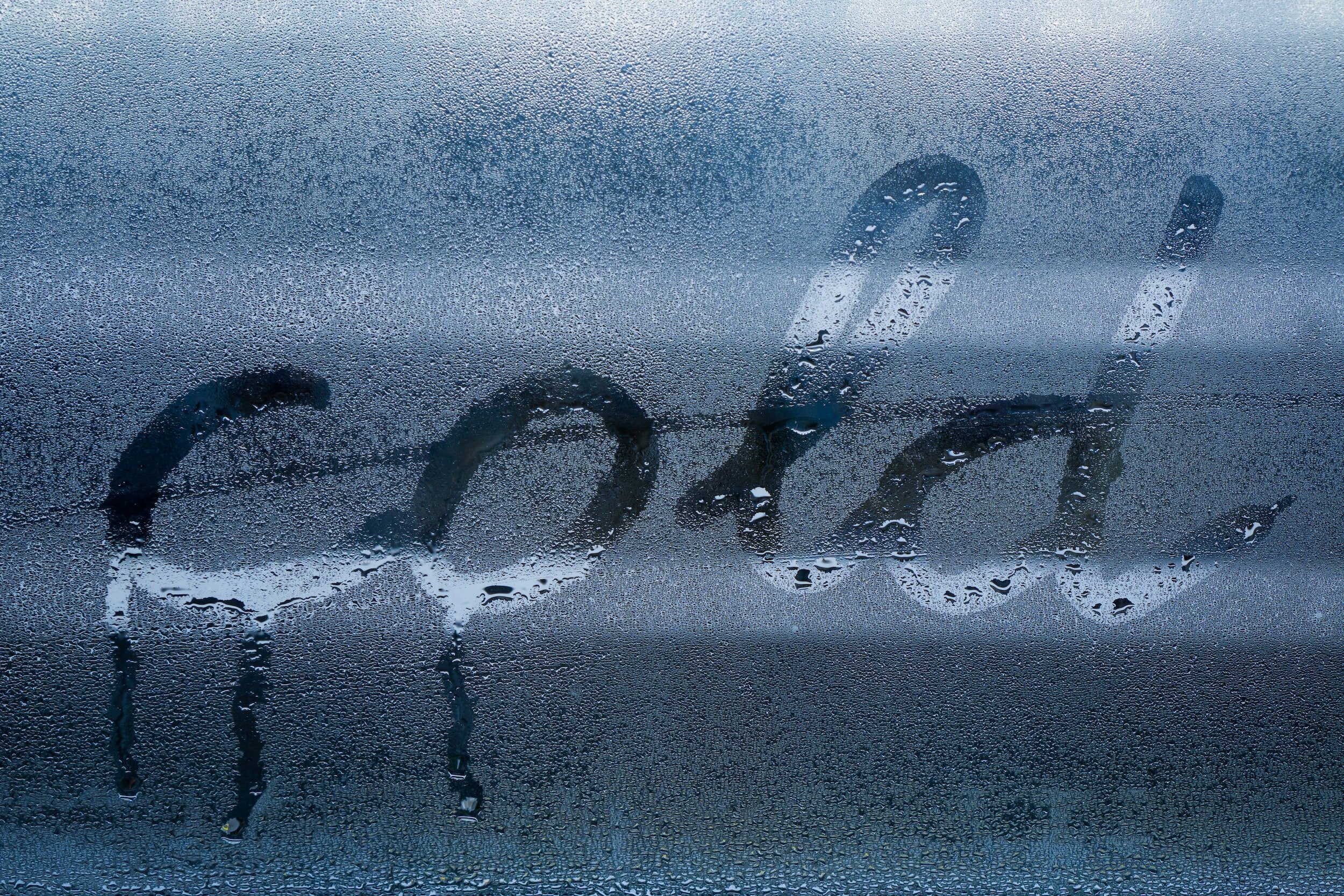
A fictional piece that slid into place after the phrase ‘steam on the windowpane’ lodged itself on a post-it. It’s the reader who ascribes meaning, the author just starts the ball rolling.
It’s winter on the top deck
With the morning commuters
Yawning, respiring
Exhaling, coughing - and I,
Creating finger-art,
In our collective breaths
Draw a line on the window
And escape to an outside world
Of rushing trees and cityscape
On my way to fit snugly
With another,
A living jigsaw piece of
Flesh and vibrant clothes,
Smiles and sadness
To meander through the
Mystery of knowing someone
You can never fully know
To exchange words
To exchange a kiss
A hug
A steamy cup of coffee
After, a walk
Through a park brightly lit
In a January sky
Brilliant in its clean-air blues
Passing others and their dogs
Exporting tufts of breath
Nostrils and mouths at work
The rhythm
Of footfalls and arm-swings
Taking me to a graveside

It’s there that I discover
How to hold my tongue
And let my grandfather speak,
His advice still seeping up
From under, from inside
His interred frame.
A man with strong eyebrows
And a piercing gaze
With love simmering
In every harsh syllable
Of his few words:
‘Whatever you do, son, put some
Steam on the windowpane’
I sigh and wish he could see
His message left trickling down
On the number forty-two.
Advice from a hard life
Of personal victories kept
Far from public gaze
His pride, tucked away
In the soil that fed us
During the impoverished
Years, that bought
My school shoes
And hid his tears.
We Shall Rise
About to leave for the beach…
Escaping to the beach
Sandals and tee-shirt discarded
Looking down at the
Rhythm of the waves
Toes tipping over the jetty
My arms leap up and,
Free from the planet, I rise…
…and fall

Columns of sunlight pour
Through the water illuminating
Seaweeds waving with joy
Fish dart about
Iridescent in shoals, but
No sooner do I relax,
Calm and at home,
Than I rise
Wounded healers, fashioned
Somehow to sink like stones
To suffer shipwreck and sorrow
Our outer garments,
Facades and masks removed
O! Take us under Lord
Let us see life and light
As we fall
Until at home
Above and below
In season and out of season
Abounding or abased
Until we know You, truly,
In reverses and walking
Drenched and anointed,
Then we shall rise
And on that day
When the Sun falls, when
Dress rehearsals are complete
When we journey beyond
Our horizons, what we know,
And all is laid aside,
We shall rise
To face the One, whose
Garments were taken and torn,
Distracting the soldiers
His toes tipping over the brink
And arms stretched out wide
Proving for all eternity
That falling
Is only a prelude:
We shall rise.
Lost & Found
Stereotyping isn’t particularly clever but I hope you don’t balk at its use here and can enjoy the point of the poem…even if you are a Lost & Found Officer and feel aggrieved at my description!
A long heavily stained
Desk, teak maybe
Stretched across the dingy
Office a flight of stairs
Under the concourse
Where life is faster

The man, an identikit
For all L&F officers?
Overweight, pallid
And unimpressed
A trained smile,
No deus ex machina,
No joy, and I wonder if
Anyone is waiting for him
Or whether we all
Look lost and this Earth
Is where we are deposited
Until Someone comes
For us
Growing Towards the Light
Growing Towards the Light was inspired by the mundane act of turning a geranium around so a different side could get the light
Are you?
Is what he said
Straight in, session one
After small talk about the
Geranium on his bookshelf

And me prevaricating
Talking about auxins,
Anything
Except why I was there.
I thought session one
Would be…
Less poetic, less allegorical
You know
Less tangential
But he was straight in,
On my turf
Trespassing on purpose
Irritating the metaphorical
Edges of me, to flip me,
To see what’s underneath
Like the limpet
I was am will be…
Trouble is with these
Professionals
They charge enough
So silence is expensive.
I turned around
And said ‘Yes, I am.
That’s why I’m here’
His name, engraved by the way
On a brass plate, Sr. Garcia,
From Buenos Aries,
‘Call me Jesús’ he said,
His warm smile told me
Where to sit
I nearly knelt
Paris ’24 – 4th June 2023
Paris ‘24…it’s back on
It’s been a while and, no I haven’t been training at altitude, or investigating the legality of oxygenated blood transfusions prior to racing, or pulling enormous tractor tyres, or cricket-square rollers across the Downs, or anything remotely eye-catching.

I’ve just had an MRI scan on a dodgy nerve in my left foot, visits to two physiotherapists (shoulders and back), and an increasing range of hilarious exercises from the physios and an osteopath to keep me super-supple.
That’s the state of play of this 60+-year-old even attempting to return to running, let alone meet the qualifying time for the 10K ready for Paris ’24.
But I’m on the way back – hence the return to the blog.
3 x 5K runs and I’ve lopped 5 minutes off my first time just over a week ago. At this trajectory, I will break the land speed record for a Walrus in a few weeks and be outpacing old Labradors before you can say ‘Allez France!’

The next step is to run 5 miles, not 5K, then 10K…by the end of June.
Expect a follow-up report in detail.
Two Toothbrushes
Staying with friends…things to notice in the bathroom
That soft early morning light
Seems to catch things unseen
Cobwebs in a sway
Translucent green leaves
Shedding a fitting peace

That time of day
Requiring no speech
Facial muscles
Yet to recall
Quite what to do
An automatic pilot
Shuffles you forward
To a mirror, to a basin
To a shower as yesterday
Is washed away
And there they sit
Like living counterparts
Facing each other:
Two toothbrushes
Quite different
Yet revealing more than
Speech can convey. Bristles
Worn down on one side
This one, encased in unrinsed
Paste, contentedly untidy

The other, almost shining
Upright, ready for life and love
Disaster, and heartache,
Not quite comprehending
Her neighbour
A guest I am, immersed
In a forty-year marriage
For three mornings.
Unbeknown to them
I guess,
Who owns each brush
Standing as they do
Opposite, yet facing each other
In the morning light
Shedding a fitting peace.
It’s 9pm, Bristol
9pm, back garden, under trees overhanging from the wood, whisky and cigar and stillness
A cigar tip glows red in the dusk
As a puff of smoke exhales
Into the trees -
Whisky in hand he watches
As the rough and aromatic
Scents disperse.

Above, the trees seem to
Breathe the wind, in, out
And send creatures to
Fill the cooling air:
First a lone wood pigeon
Maybe the last of its kind
It’s plaintive echoes
Receiving no reply
A solitary Robin, out late,
Like the next thought,
Unexpectedly lands
Closer than a brother
The biters arrive:
Invisible flesh nibblers
Then silent, swift, skilful
Insect-hungry bats swarm
The Battle of Britain
Renewed in the sky above.
The cigar stub
Damp and dulled
Calls time.
Inner contentment
Seeps in like the
Rasping warmth

Of the golden measure.
Fingers exploring familiar
Ridges of the cut-glass
Unconscious of the
Gift just given:
May the peace of the Lord
Be always with you.
Bluebells on the Beach
Beach Poem iii
In the wood behind my house, April means bluebells. They arrive, seemingly, overnight. Somehow an image emerged of bluebells on the fringes of a pebble beach. One thing led to another.

In a blue-violet trumpet, and,
From aeons past,
In each pebble
Is the thought that thought of you
Is the light that gave you light
Is the temporary
And the unchangeable
You
In the one;
Colour and light,
Swaying in the breeze, there
For one deceptive purpose:
Seduction.
Your honey sap
The future trap.
In the other, granite grey,
Hard yet smooth
In your palm
A missile in the hand
Of God
Picked up and launched
Through my defences
The bluebell on the beach
Swept there by tides and
The four winds
Nestled against each other
Trampled by strangers
The congruent parts
Of a woman
Of a man
English Literature and Cold Turkey…Report One.
Cold Turkey…the downside of trying to be wise…the story of revising for an A-Level English Literature exam without tea or coffee…and why
My normal routine: get up, kettle on, R4 on, either a tea-bag or looseleaf tea in small pot and, cereal, R4 off, wander into lounge and Ahhhh! That first sip of a cuppa to remove the night and start the day.

About 11 am, coffee beans ground to dust, cafetiere in operation, and…Relax…with coffee and maybe a slab of Cadbury’s plain. Perfect.
A normal day consisted of one coffee and maybe 5 cups of tea.
Until Saturday.
The centre-of-gravity of this story is my attempt to pass A-Level English Literature. In a few weeks’ time I shall be sat amongst impossibly talented 18-year-olds trying to control my thoughts, telling my pen-writing muscles not to cease up, and (for a 65-year-old, the greatest fear) not having to ask to be excused more than twice in the 3 hours of exam hall torture.
So…preparations – apart from intense revision – include:
1. Fasting the day before the exam (let the reader surmise the reason why)
2. A break from tea and coffee…i.e. caffeine, tannin, and all other diuretics
Sensible?
So, I Googled the likely side effects, the ‘cold-turkey’ side-effects of giving up tea and coffee:
The invisible addiction: is it time to give up caffeine? | Coffee | The Guardian
The scientists have spelled out, and I had duly noted, the predictable symptoms of caffeine withdrawal: headache, fatigue, lethargy, difficulty concentrating, decreased motivation, irritability, intense distress, loss of confidence and dysphoria. But beneath that deceptively mild rubric of “difficulty concentrating” hides nothing short of an existential threat to the work of the writer [Edit and exam reviser]. How can you possibly expect to write anything when you can’t concentrate?
Three days in and I can report, darn it, ALL of the above symptoms. I don’t know what dysphoria is but I’m not sure I care…the incessant headache, leg aches, lethargic waves that roll over one, and stranger periods of distress…darn it, it’s all true!
Three days in and I can report, darn it, ALL of the above symptoms
But I’m told this will ease after nine days…so…a week to go of hoping the benefits will outweigh the longing for that first taste of something better in the morning than the dried inside of one’s mouth and sour lips after a night’s sleep, snoring - and sneezing in the hay-fever season.
Meanwhile, it’s back to Othello, Jane Eyre, Post 1900 Poetry, Spies, Skirrid Hill, and Streetcar Named Desire and wading through critics of Patriarchal societies, literature as a Marxist class struggle, and attempting to view the above books through modern, post-modern, and meta-modern lenses.
The moral of this tale? Not enough energy to enter a debate about morals…until it’s over. The abstinence, that is.
Expect Report Two…when I feel human
Rabboni
A one-off…not deliberately an Easter-oriented poem but it is
Why come so vulnerable
Covered in straw?
You make everyone suffer
Your arrival took its toll
On Joseph, on Mary, and children
Extinguished by a king
Why a mere carpenter’s son
Out of the way, up North
In Nazareth?
Why wait so long
An inert Messiah, watching
The blind lead the blind?
Jesus, why shun the limelight?
Why refuse the crown?
Those willing to honour the
King of glory?
Why relinquish riches, not knowing
Where to lay your head?
After all said and done
Why set your face to Jerusalem?
You stilled the storm, my storm,
Yet offered your wrists to nails
Your head to thorns
Your cheeks to spittle
And, risen, in dawn dark
Avoiding adulation
You dressed as a gardener
Trowel in hand,
Earth under your fingernails
And spoke my name
The beach…2 “Paddle Faster”
The second poem in a short series on The Beach…in part, autobiographical and in part inspired by ‘Paddle faster’ - a line from a film I watched recently
Closing my eyes I lift the paddle high
Above my head
A push sends me scuttling
Down the steep pebble incline
The sound like a waterfall
Hard round pebbles scraping the keel
Five seconds of acceleration and…
Into the wash
Into the lapping waves
Orange nose cutting through the surf
I paddle faster

Eyes open, blinking away the salt and Sun
Looking back at the hundred or so
Souls, large, small,
Young, old
Spiritual and secular
Clothed and almost unclothed
The distinct sound of a summer’s day
The beach, a playground for all…
Moments pass…then, turning
Away from the shore
I paddle faster
My fibre-glass capsule,
Skeg rope pulled tight
Water falling along the paddle
The only sound now, thumps
Of sides on wave, wave on sides
An exchange just beyond me
Not known
Until you permit yourself to be
Baptized in the ocean.
Paddling faster, deep and strong
Out here, away from voices,
One hears a Voice
Calling you onward, not back
Calling you home perhaps
‘Slip between the harbour arms’
The urgent voice, strong now,
‘Paddle faster!’
Has time come to lift my paddle
High above my head
To the light?

No. Not yet. It’s not time.
I’m headed East
With the tide and current
The wind making the sea alive
A fearsome fight
Five miles or so
Until, surfing, I ram into
Shingle, sand, and slopes
My interim home
Of a friend calling to me
‘Paddle faster!’
The Beach…i
First in a set of poems about the beach…summer in view…but a beach is a good place to be in all seasons
Turquoise and white the waves roll in
crashing at shallow angles
along the shoreline.
Wandering among the shingle,
the seaweeds and beached wood,
a man, absent-mindedly,
smooth pebble in hand, is at home.
Quiet, lost in thought,
surrounded by the wet roar

Raiders of the Lost Ark…and the Three-in-One
Raiders of the Lost Ark - what can we learn?
The names we associate with the film, Raiders of the Lost Ark, are Harrison Ford, playing the archaeologist Indiana Jones, and Steven Spielberg the director, but it was Lawrence Kasdan who wrote Raiders (and co-wrote the Star Wars films The Empire Strikes Back, Return of the Jedi, The Force Awakens and others).
Spielberg and Kasdan, it may not be surprising to know, are Jewish.
Grappling as they did with the deeply Jewish angst over the lost Ark of the Covenant, Spielberg and Kasdan introduced to the world the biblical account that the ark of the covenant contained a power greater than any earthly power. One that, in the film, our hero, Indiana Jones, managed to prevent the Nazis from acquiring.

The Ark, in fact, was a fairly small acacia wooden box laid in the Holy of Holies in the Temple overlaid with gold, containing the stone tablets engraved with the Ten Commandments, a pot of manna, and Aaron’s rod that budded. It was lost when the First Temple was destroyed in 586 BC…although Ethiopian Orthodox Christians claim the Ark is located in the Church of St Mary of Zion, in Askum, several hundred miles north of Addis Abiba.
The action is in the Holy of Holies…the Spirit of God witnessing with our spirit that we are children of God.
From the perspective of the New Covenant, the physical temple, important though it had been, was merely an earthly copy of the heavenly original. Each part of the temple, therefore, has a present-day eternal counterpart including the three courts: the outer court, the Holy Place, and the Holy of Holies, and, specifically, the ark and its contents held within the Holy of Holies, in the presence of the glory of God.
If the acacia box represents the new spirit God has put in those whose faith is in Christ, the contents of the ark represent God Himself dwelling in each believer. In the New Covenant, the physical temple in Jerusalem has been replaced by believers: ‘temples of the Holy Spirit’ 1 Cor 6v19.
If you had looked inside the box at the three objects, physically distinct and seemingly unrelated from each other, would have stared back, inert and unremarkable, however, the three objects represent three facets of God, a three-in-one reality.
1. The tablets of the commandments – but in the New Covenant the engraves the law on our hearts (Jer 31 v31f). Paul wrote about the ‘law of the Spirit of life’. This is what is set loose in us, nothing short of God’s own life. And He doesn’t need an external written law (the tablets of stone) to know how to act!
2. The pot of manna – representing the miraculous ‘daily bread’ or ‘bread of heaven’ given to the Jews as they made their way to the Promised Land from Egypt. Rather than praying for God’s word to come to us from outside, externally, God has Himself in our spirits and His word(s) shape our lives. It isn’t that we need His word for ‘our lives’; it is more that His word is our life. Jesus said ‘the words I speak to you are spirit and life’
3. Aaron’s rod that budded – if the rod represents us in our humanity, like the acacia box made from dead wood, the miraculous life that comes from it is His life. True Christianity, true spirituality, starts when His life appears in us.
Attempting to live the Christian life – either as a believer or, maybe as a non-believer who admires the teachings or person of Christ – through your physical abilities (the outer court) or your soulish strengths (intellect, emotional passion, or sheer will-power), is missing the point.
The action is in the Holy of Holies…the Spirit of God witnessing with our spirit that we are children of God.