Book Review: There Are Rivers in the Sky, Elif Shafak, Penguin
‘Towards evening, they carry the sick boy out on the street….horribly dehydrated, his face shrivels into a gruesome mask – eyes shrunken, teeth protruding, cheeks hollowed, and his skin a scary shade of blue, the colour of a bruise. Cholera – the blue terror.’
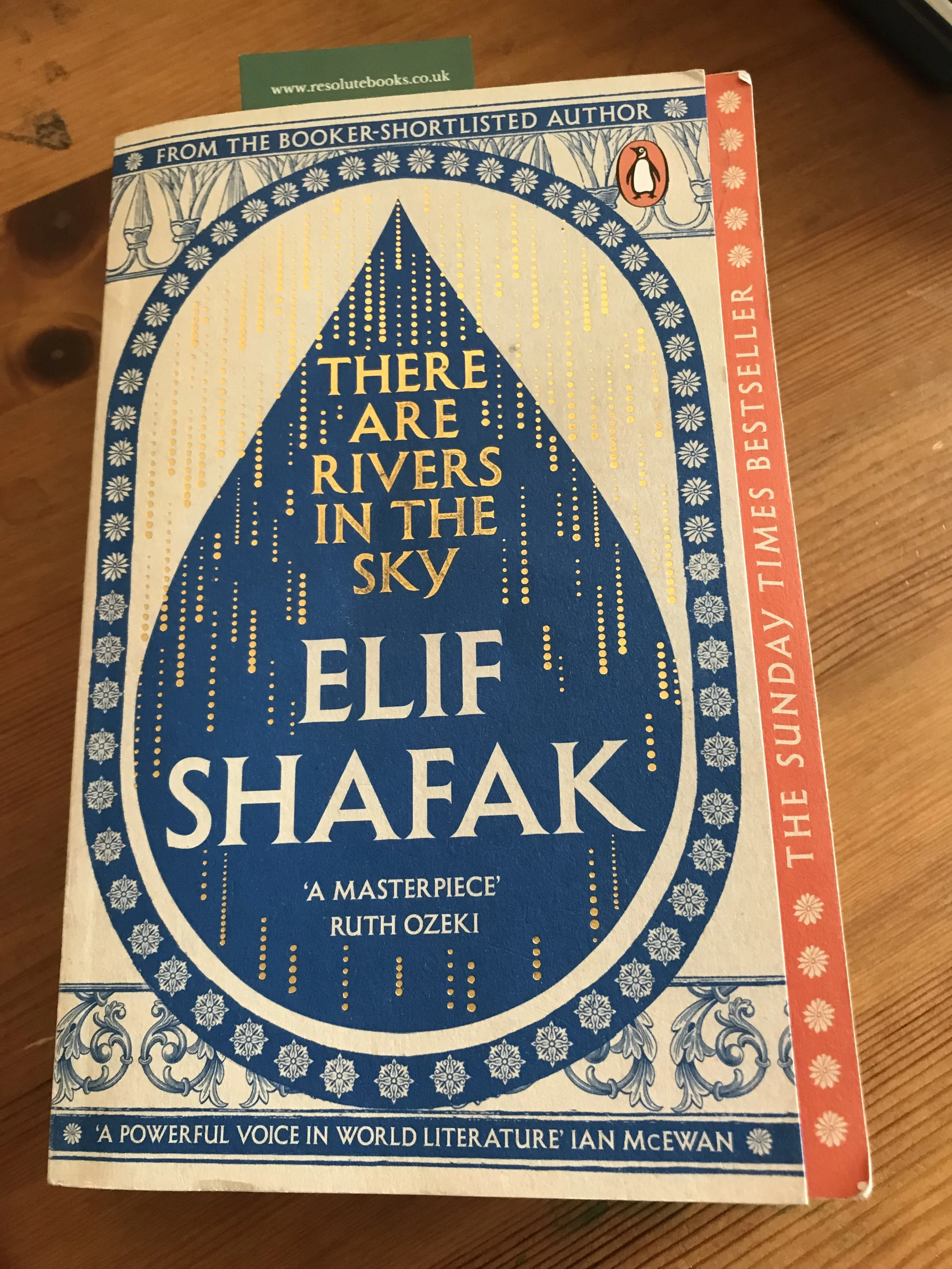
This is a remarkable book building bridges via a single drop of water from the 6th Century BC in Babylon, to Victorian London, and on up to the present day, tracing the tragic persecution of the Yazidis in the Turkish valleys near the River Tigris in 2014, ending in London, in 2018.
In reviewing this book, I am disappointed to find that I only curled two pages for future reference and quotes. The fact is that I found the book so engrossing, hoping from one century to another, that I clean forgot to do my usual page bending, notes in the margin kindathing.
Elif Shafak has produced in There Are Rivers in the Sky, a tapestry that outmanoeuvres time, by stitching together three common themes: the colour blue, water, and a poem inscribed on tablets during the reign of Ashurbanipal in Ninevah, 640s BC. He has built up an impressive library, but his most treasured possession is a poem inscribed on a single tablet.
‘The king opens the box, which contains a single tablet…brightly coloured – the blue of restless rivers.’
The fate of this tablet, recording a poem from the Epic of Gilgamesh, itself a flood story, maintains the link between the colour blue, water, and the poem.
No sooner than you are immersed in the history of the poem and Ninevah, that Shafak yanks you free and lands you on the banks of the River Thames and introduces her readers to ‘King Arthur of the Sewer and the Slums’, born in Victorian London, and the link between ancient history and the present day.
Such an engaging character, a man born with a prodigious memory, we follow him literally from his birth to his death; he ‘breathes his last on the shores of the River Tigris.’ If you like romance and tragedy, you won’t be disappointed.
Then there’s the conversion of two characters, Yazidi Narin, whom we meet in 2014 by the River Tigris, and Zahleekah, in London in 2018. She is carrying a cardboard box with a few possessions en route to her new accommodation, in a houseboat, ‘anchored along the historic Cheyne Pier’. Very close to where King Arthur of the Sewer and the Slums was born.
She’s just broken up with her boyfriend and finds new friendship with a neighbour, Nen, a tattooist, whose name refers to the primordial waters of creation, and represents a tantalising sense of new beginnings for Zahleekah, and Narin.
This is a masterpiece.
One to add to your TBR pile!