‘As my own mental health began to suffer…I started to write about my downward spiral…daring to speak up about my struggles, despite my…fears about how others would view me’
I read this book by mistake.
I was sure I was about to read a book written by Patrick Dixon, the well-known futurist and Christian commentator! It took me a while to realise that this Patrick, Patrick Regan OBE, was also a Christian commentator…and well known…but for quite different reasons.
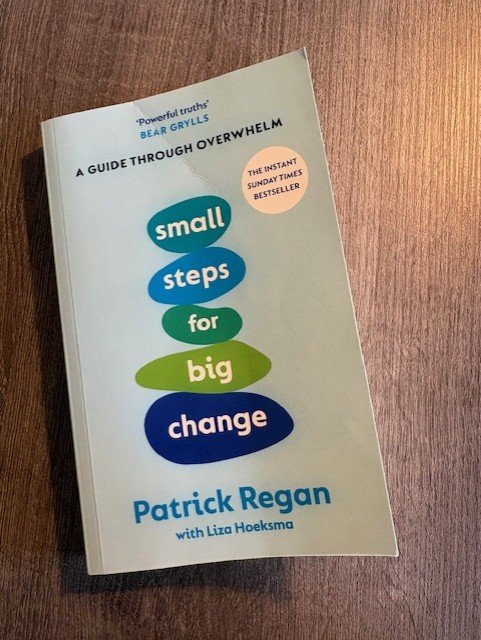
I knew Patrick Regan as the founder of XLP, a crime prevention charity that worked with young people in London, and Kintsugi Hope, a network of meetings that promotes hope and healing for those struggling with brokenness.
Once I had readjusted my perception of who wrote the book (!), I was surprised to find that Patrick had faced mental health issues himself, and Small Steps, therefore, had its origins in lessons learnt through his own suffering and recovery.
The three sections: (I) Start Small, (II) Create Space, and (III) Think Differently give a clear, easy-to-follow, and helpful outline – you will not get lost in technical language or need a degree to understand psychological theory. And yet it’s thorough and well thought through.
Throughout Small Steps, Patrick interrupts the flow of writing with bullet-point summaries or new thoughts. This is very helpful as it pins down the anecdotes, quotes from the famous, and arguments making up the bulk of the book. Here’s an example:
• Each evening, write down three things you’re grateful for
• Spend 10 minutes writing in a journal about a situation that has been bothering you…
Speaking of quotes that Regan uses, I liked this one from Adam Grant:
‘Great thinkers don’t harbour doubts because they are imposters. They maintain doubts because they know they are partially blind, and they’re committed to improving their sight’
Brené Brown also gets quite a bit of airtime. In a chapter, Space for Connection, Patrick opens with ‘I struggled to fit in at school’ and he quotes her: ‘True belonging is the spiritual practice of… belonging to yourself so deeply that you can share your…self with the world’
Regan approaches mental health from the perspective of his Christian faith; he includes wisdom wherever he has found it. He is open about his own struggles, but in Small Steps he emphasises hope and recovery…you are not left languishing in sympathy or marooned in empathy without direction. The title gives the framework of his recipe: Small Steps for Big Change; a good title.
On a personal note, I’m not a great fan of self-help if it becomes another reason to be self-obsessed and feed into the culture of the self, which seems to be at the root of so much mental health…BUT…I did indulge in the exercise Patrick recommends near the end of the book, Identifying Your Values.
Even the heading made me cringe. Talk of values, philosophy, vision statements, and the like usually makes me want to scream and run for the hills, eat celery, or take a cold shower. But…to my great surprise, this was enormously clarifying. Maybe you’ll find the same.
A final quote from Desmond Tutu followed by Regan’s motivation for writing Small Steps:
‘ “There comes a point where we need to stop pulling people out of the river. We need to go upstream and find out why they are falling in.” My hope with Small Steps…is that it offers you the chance to take a step back, get upstream and see what’s going on there.’
I, for one, believe Patrick Regan has succeeded in this task.